June 2026
How to authenticate a vintage trench coat: labels and era tells
Authenticate vintage trench coat pieces with confidence: read labels, decode hardware, date the silhouette, and spot online reproductions decade by decade.
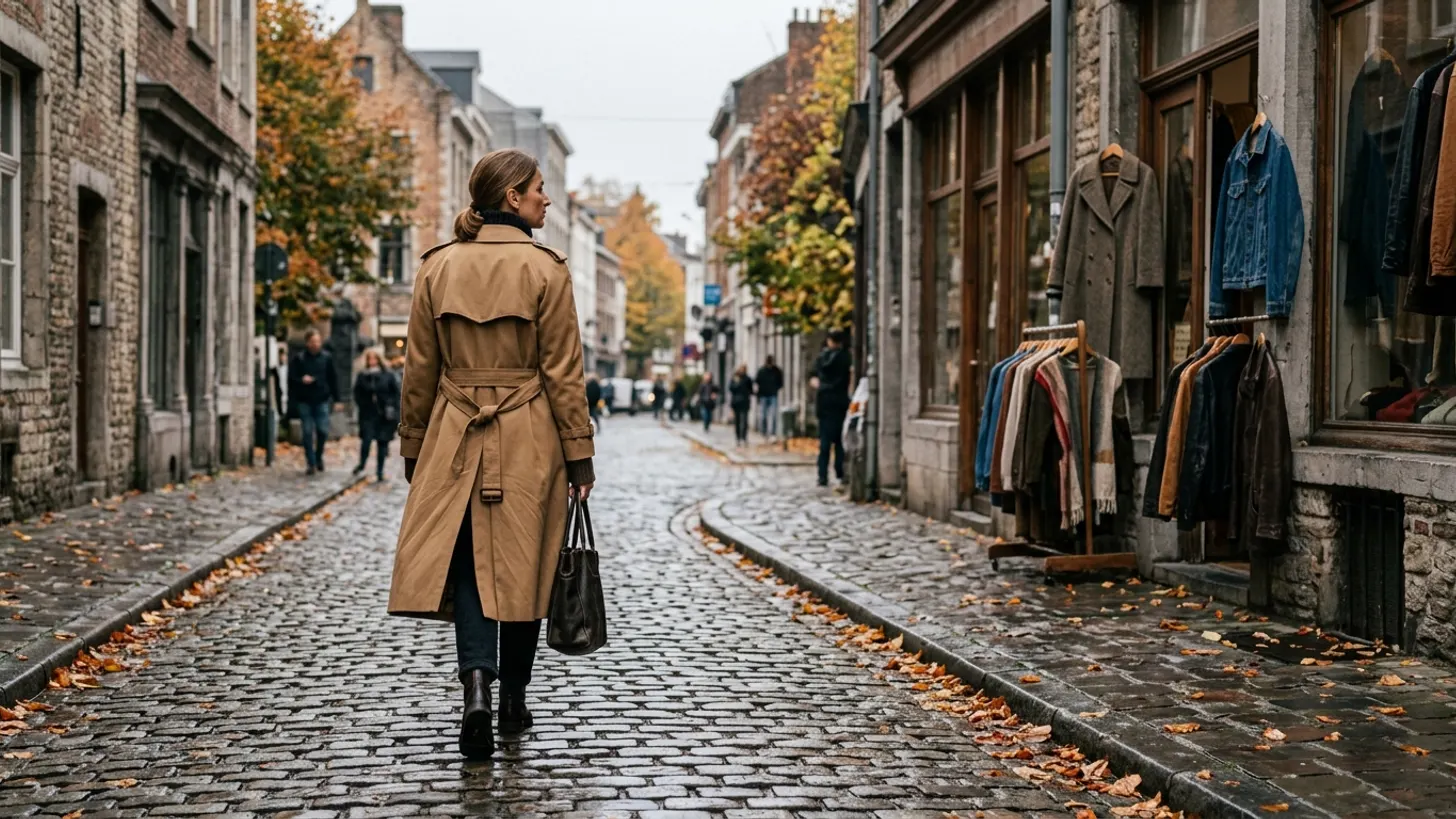
In 2019, Erin came within one bid of paying AUD 640 for a coat listed as a 1958 Burberry at an online auction preview. The label was convincing: woven rayon, serif font, Made in England stitched flat across the seam allowance rather than tacked at corners. The gabardine weight registered correctly in her hands. What stopped her was the storm-flap snap. A small magnet pulled to the dome in under a second, confirming brass-plated steel rather than solid brass, a material change that did not reach trench coat production until the mid-1970s.
That snap test came from Frances Whitmore, who spent sixteen years authenticating outerwear consignments at the Mossgreen auction house in Melbourne before its closure in 2018. Frances called the magnet the cheapest authentication tool in the trade and the one sellers most often forgot to anticipate. To authenticate vintage trench coat pieces at that level of precision, no single signal holds on its own. Construction, hardware, label, and silhouette have to agree.
What separates a genuinely vintage trench coat from a modern reproduction
Three things separate a 1950s or 1960s trench from a 2024 reproduction: the gabardine weave, the hardware weight, and the slow finishing work hidden inside the seams. Reproductions simplify the storm flap, swap brass for plated zinc, and bartack the belt loops by machine in seconds.
Thomas Burberry patented his tightly woven gabardine in 1879, and the brand's Equestrian Knight trademark was registered in 1909. Those two dates anchor every pre-war Burberry authentication. Aquascutum traces back to 1851 and ran on a rubberised wool that competed with Burberry's gabardine through WW1. By the 1940s, both houses had settled into a recognisable construction vocabulary: tightly woven cotton gabardine, brass D-ring belt hardware, raglan sleeves, and a right-side chest storm flap on military-spec pieces.
Reproductions sold today copy the silhouette but compromise on weight. A genuine 1960s Burberry weighs around 1.8 to 2.2 kg in size 40R. A modern reproduction in similar dimensions often comes in at 1.1 to 1.3 kg, because the gabardine has been thinned for cost and drape. If you receive a coat that feels light in the hand and the fabric flexes too easily, suspect the era before you check the label. The Australian consumer review body Choice has documented the growth of artificially aged garments in the resale supply chain, where modern fabric is distressed to look period-correct. Before you authenticate vintage trench coat pieces sight unseen, study the seller's weight, weave, and hardware photographs in that order.
How to authenticate vintage trench coat labels by maker and decade
You authenticate vintage trench coat labels by reading the woven thread, the font geometry, and the country-of-origin stamp together as a system. Each decade left signatures: 1940s labels used woven rayon and serif fonts, 1950s American-made pieces show RN numbers, and 1970s coats add care-symbol legends and synthetic-content disclosures.
The US Federal Trade Commission Registered Identification Number system has been in use since 1952. Each RN is a unique number assigned to a single business, and any RN remains searchable through the FTC public database forever. If a coat carries RN 13670, that number resolves to London Fog Industries; a different RN resolves to a different manufacturer entirely. Mandatory care-labelling guidance shows how labelling conventions evolved in parallel jurisdictions and helps collectors decode similar tags.
Burberry's labels moved from "Made in England" hand-stitching to the post-1999 "Burberry of London" phrasing. Aquascutum used a different lining-tag placement: chest-side until 1968, hip-side after. The thread color of the label dates the piece: pre-1970 labels often used a slightly off-white rayon thread that has yellowed; 1980s replacements were stitched in true white polyester. When you authenticate vintage trench coat labels, photograph both the front and the reverse of every tag, since the reverse often carries fabric content stamps in fading ink that confirm the decade.
Hardware details that authenticate vintage trench coat construction
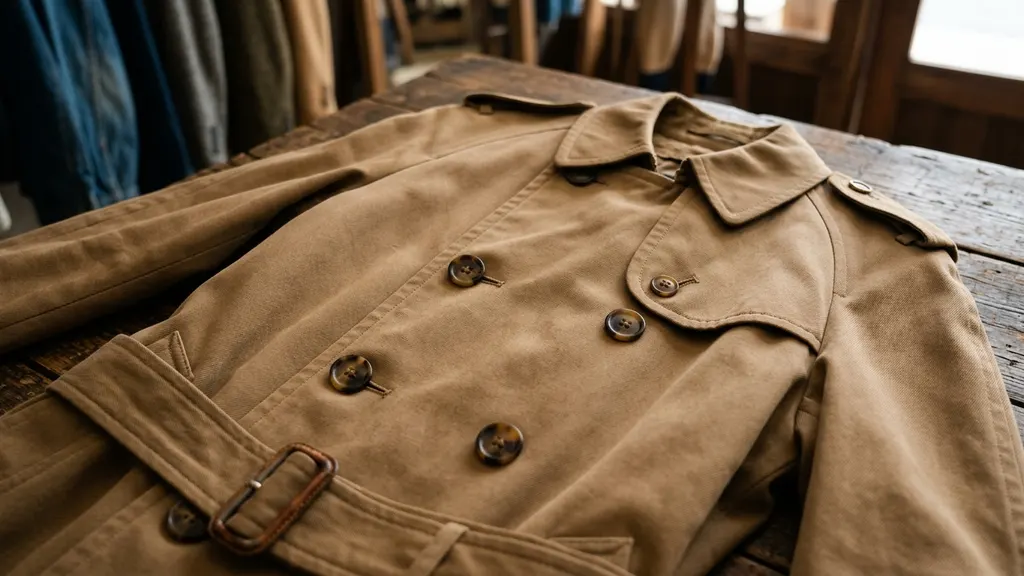
Hardware does most of the dating work once you authenticate vintage trench coat seams. D-rings, buckle tongues, button shanks, and snap closures shifted shape across decades. A pre-1960 D-ring is forged brass with a visible weld line; a 1980s reproduction shows a clean cast finish with no weld.
Mid-century military and civilian trenches followed a near-identical specification: a 10-button double-breasted front, D-ring belt hardware on the belt itself, a right-side chest storm flap (the so-called gun flap), throat latch with a single button, and shoulder epaulets with hand-tacked corner stitching. Australian Standards records on textile and apparel construction give a useful comparison framework for how factory specifications were written and policed at the time.
| Feature | 1940s | 1950s | 1960s | 1970s |
|---|---|---|---|---|
| D-ring type | Forged brass, weld line visible on inner curve | Forged brass, weld line visible | Forged brass, weld line visible | Forged brass, weld quality declining from late decade |
| Button shank | Horn-and-brass, forged wire loop | Horn-and-brass, forged wire loop | Forged wire loop to 1965, then transitional | Moulded plastic shank, visible seam line |
| Belt buckle width | 4 cm, single prong | 4.5 cm by late decade, single prong | 4.5 cm, single prong | 5 cm, second prong slot added mid-decade |
| Snap material | Solid brass | Solid brass | Solid brass | Brass-plated steel from post-1975, magnet-detectable |
Button shanks are a small but reliable signature. Pre-1965 horn-and-brass buttons have a single shank wire forged into a loop; mass-produced 1980s buttons used a moulded plastic shank with a visible seam line. Belt buckles widened by decade: 4 cm in the 1940s, 4.5 cm by the late 1950s, 5 cm and a second prong slot by the mid-1970s. Snaps on storm flaps moved from solid brass (pre-1970) to a brass-plated steel core (post-1975) that you can detect with a small magnet. If a seller refuses to photograph the inside of the belt buckle or the back of the storm-flap snap, treat that refusal as data. For long-term care guidance on hardware patina, see our vintage care guide.
We cover the details separately in How to date a vintage fur coat: era, label, and construction clues.
Dating a coat by belt, lining pattern, and silhouette
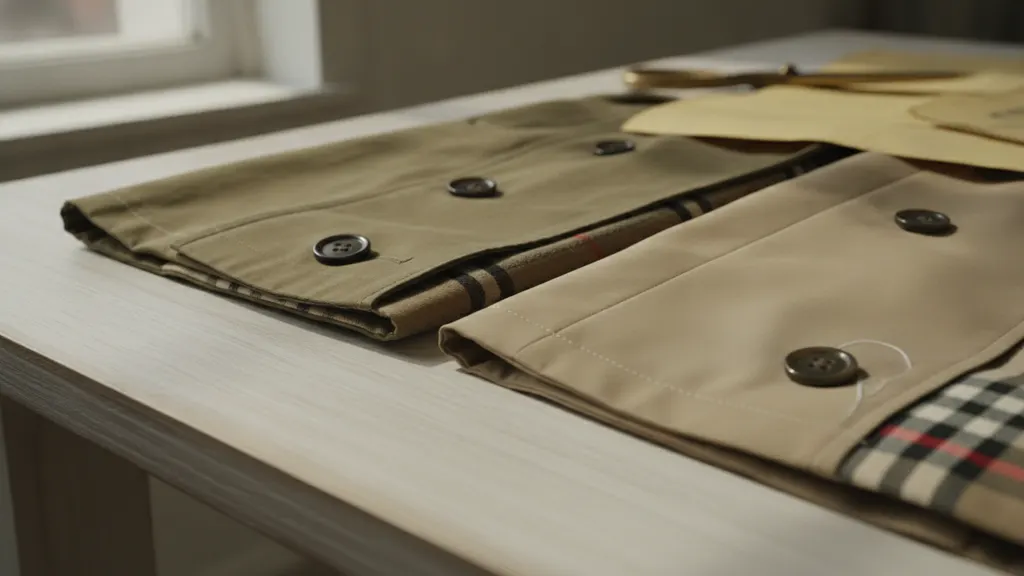
Belts and linings cluster the period-correct details. A 1940s belt buckle has a single brass prong and a 4 cm width; 1970s buckles widened to 5 cm and added a second prong slot. Linings followed fashion: 1950s pieces used solid rayon, 1960s introduced check patterns, 1970s added paisleys and small geometric prints.
Silhouettes shifted alongside the lining work. The 1940s shoulder was set-in and lightly padded; raglan sleeves took over in the early 1950s for civilian pieces. By the 1960s, the back yoke grew a half-inch wider to accommodate the heavier inner-lining wool that British and American houses used through the early 1970s. The Penny Lane silhouette that defined late-1960s and early-1970s rock-era pieces shortened the body length to mid-thigh and added a contrasting shearling collar. For collar leather identification work, our vintage leather notes walk through tanning marks and dye signatures by decade.
Linings tell a similar decade story. Burberry's nova check, first registered as a lining pattern in 1924, remained internal-only until the late 1960s. If a coat carries an exposed nova-check cuff or under-collar from before 1967, treat the dating claim as suspicious. Government circular-economy guidance on textile lifecycle research gives useful context for the era you are evaluating. A practical field rule: silhouette first, then belt and buckle, then lining, then label. If three of four agree on a decade, you have a credible date. When you authenticate vintage trench coat dating using the silhouette-first rule, you avoid mistakes that come from over-trusting a single label photo.
Red flags when you authenticate vintage trench coat online
You authenticate vintage trench coat listings online by cross-checking the seller's photos against decade-correct details. Red flags: a label photo that crops out the country-of-origin tag, hardware that looks too clean for its claimed era, polyester thread visible in repair work, and silhouettes that mix a 1970s yoke with a 1950s belt.
The largest online red flag is missing label photography. Reputable sellers photograph the front label, the reverse label, the fabric content stamp, the size tag, the cleaning code tag, and the inside of the belt buckle. If any of those six photos are missing, request them before bidding. Sustainability Victoria's textile sourcing guidance reinforces why provenance documentation matters when buying secondhand.
The second flag is hardware that does not match the claimed decade. A 1953-claimed coat with brass-plated steel snap closures fails the basic period test, since brass-plated steel did not arrive in trench coat production until the late 1970s. The third is silhouette inconsistency. A photo set that shows a Penny Lane mid-thigh body with a 1940s set-in shoulder is a coat that has been altered, recombined, or mislabeled. Provenance disclosure should be honest. "Sourced from estate in Asheville, garment care label removed, original belt present" is more trustworthy than vague claims of "guaranteed 1962". Sol Siren describes every piece in the shop this way as a matter of standard practice. Read how Erin sources and evaluates each garment for context on the studio process. If you authenticate vintage trench coat listings with these checks running in parallel, both fraud and accidental misdating become easier to spot.
Frequently asked questions
How do I authenticate vintage trench coat pieces from Burberry versus reproductions?
Real Burberry trenches from the 1940s through 1980s show a tightly woven cotton gabardine with measurable weight (around 1.8 to 2.2 kg in a size 40R), brass D-rings with a forged weld line on the inner curve, and a woven Made in England label stitched flat across the seam allowance rather than tacked at corners. Reproductions skip the weight, swap brass for plated zinc, and tack the label at four corners. Cross-reference any RN number against the FTC public database, since reproductions often clone older RNs incorrectly or omit them entirely. Product safety frameworks show how labelling is regulated in similar markets. When you authenticate vintage trench coat purchases online, run all four checks together.
What does the FTC RN number on a vintage trench coat label mean?
The Registered Identification Number is a unique identifier issued by the US Federal Trade Commission and required on most textile and wool garments produced for the US market since 1952. Every RN resolves to a specific business through the public FTC database. When you read a vintage label and see RN 13670, that number tells you the manufacturer, which in this case is London Fog Industries. If a coat claims a 1940s date but shows an RN, the label was added or replaced after 1952. RN evidence is among the precise authentication tools available to collectors. The Choice consumer reviews explain how labelling protections work for buyers in adjacent jurisdictions.
Can I machine wash a vintage gabardine trench coat?
No. Cotton gabardine from the 1940s through 1970s was treated with proprietary water-repellent finishes that machine wash will strip permanently. Vintage trenches should be cleaned by a specialist dry cleaner experienced with period gabardine, with spot-cleaning between full cleans handled at home using a damp cloth and gentle soap. Hardware corrosion is the second risk: brass D-rings and buckle tongues can develop verdigris in damp wash cycles. CSIRO fibre research outlines how natural fibre finishes degrade under mechanical agitation. Store the coat on a wide wooden hanger in a cool dark space and re-treat the gabardine every five to seven years.
How much should I pay for a genuine 1970s vintage trench coat?
Auction and resale prices for a credibly authenticated 1970s Burberry or Aquascutum trench in good condition range from USD 350 to USD 900, depending on lining condition, hardware completeness, and provenance. Coats with documented estate sourcing, original belt, and intact storm flap snaps trade at the upper end. Mid-tier American makers like London Fog from the same era price between USD 150 and USD 350 for similar condition. Avoid sellers who claim a 1970s date but price the coat at modern fast-fashion levels, since that pricing nearly always signals a reproduction or heavily damaged piece. The Choice consumer rights guide explains your refund options if a listing turns out to be misrepresented.