June 2026
What is a vintage penny lane coat? The 1970s silhouette explained
A vintage penny lane coat is the 1970s shearling and fur-trimmed silhouette named after Almost Famous. Origins, identification, styling, and care notes.
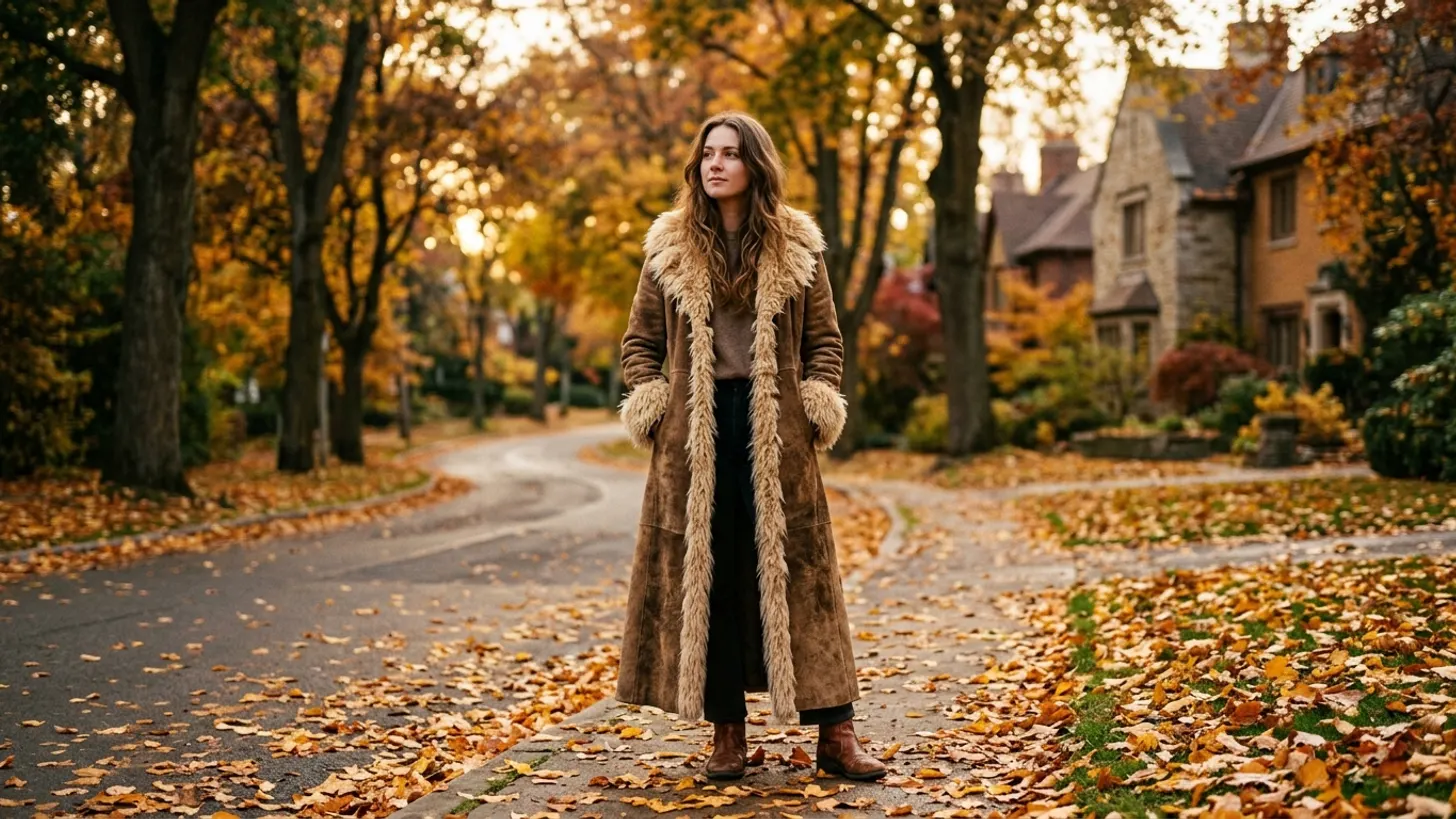
Penny Lane Pignatelli, the band-aid in Cameron Crowe's Almost Famous, walks through the 2000 film in a knee-length shearling coat with a curly mongolian collar. Two and a half decades later, that coat has a name. A vintage penny lane coat is the 1970s mid-thigh silhouette in suede or leather with a deep cream or natural shearling lapel, often trimmed in mongolian or curly lamb. The garment in the film was real period vintage, sourced rather than fabricated. Almost everything sold under the label today follows that template.
What is a vintage penny lane coat?
A vintage penny lane coat is a mid-thigh 1970s outerwear silhouette built on a suede or leather shell with a deep shearling lapel that frames the face. The name comes from the character Penny Lane in Almost Famous, but the construction predates the film by three decades.
The defining features stay consistent across the period. Notched or wide-spread shearling lapels in cream, ivory, or honey tones. A suede or smooth leather body, usually in chocolate, camel, or rust. Hidden snap closures or a single concealed button. Knee-length hems that hit between mid-thigh and the top of the calf. A boxy shoulder line that softens at the waist without nipping in.
The look entered mainstream fashion through the Eastern European folk revival that swept Western design houses between 1968 and 1975. The Metropolitan Museum of Art's Costume Institute archive documents shearling outerwear in this exact silhouette from designers including Yves Saint Laurent and Anne Klein during the period.
The origin of the vintage penny lane coat silhouette
The vintage penny lane coat silhouette traces back to two parallel sources in the late 1960s. Saint Laurent's 1968 Russian-influenced collection introduced shearling-lined coats to ready-to-wear, and Afghan trade routes carried hand-embroidered shearling jackets into London and Paris boutiques during the same window.
By 1971, American department stores stocked domestic versions made in Texas, California, and upstate New York. Manufacturers like Penny Lane Ltd., Lilli Ann, Pioneer Wear, and Marvin Richards produced the boxy shearling-lapel coat for a market that had absorbed the boho aesthetic but wanted polished construction. Harper's Bazaar editorial archives from 1972 through 1975 show the silhouette across runway and street coverage.
The Almost Famous association came retroactively in 2000. Costume designer Betsy Heimann sourced an actual 1970s shearling coat for actress Kate Hudson rather than fabricating one. The garment in the film is a real period piece, which is part of why collectors of a vintage penny lane coat cite the film as proof of authenticity rather than as the origin.
Materials and construction details
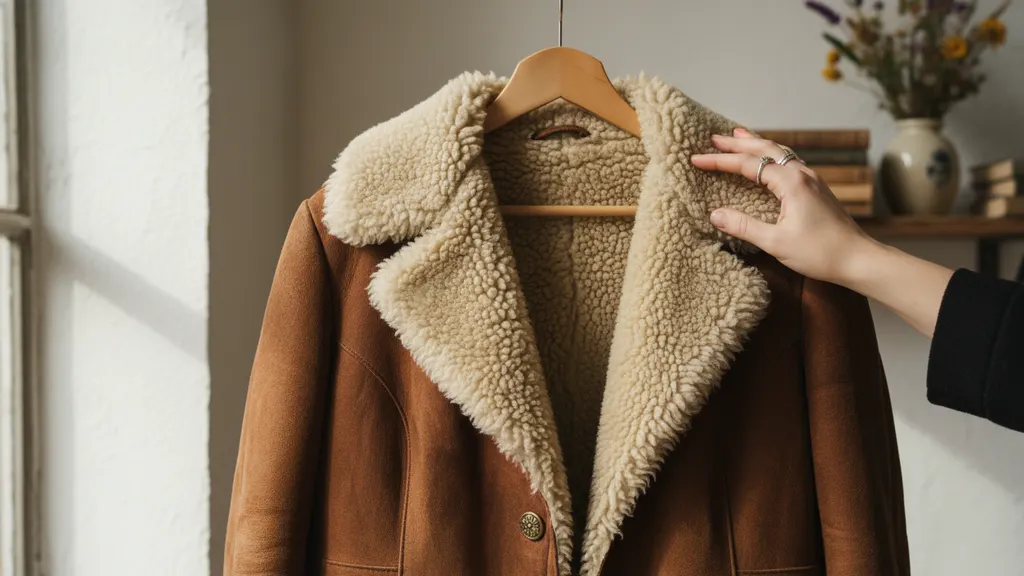
Three materials dominate authentic 1970s examples. The shell is suede (cowhide split, occasionally pigskin) or smooth aniline leather, the lapel is genuine shearling or mongolian lamb, and the lining is acetate, rayon, or quilted nylon.
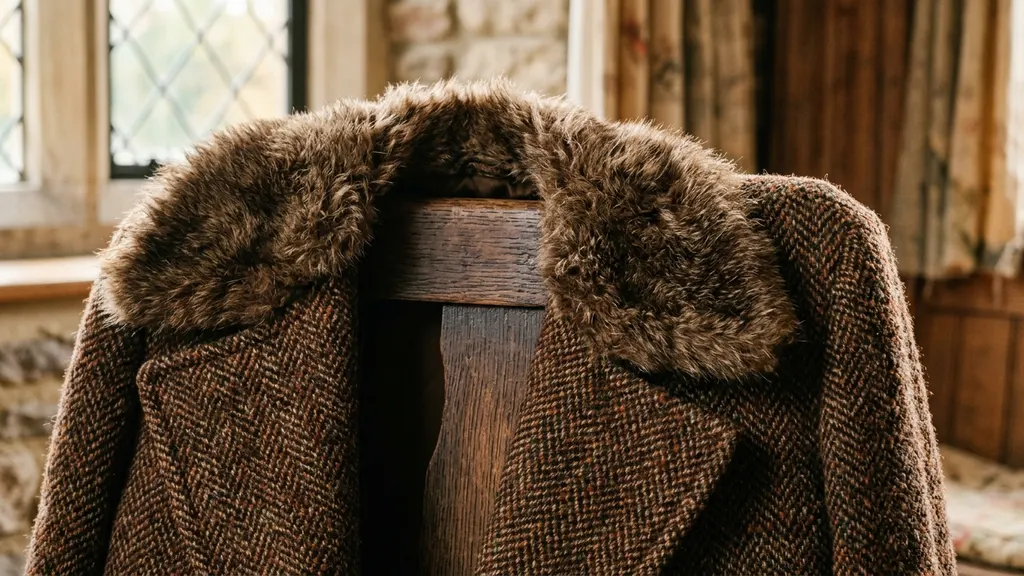
Shearling is sheepskin tanned with the wool intact. Mongolian lamb is a longer, curlier fleece sourced from Tibetan or Mongolian breeds and dyed cream or natural. Curly Persian lamb (also called karakul or astrakhan) is denser and tighter, identifiable by its swirled rosette pattern. The Victoria and Albert Museum's fur and leather reference explains the visual differences between these three across surviving 20th-century garments.
| Lapel material | Visual character | Common era |
|---|---|---|
| Shearling | Short to medium wool, leather backing visible at edges | 1968 to 1980 |
| Mongolian lamb | Long curly fleece, cream or dyed | 1970 to 1979 |
| Curly Persian lamb | Tight swirled rosettes, denser hand | 1965 to 1975 |
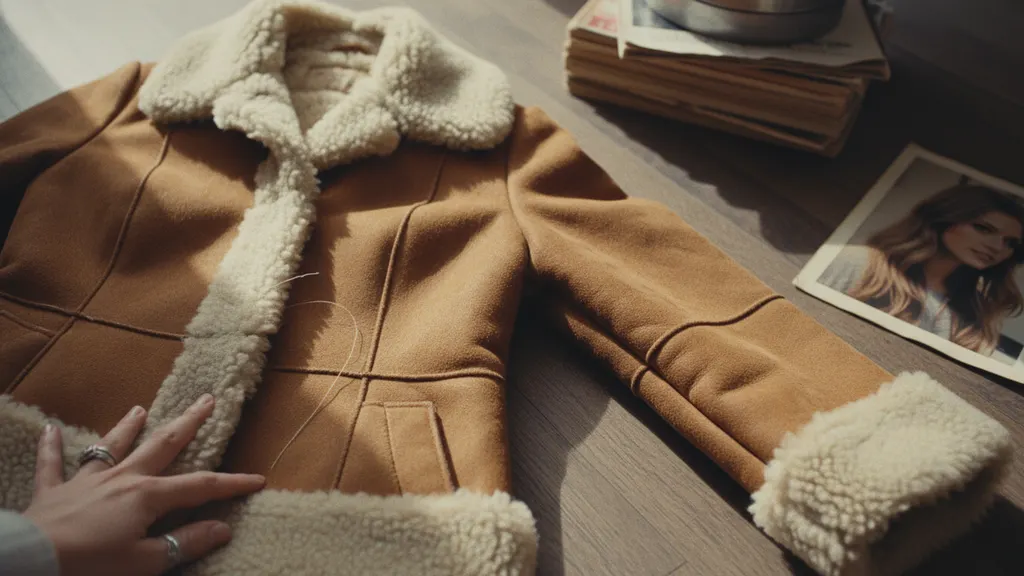
Construction tells you almost as much as material. Period pieces are sewn on industrial straight-stitch machines with cotton-wrapped polyester thread. Linings are bagged at the hem rather than stitched flat. Pockets are slit and welted, not patch. Buttons, when present, sit hidden under a placket or get replaced with concealed nickel snaps. Visible hardware on the front of a 1970s example almost always indicates an 1980s or later reproduction. For tactile reference, our guide to identifying vintage shearling walks through the construction tells.
How to identify an authentic vintage penny lane coat
Identifying an authentic example starts with the label. Period union tags from the International Ladies' Garment Workers' Union sit across the bottom of the inner collar lining. Care labels with the now-standard symbol set were not federally required until 1971, so pre-1971 examples often carry no care instructions at all.
Check the shearling. Genuine sheepskin lapels have leather backing visible at the cut edges, and the wool grows in directional patterns that change density across the lapel. Synthetic substitutes (which appear in late-1970s budget reproductions) have woven or felted backing and uniform pile direction. The Vintage Fashion Guild label resource catalogues period union tags by year, which lets you cross-check claimed dates.
Smell is diagnostic. Real shearling carries a faint lanolin and leather scent that intensifies in humid conditions. Suede shells smell of the tannins used in the period (vegetable-tanned suede has a distinct earthy note). Reproductions and fakes smell of acrylic, polyester, or chemical fixatives. Erin's intake process for any such piece involves a 48-hour off-gas evaluation in a climate-controlled room before listing.
Styling a vintage penny lane coat today
A vintage penny lane coat works hardest as the structural element in an otherwise loose outfit. The coat carries the silhouette, so what goes under it can stay soft. Flared denim, slip dresses, ribbed knit turtlenecks, and ankle-cut leather boots are the most period-correct pairings.
Modern styling departs from the 1970s by ignoring the matched set. Original wearers paired the coat with floor-length suede skirts and platform clogs. Contemporary editors at Vogue and WhoWhatWear document the look across 2022 to 2025 street style with cropped denim, baby tees, and straight-leg trousers instead. The coat reads vintage; the rest reads now.
Color matters more than people realize. Chocolate or rust shells with cream shearling lapels are the most versatile, working across cream, ivory, denim, and black base palettes. Cream-on-cream examples (a fully bleached shearling shell with matching lapel) are striking but harder to wear, and they show wear faster around cuffs and pockets. For period-correct outfit references across the decade, see our 1970s fashion collecting guide.
Care, condition, and what to expect
Suede and shearling outerwear of this age cannot be treated like contemporary outerwear. A genuine 1970s vintage penny lane coat is between 47 and 56 years old as of 2026. Period adhesives, threads, and tanning chemicals have aged together, and any cleaning or restoration approach must respect that.
Spot clean with a dry suede brush only. Avoid water, solvents, and any commercial leather conditioner not specifically formulated for vegetable-tanned suede. Store on wide wooden hangers, never wire, and keep the coat away from direct light. The Smithsonian's textile conservation guidance for sheepskin and shearling recommends 45 to 55% relative humidity and 60 to 68 degrees Fahrenheit storage. Our deeper vintage suede care notes cover seasonal storage rotation.
Expected condition varies. Common: cuff darkening, pocket entry wear, shearling matting at the lapel fold line. Acceptable: minor body staining if it does not penetrate the suede surface, light fleece compression. Disqualifying: dry rot in the leather, brittleness that cracks at the seams, mold odor, and tears longer than 1.5 inches.
Frequently asked questions
Are vintage penny lane coats warm enough for sub-freezing weather?
Genuine shearling provides natural insulation comparable to mid-weight wool, but the construction does not perform like contemporary technical outerwear. The shearling lapel insulates the neck and upper chest. The suede or leather shell offers moderate wind resistance but limited thermal retention. Most authentic examples are best for 25 to 50 degrees Fahrenheit with a sweater layer underneath. Below 20 degrees, layer a down vest under the coat or save it for milder days. The V&A textile conservation team notes that period shearling outerwear was rated for European winter conditions, not North American polar weather.
How do I know if the fur trim on these coats is ethically acceptable?
Pre-1980 shearling and mongolian lamb were sourced as agricultural byproducts of the meat industry, distinct from the modern factory fur trade. Ethical fashion researchers, including Humane World for Animals, distinguish between buying new fur and rehoming a vintage piece. Rehoming extends the life of a garment that already exists and reduces demand for new production. If the ethics matter to you, ask the seller for sourcing documentation, decade attribution, and confirmation that the piece is genuine vintage rather than a 2010s reproduction using contemporary fur.
What is the difference between a Penny Lane coat and an Afghan coat?
Both belong to the 1970s shearling family, but the silhouettes differ. An Afghan coat is unstructured, embroidered, often reversible with the fleece worn against the body, and cut to fall to mid-calf or lower. The penny lane silhouette has a tailored shell, a defined shoulder, and shearling restricted to the lapel and sometimes the cuffs. The Met Museum costume timeline places both garments in the same period but classifies them under different lineages: Afghan coats descend from Central Asian folk dress, the penny lane line from American and Western European ready-to-wear.
Can I get a vintage penny lane coat re-lined or repaired?
Yes, but find a specialist. Standard tailors and dry cleaners are not equipped to handle vintage suede, shearling, or 50-year-old adhesives. Look for a furrier or vintage restoration specialist with documented period experience. Common repairs include relining (acetate or rayon replacement, expect $200 to $400), cuff edge binding ($75 to $150), and shearling re-attachment at lapel seams ($150 to $300). The Vintage Fashion Guild restoration directory maintains regional listings. Avoid anyone who suggests dyeing the shell, replacing the shearling with synthetic, or any chemical cleaning process.