May 2026
How to date a vintage fur coat: era, label, and construction clues
A specialist's guide on how to date a vintage fur coat by reading union labels, lining materials, pelt seams, and silhouette across the 1940s through 1980s.
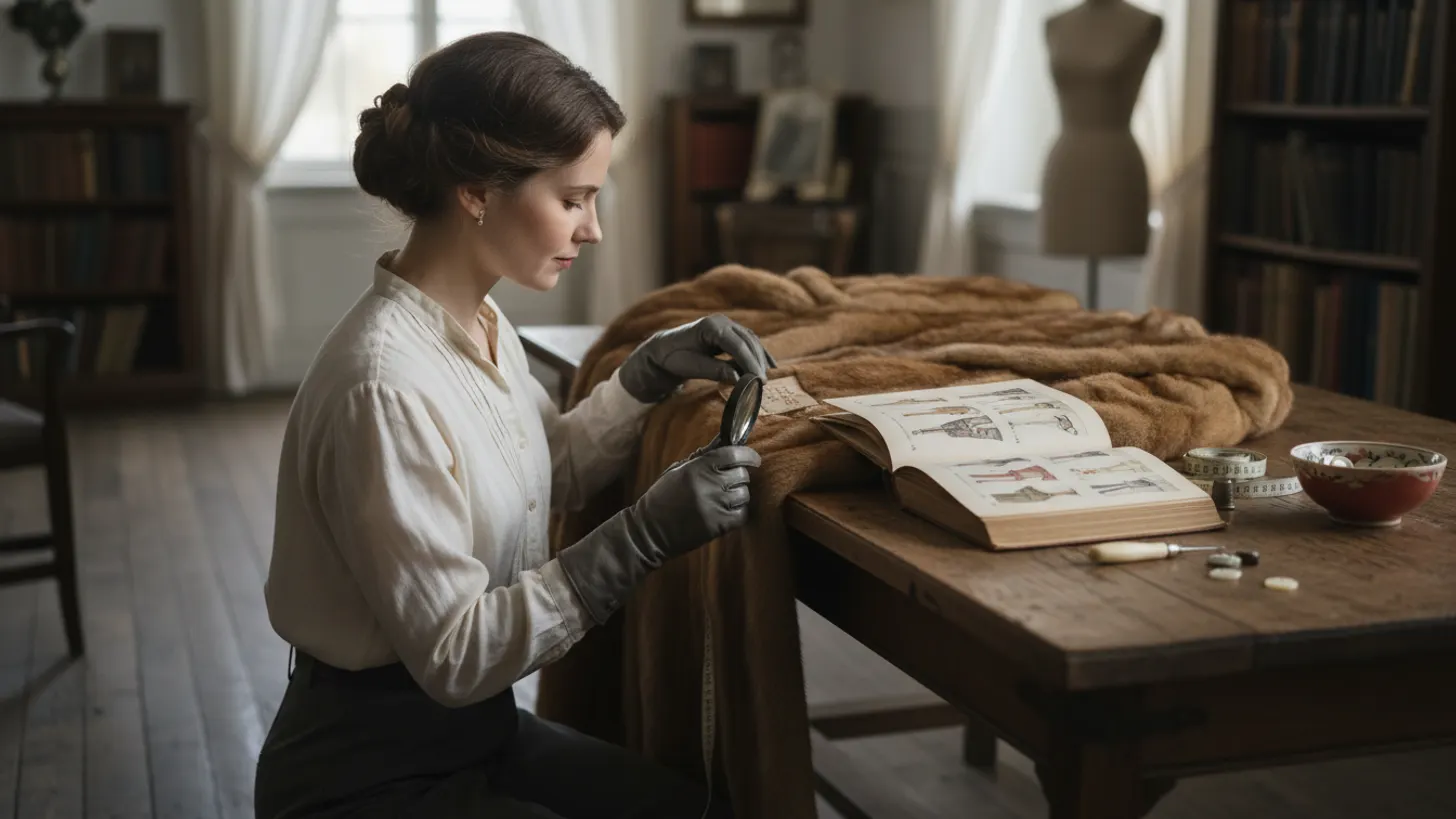
A woman brought me a dark mink coat last spring, inherited from her grandmother. No paperwork. Just a satin lining, a faded label, and tight pelt seams running shoulder to hem. That afternoon I spent reading her coat, decade by decade, is the same process I follow when buyers ask how to date a vintage fur coat. Here is what to look for, in the order I look.
Why how to date a vintage fur coat starts with the label
The label is the first place I look. If it is intact, it pins the piece within a five-year window without any other evidence. Anyone learning how to date a vintage fur coat starts with that label, because the 1939 International Fur and Leather Workers Union mark is the most reliable single dating signal you can find on a coat.
The Vintage Fashion Guild Label Resource tracks how these labels shifted across decades. Three eras of union design help here. The 1939 to 1955 label carried a circular red and blue logo with the full union name spelled out. From 1955 to 1973, the design simplified to a horizontal blue rectangle with cleaner typography. After 1973 the union merged into the Amalgamated Clothing Workers, and the label carried a new ACTWU mark.
If the label is missing, that itself is information. Mass-market production from the late 1970s onward sometimes skipped union labels, particularly on imports. Department store and furrier labels fill the gap. The Metropolitan Museum of Art fur history piece notes how I.J. Fox, Maximilian, and Ben Kahn each ran distinct label runs that researchers have mapped against catalog records. A monogram font, a phone number with a four-digit exchange prefix, or a zip code's absence (USPS adopted zip codes in 1963) each narrow the production window. For related dating clues on other vintage outerwear, see our guide to dating vintage leather jackets.
Reading the lining: silk, satin, acetate
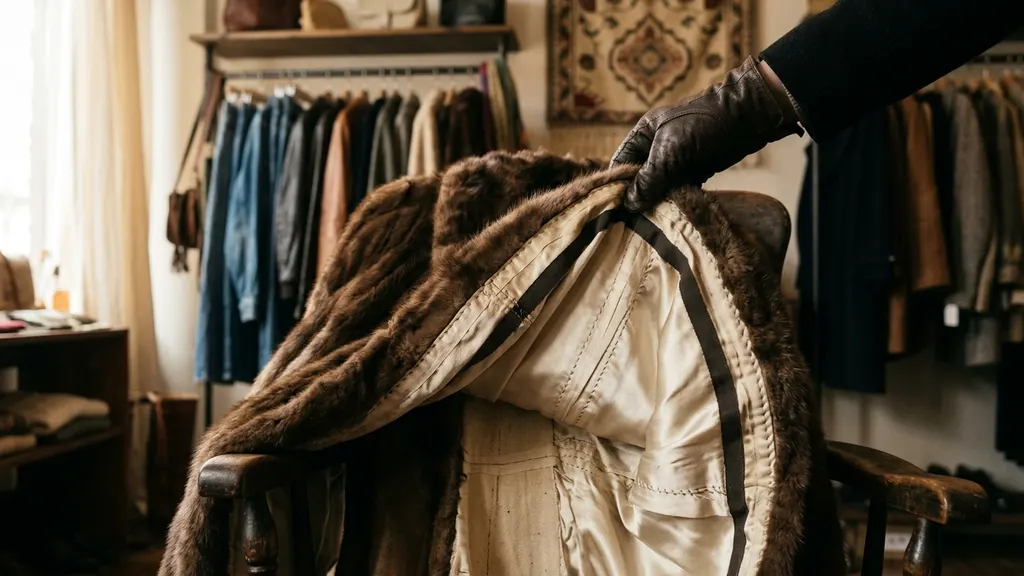
Linings tell a chronological story that is almost impossible to fake. Once you have checked the label, the lining is the second step in how to date a vintage fur coat. Until roughly 1960, the standard was silk satin. By the mid-1960s, acetate replaced it. Nylon dominated by 1980.
Run your fingers along the inside of any vintage piece. Silk satin feels cool, almost slippery, with a subtle weight. Acetate feels papery and warmer to the touch. Nylon has that telltale plasticky bounce. Hold a small section to the light. Silk shows an uneven, organic weave. Acetate looks uniform but lustrous. Nylon shows a regular grid pattern.
Color and pattern matter too. Pre-1960s linings tend toward solid jewel tones (emerald, sapphire, burgundy) or quiet pinstripes. Late-1960s linings often display bold paisley, geometric, or floral prints reflecting the period's broader textile fashion. The FIT Museum textile collection documents how synthetic fiber adoption tracked closely with broader fashion industry shifts after World War II.
How to date a vintage fur coat through construction techniques
Construction is where the deepest clues live. A furrier's seam technique is fingerprint-specific to their training era. Knowing how to date a vintage fur coat by construction means looking at three places: the pelt joins, the hem, and the closure. Each tells you something different.
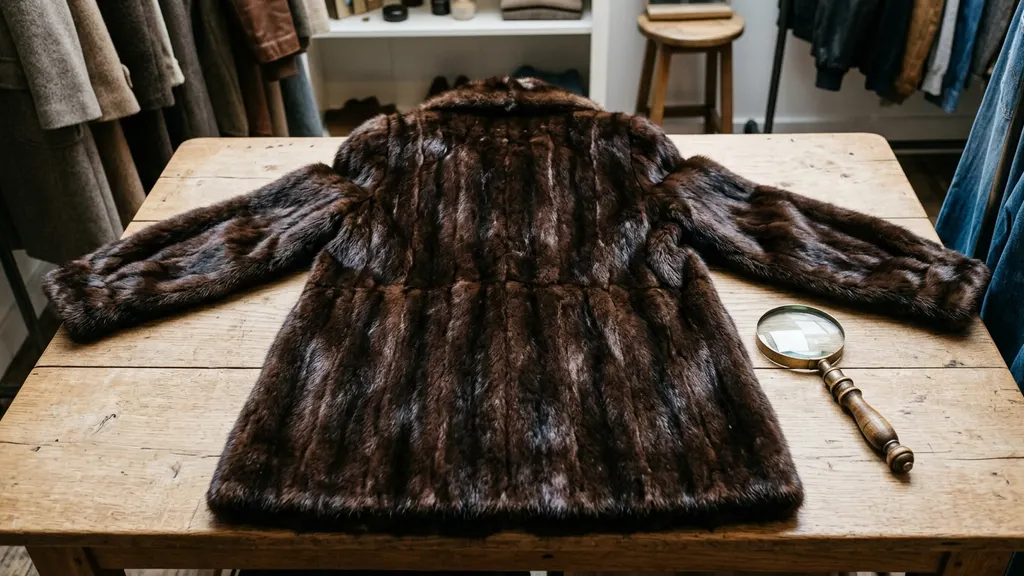
Pelt joins reveal the most. From the 1920s through the late 1950s, most coats used vertical seams, with each pelt running from shoulder to hem in long strips. The 1960 emergence of the "let-out" technique changed this. Furriers cut each pelt into thin diagonal strips and re-stitched them at a stretched angle, producing a longer, lighter coat with horizontal banding. By 1970, let-out was the standard for mink and sable, peaking in popularity through 1979. The Vintage Fashion Guild furs and pelts archive documents the spread of let-out construction across the industry.
Hems offer their own evidence. Pre-1960 hems were hand-finished with a blind stitch and often included a chain weight sewn into the lining to maintain drape. Post-1970 hems frequently use machine-stitched bias tape, faster to produce but visible from the inside.
Closures are decade-specific. Frog closures and chain links dominated 1940s and early 1950s pieces. Hidden hook-and-eye combinations replaced them through the 1960s. Snap-closure plackets behind decorative buttons became common only in the late 1970s, and external statement buttons (large, often resin or imitation horn) define the 1980s look.
Pelt direction: how to date a vintage fur coat by seam patterns
Pelt direction is the third major signal in how to date a vintage fur coat. Looking at the fur side, hold the coat flat under good light. Vertical drop patterns signal pre-1960 construction. Horizontal banding signals the let-out technique that defined 1960 to 1979 fur production.
Stitching itself is its own dating tool. Pre-1960 pieces show hand-stitching at the pelt joins, with stitches roughly two millimeters long and slightly uneven. By the late 1960s, industrial fur-sewing machines (the Hugo Hudig and similar makes) produced uniform stitches at one to one-and-a-half millimeters. Inspecting any seam under a magnifier, a jeweler's loupe works fine, tells you which era of machine made it.
Splits at the seams are common in older coats and not a reason to walk away. The fur thread used through the 1960s was untreated cotton, which dries out and snaps after fifty or sixty years. A reputable furrier can re-stitch any split for $40 to $90 per seam. The Victoria and Albert Museum archive on 1940s and 1950s fashion documents how fur garments were considered investment pieces, built to be repaired across decades rather than discarded. For shearling and lambskin dating, see our vintage shearling sourcing guide.
Silhouette and shoulder shape across decades
Silhouette adds the next layer when figuring out how to date a vintage fur coat across decades. Even before you pick up a coat, the shape of the shoulder and the length of the body place it within an era. Fur silhouettes track ready-to-wear silhouettes closely.
The 1940s brought structured, slightly padded shoulders and a slim, knee-length cut, often with a wide notch collar. The 1950s softened this into a rounder shoulder, three-quarter sleeve, and a fuller cocoon body, reflecting Dior's 1947 New Look. The 1960s flipped again toward minimalism: cropped jackets, dropped shoulders, and clean A-line skirts, sometimes paired with mod accents.
The 1970s introduced length and drama. Full-length swing coats with fox-fur trims, broad lapels, and tie belts dominated the decade. A long silhouette and oversized collar usually signals 1973 to 1979. The 1980s reintroduced the strong shoulder, but cut more extreme: angular, padded, statement-making, often paired with a shorter hem. The Vogue archive of vintage fur styling shows how each silhouette anchored a different cultural moment, from postwar optimism to disco-era abundance. For more on a related silhouette story, see our Penny Lane coat history piece.
| Decade | Lining | Pelt seams | Shoulder | Common closure |
|---|---|---|---|---|
| 1940s | Silk satin | Vertical | Padded square | Frog or chain |
| 1950s | Silk satin | Vertical | Soft round | Hook and eye |
| 1960s | Acetate | Let-out diagonal | Dropped natural | Hidden hook |
| 1970s | Acetate / nylon | Horizontal let-out | Soft natural | Tie belt |
| 1980s | Nylon blend | Mixed | Padded angular | Statement button |
How to date a vintage fur coat using era-specific details
Once you have checked the label, lining, construction, and silhouette, the last layer of dating clues lives in the small accessories: buttons, buckles, monograms, and care instructions. Knowing how to date a vintage fur coat from these details often resolves a five-year window down to a two-year one.
Care labels are particularly useful. The Federal Trade Commission required care labels on textile garments only from 1971 onward (the FTC Care Labeling Rule), so any sewn-in care instruction tag dates a coat to after that year. Pre-1971 coats rely entirely on the maker's word and a furrier's storage tag, often handwritten in pencil on linen.
The Endangered Species Act of 1973 changed available furs. After 1973, leopard, ocelot, jaguar, and some otter species could no longer be sold new in the United States. A coat in those materials is either pre-1973 or imported through an exception. The Humane World for Animals fur industry archive documents which species were affected by which trade restrictions across the 1970s and 1980s.
Buttons and buckles also help. Bakelite buttons were largely phased out by the late 1950s, replaced by plastic and resin imitations through the 1960s. Real horn buttons reappeared in the late 1970s as natural materials returned to fashion, then faded again in the 1980s in favor of large statement plastic. Knowing how to date a vintage fur coat down to the button takes practice, but it works.
For a closer look at this, see How to date vintage denim: stitching, labels, and era-specific clues.
Frequently asked questions
How do I tell if a fur coat is from the 1950s or 1960s?
The fastest signal is pelt seam direction. A 1950s coat almost always shows vertical pelt seams running from shoulder to hem in long, continuous strips. A 1960s coat tends toward diagonal or early let-out construction, with pelts cut into thin slanted bands and re-stitched at a stretched angle. Lining also helps: silk satin points to the 1950s, acetate to the 1960s. Shoulder shape is the third tell. The 1950s soft, rounded shoulder gives way to a dropped, more natural 1960s line, per the Harper's Bazaar vintage fur history archive.
Can a union label tell me the exact year a fur coat was made?
A union label narrows the production window to a roughly fifteen-year range, not an exact year. The labels did not encode dates, they encoded union affiliation. What helps is recognizing which era of label design you are looking at: the 1939 to 1955 circular emblem, the 1955 to 1973 horizontal rectangle, or the post-1973 ACTWU mark after the union merger. Combined with the lining material, pelt direction, and silhouette, a union label closes the dating window further. The Sotheby's collector's guide to vintage fur publishes side-by-side label comparisons that make these era differences visible.
What separates a 1970s fur coat from a 1980s one?
Length, lining, and shoulder shape draw the clearest line between the two decades. A 1970s coat tends to run long, often full-length, with a softer dropped shoulder, an acetate or early-nylon lining, and a tie belt or hidden snap closure. A 1980s coat returned to a more structured, angular padded shoulder, usually with a shorter hem (often hip-length or knee-length), a fully synthetic nylon-blend lining, and a large statement button or visible decorative closure. The Cut coverage of fur-coat eras documents how the 1980s power-suit aesthetic spilled into outerwear styling, especially in shoulder pad volume.
How can I tell if a fur is real or synthetic in a vintage coat?
Look at the hair structure, the backing, and the burn behavior. Real fur grows from a leather pelt, so part the hair on the inside and you should see suede-like skin. Synthetic fur is woven onto a textile mesh or knit backing. Real fur has guard hairs (longer, coarser top hairs) over a softer undercoat, while synthetic mimics the texture but lacks the dual-layer structure. A single strand of real fur burns like human hair (sulfur smell, ash), while synthetic melts into a plastic bead. This is identification through traditional methods, not laboratory analysis, as the Smithsonian Magazine history of synthetic fur describes.