May 2026
How to date vintage denim: stitching, labels, and era-specific clues
Learn how to date vintage denim using stitching patterns, label evolution, rivet construction, and era-specific clues from 1900s Levi's to 1990s denim.

Most of my best denim comes from estate sales in Pasadena, where the same family closets surface 1970s Levi's bell-bottoms alongside 1990s deadstock. Learning how to date vintage denim by stitching, labels, and hardware turned those finds into provenance instead of guesses. Most pairs reveal their decade in under sixty seconds once you know where to look. This guide walks through the markers that hold up across brands, from rivet construction to redline selvedge.
How to date vintage denim by reading the stitching first
Stitching tells the fastest story on a pair of jeans. Pre-1990 American denim almost always used chain-stitched hems and single-needle constructed back pockets. Knowing how to date vintage denim through stitch type, thread color, and seam count narrows the decade before you check a single label.
The back pocket arcuate is the cleanest tell. Single-needle stitching on Levi's 501s marks pre-1973 production. Levi Strauss added the second needle that year to speed factory throughput, a transition documented in the Vintage Fashion Guild denim history. After 1973, both rows of the arcuate run parallel and uniform. Before, the line has the slight hand-guided wobble of a single operator at one machine.
Chain-stitched hems leave a railroad-track twist on the inside leg, visible when you turn a cuff up. The chain breaks if cut and travels backward through the seam, a quirk that produced the famous fade roping along the bottom of well-worn 1950s and 1960s jeans. Lockstitch hems, dominant after the 1980s, lay flat and do not come undone when nicked.
Orange contrast thread on the outseam and pocket bags appeared on Levi's around 1873 with the original riveted patent and remained near-constant. Yellow thread became standard for top-stitching by the 1960s. For a closer look at how the Big E red tab interacts with stitch dating, see our guide to identifying Levi's Big E tabs.
Rivets, buttons, and hardware as era markers
Hardware never lies the way labels can. The single most useful test for how to date vintage denim is the hidden rivet on the back pockets. Levi Strauss covered the back pocket rivets in 1937 to stop them scratching saddles and furniture, then phased the hidden rivet out entirely in 1966 when the bartack stitch replaced it.
If you can feel rivets through the back pocket fabric from inside, you are pre-1966. If the back pocket corners show small exposed rivets, you are between 1966 and the mid-1970s. After that, the bartack became universal. The Smithsonian Magazine history of American blue jeans documents this construction change in detail.
Donut buttons (with a recessed center ring) on the fly indicate pre-1980 production on Levi's, Lee, and Wrangler. Flat-stamped buttons came in with industrial cost-cutting in the early 1980s. Look at the back of the top fly button: a numeric stamp (2, 6, 8, or 16, for example) identifies the factory of origin, and the Met's American workwear collection records include button stamp numbers from the 1940s onward.
Talon zippers, with the brass slider stamped TALON, dominated American denim through the early 1970s. Scovill and Conmar followed. YKK overtook all of them by 1980. A bronze TALON 42 zipper on a pair of women's high-rise jeans usually reads 1968 to 1974.

How to date vintage denim through labels and tags
Labels are the index card of provenance. Knowing how to date vintage denim by tag construction means reading the back patch, neck label material, and care instructions in sequence rather than as separate clues.
The Levi's back patch shifted from leather to a printed cardboard-paper hybrid (the so-called Jacron patch) in 1955. The Big E red tab, with capital E across all four letters, was used from 1936 through mid-1971. The lowercase e tab appeared mid-1971 and continues today. This single feature dates 35 years of Levi's production. The FIT Museum's denim exhibition notes treat the red tab transition as the most commonly checked Levi's marker.
Wrangler and Lee follow similar patterns. Lee's union-made woven label in red, white, and blue ran 1944 through 1975, after which the printed white label took over. Wrangler's Blue Bell parent-company tag was discontinued in 1986.
Care symbols appeared on inner tags after ISO 3758 became standard in 1991. If a pair has no care symbols anywhere on inside seams, the garment is almost certainly pre-1991. The combination of an absent care symbol panel with a paper back patch and a Big E tab is conclusive evidence of a 1960s pair.
Country of origin tags became required by U.S. customs after 1984, then expanded to include exact city in 1996. A Levi's tag reading simply MADE IN USA without the city is between 1984 and 1996. For a side-by-side construction reference, see our guide to Cone Mills White Oak history.
Selvedge, weave, and fabric weight
Selvedge denim has the self-finished edge from shuttle looms, the kind of fabric that almost always means pre-1983 American production or contemporary Japanese revival. Anyone learning how to date vintage denim should handle a known 1960s Cone Mills pair to feel the weight in the hand: roughly 14 ounces, dense, with a slight stiffness that gives way only after years of wear.
Cone Mills' White Oak plant in Greensboro, North Carolina, supplied Levi's with redline selvedge denim until shuttle loom production wound down at scale around 1983, according to Business of Fashion reporting on the Cone Mills closure. The original White Oak mill itself closed in 2017, a moment covered by The New York Times and treated by collectors as the end of an era for American mill denim.
Fabric weight follows the decade. 14oz dominated the 1960s. Lighter 12oz emerged in the 1970s with the bell-bottom boom and demand for softer drape. 11oz became standard by the 1990s as washes got more aggressive and fabric had to survive stonewashing. Japanese repro denim from the 1990s reversed the trend, deliberately producing heavyweight 16oz to 21oz selvedge for purists.
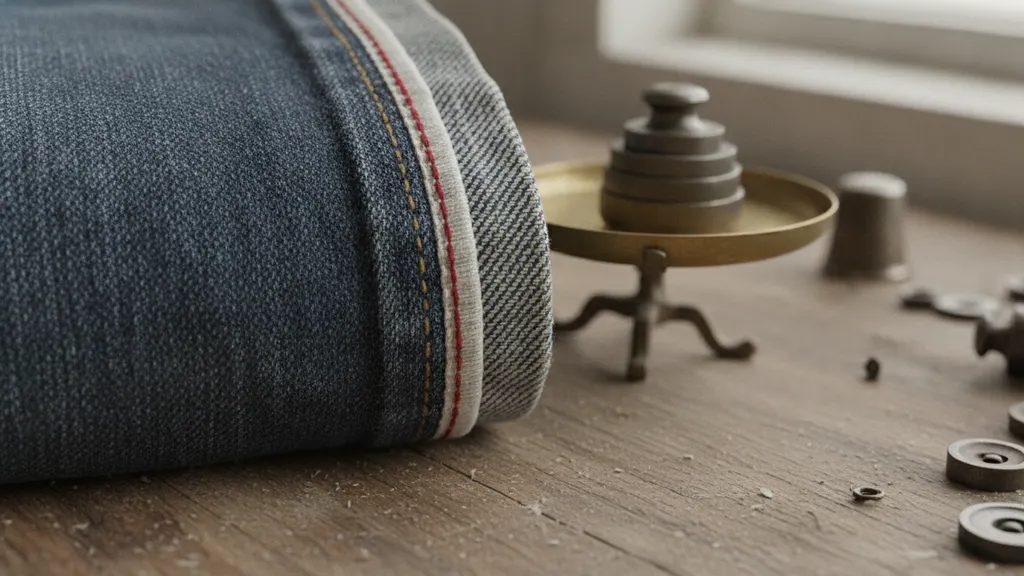
The selvedge ID color is its own dating clue. Red line selvedge ran on Levi's 501s through the early 1980s. Green, yellow, and pink selvedge IDs appeared on other contract orders and on other brands. For a buying-side reference, our selvedge denim buying guide covers what each color signals.
How to date vintage denim by silhouette, wash, and fit
Silhouettes shift faster than construction. Knowing how to date vintage denim by leg shape, rise, and finish gives a second opinion after stitching and labels. Most pairs reveal their era from across a room before you touch the fabric.
High-rise straight cuts with a true 11 to 13 inch rise dominated the 1960s. The waistband sits at the natural waist, and the leg falls straight from hip to ankle without taper. Bell-bottoms peaked 1969 through 1975, with flares as wide as 22 inches at the hem on women's pairs and 19 to 20 inches on men's. Boot cuts followed, gentler than bells, holding the silhouette through the late 1970s.
Stonewashed light blues marked the 1980s. The wash uses pumice stones in industrial dryers to break the dye on the surface, producing the powdery cast that reads instantly as Reagan-era. Acid wash, with its mottled bleach pattern, peaked from 1986 to 1991. Black overdye jeans (where indigo was dyed over with sulfur black) ran 1992 to 1998.
When stitching and labels are missing, this is how to date vintage denim by fabric and silhouette alone. A 16 inch flare with a 12 inch rise in heavyweight indigo is 1971 plus or minus three years. A loose tapered acid wash with a high-rise fit is almost certainly 1988 to 1990. Storing those pairs properly afterward matters too: our notes on vintage denim care cover folding, hanging, and humidity.

Frequently asked questions
How can I tell if vintage Levi's are pre-1971?
Look for the Big E red tab with capital E across all four letters and the single-needle arcuate stitch on the back pocket. The Big E ran from 1936 to mid-1971 across the entire Levi's lineup, after which the small e replaced it on every model. A paper back patch and an absent care symbol panel inside the waistband confirm pre-1971 production. The Vintage Fashion Guild Levi's label reference treats the Big E as the most diagnostic single feature on twentieth-century pairs. Combine that with hidden back pocket rivets and you have a pre-1966 pair with reasonable confidence.
What does the red line on the inside seam mean?
The red selvedge ID line runs along the self-finished inside seam of denim woven on shuttle looms. On Levi's 501s, the redline marks production from a small number of contract mills, most famously Cone Mills' White Oak plant in Greensboro, North Carolina, which wove for Levi's from the early 1900s until shuttle production wound down around 1983. The Victoria and Albert Museum's denim history traces the global rise of shuttle-loom denim production through the twentieth century. Other selvedge ID colors (green, pink, yellow) signal different mills or different brands altogether.
Are care labels reliable for dating denim?
Care labels became reliable dating evidence only after ISO 3758 standardized international care symbols in 1991. Before that year, U.S. care labels existed but in inconsistent formats. The fastest application of how to date vintage denim using only care instructions is checking for symbol presence: no symbols and no fiber-content panel typically means pre-1971; written care instructions without symbols mean 1971 to 1991; full symbol-based panels mean 1991 onward. The Smithsonian Magazine history of the care label documents how garment labels became standard tools for dating twentieth-century American clothing.
How do I date vintage denim with no labels at all?
When all the labels have been cut out or worn off, construction is how to date vintage denim without any text reference. Check rivets first: hidden back pocket rivets mean pre-1966, exposed rivets mean 1966 to mid-1970s, no rivets at all mean post-1973 bartack stitching. Then check thread color, single-needle versus double-needle arcuate, button stamp number, and fabric weight. The Met Museum's American workwear exhibition record documents these construction markers as primary identifiers when textile labels are absent. Selvedge ID color and shuttle-loom seam roping are the secondary confirmation that holds up even after extensive wear.