June 2026
What is a vintage Afghan coat? The 1960s counterculture icon explained
What makes a vintage Afghan coat authentic: 1960s sheepskin from Kabul's Chicken Street, hand-embroidered leather, and how to spot 2000s reproductions.
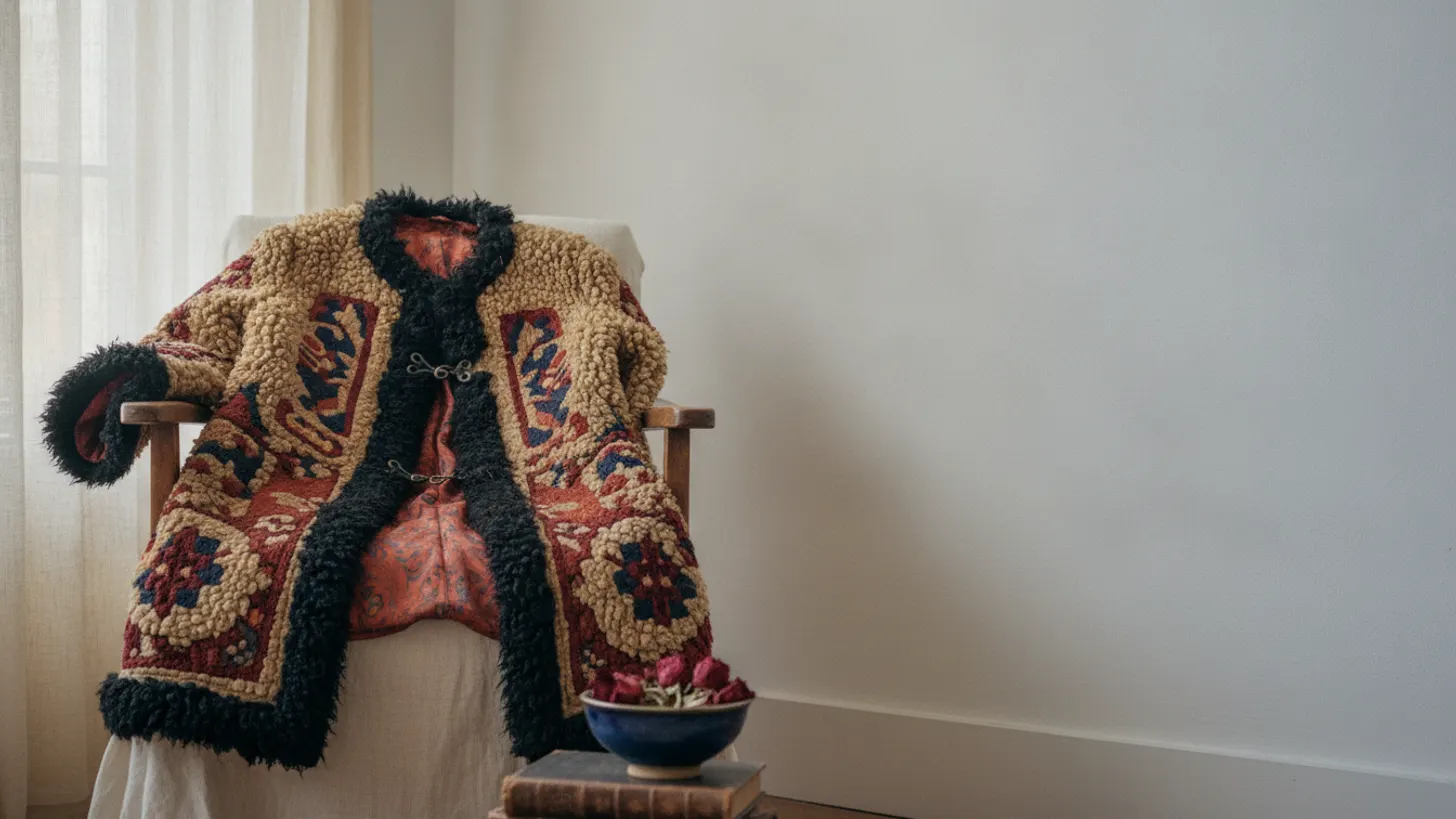
In 1968, Mick Jagger stepped out in Marrakech wearing an embroidered shearling slung over his shoulders, and within eighteen months Vogue editors were chasing the same silhouette through London street markets. That shearling was a vintage Afghan coat: hand-stitched in Kabul, traded along the Hippie Trail, and brought home by British travelers who never imagined it would land on Carnaby Street. Here is what the garment actually is, why it mattered, and how to tell a genuine piece from a 2000s knockoff.
What is a vintage Afghan coat? Origins on Kabul's Chicken Street
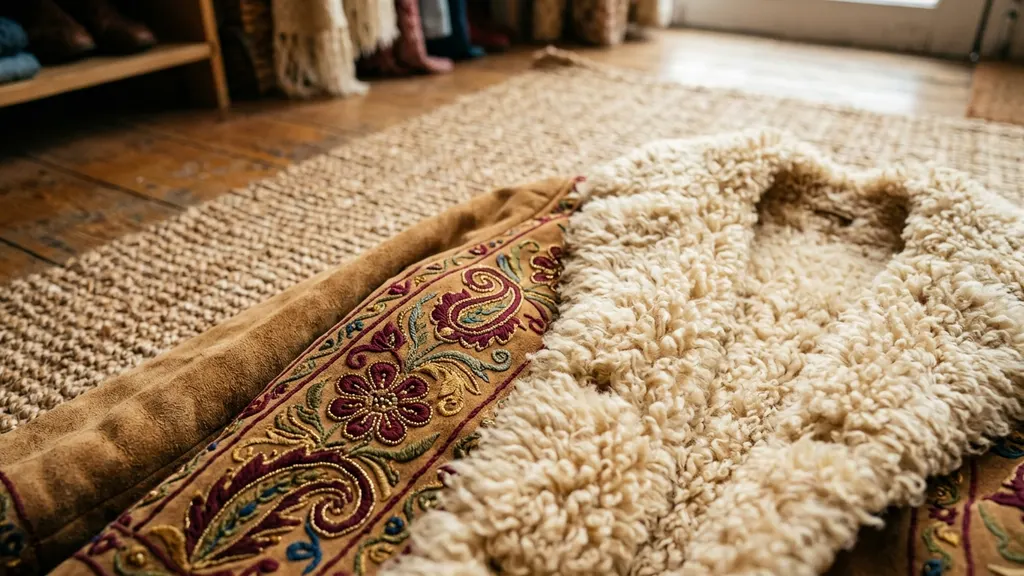
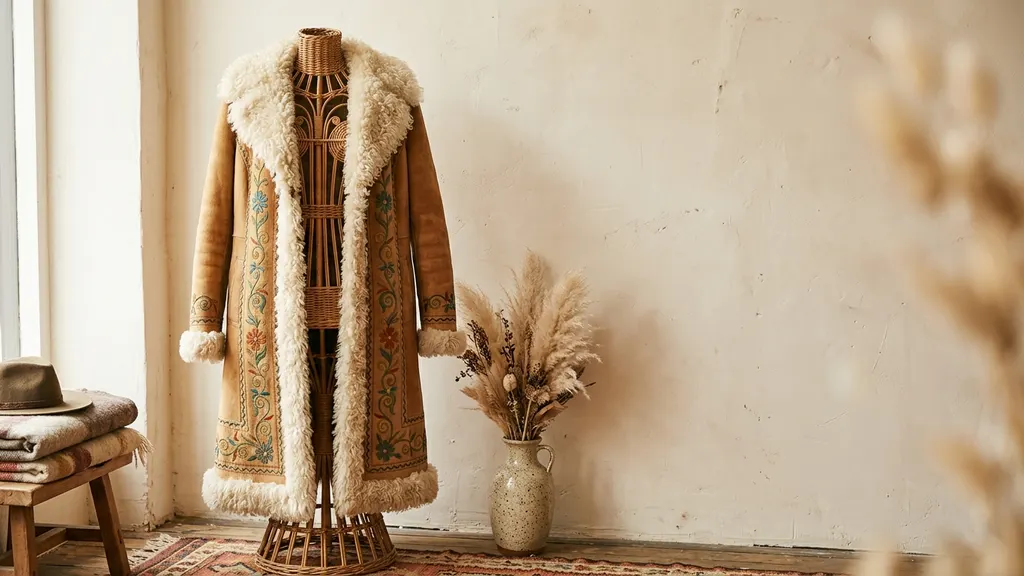
A vintage Afghan coat is a sheepskin garment with the curly wool worn against the body and hand-embroidered tanned leather facing outward. The form developed in Afghanistan over generations, with the highest concentration of makers selling from Kabul's Chicken Street market district through the 1960s, according to records held by the Victoria and Albert Museum textile and fashion archive.
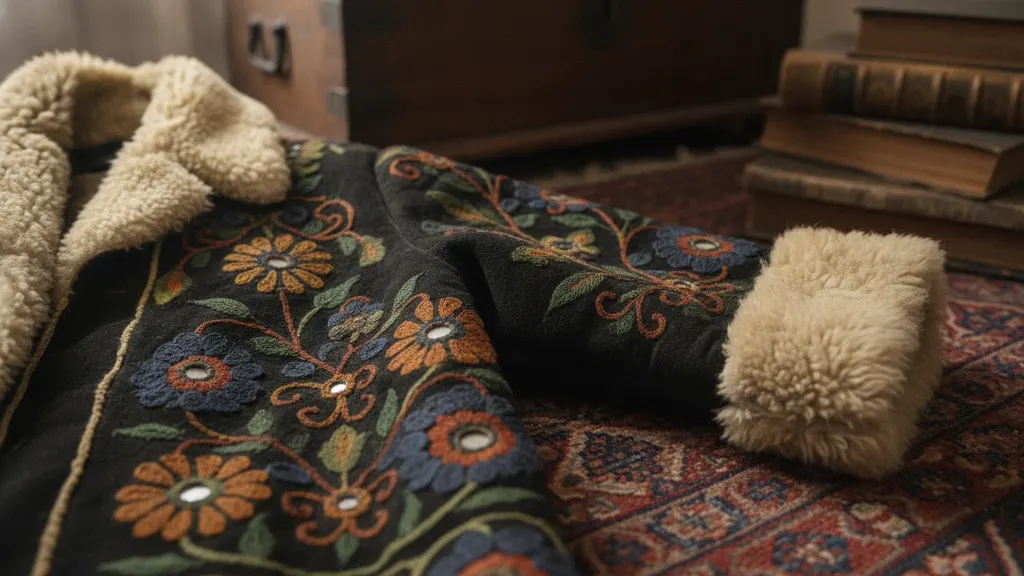
The base hide is typically Karakul, a Central Asian breed prized for its tight astrakhan-style curly fleece, or local fat-tail sheep, tanned with vegetable bark and stitched into a long, collarless or shawl-collared silhouette that reaches mid-thigh or knee. Embroidery patterns of silk floss in cream, ochre, and dusty rose trace floral and paisley motifs around the placket, hem, and cuffs. The most prized examples carry silk-lined hoods and small mirrored discs sewn into the embroidery, a regional touch echoed in nearby Uzbek and Pashtun textile traditions.
Hippie Trail to Carnaby Street: how the coat went mainstream
The Western adoption of the Afghan coat tracked the Hippie Trail, the overland route that carried British and American travelers from London through Tehran, Kabul, and on to Kathmandu, almost exactly. Many who made that journey returned home with one or two embroidered coats stuffed into their packs. By 1967, small boutiques like Granny Takes a Trip on the King's Road were selling them at prices that funded the next leg of their suppliers' journeys.
The mainstream tipping point came with rock press photography. Vogue and Harper's Bazaar ran spreads through 1968 and 1969, but the 1970 film "Performance" starring Mick Jagger and shot in a faded Notting Hill townhouse fixed the vintage Afghan coat in the cultural record as shorthand for psychedelic London. Coverage in The New York Times Sunday style pages followed in 1971, by which point the coat had moved firmly into the mainstream wardrobe.
Authentication in thirty seconds: what the embroidery reverse reveals
An authentic vintage Afghan coat reveals itself in the first thirty seconds of handling. The shearling is dense but uneven, since some patches of wool grow thicker than others because the original animal was real and varied, not a uniform farmed hide. The leather exterior shows tanning marks, slight color shifts between panels, and visible needle holes where panels were stitched by hand rather than glued or bonded.
Embroidery is the strongest authentication signal. Run a fingertip along the back of an embroidered panel; on hand-stitched pieces, the reverse shows knotted thread tails, slight tension variations, and silk floss that catches against the skin. Machine-embroidered reproductions have flat, uniform backs with bonded backing tape. The Vintage Fashion Guild label resource catalogs Afghan and Afghan-style coat tags from 1967 through the late 1970s, which helps cross-reference any inner tag you find.
In my own sourcing, I once nearly bought a piece at a Bristol market that passed every visual check until I turned the embroidered panel over and found bonded backing tape running wall to wall across the reverse. That thirty-second check has kept me from a bad purchase more than once, and I never skip it regardless of how convincing the front looks or how confident I feel about the silhouette.
A real vintage Afghan coat also carries a particular smell. The vegetable tanning leaves a sweet, almost smoky note that ages into something closer to old library books. Synthetic reproductions tend to smell sharply chemical or, after a few years in storage, faintly plastic.
How to date a vintage Afghan coat versus a 2000s reproduction
When dating a vintage Afghan coat, the exercise comes down to four checks: the construction, the inner label, the lining, and the wear pattern. Genuine 1960s and 1970s examples were sold without any care label, since most never passed through Western retail at all. By the early-to-mid 1970s, importers in London and New York started adding their own paper or cloth tags, and these are now collector evidence in their own right and are catalogued in detail at the Metropolitan Museum of Art Costume Institute records.
Reproductions that flooded the market during the 2001 to 2008 vintage revival boom are the most common false positives. Coverage in Business of Fashion documented the reproduction wave through the late 2000s. Tells include zipped (rather than tied or hook-and-eye) plackets, perfectly symmetric embroidery, polyester thread, machine-cut hide edges, and care tags in English with country-of-origin codes from Turkey, India, or China.
Below is a quick side-by-side reference covering the checks most often missed by first-time buyers:
| Detail | Authentic 1967-1979 | 2000s reproduction |
|---|---|---|
| Embroidery reverse | Knotted thread tails | Bonded backing tape |
| Hide edges | Hand-cut, slightly uneven | Laser or machine cut |
| Lining | None, or raw silk | Polyester satin |
| Closure | Tied loops or hooks | Zipper |
| Smell | Sweet leather, faint smoke | Sharp chemical or plastic |
Cleaning and storage: what sheepskin never survives
A vintage Afghan coat is one of the most failure-prone garments to clean wrong. Vegetable-tanned sheepskin should never see water, household detergent, or standard dry-cleaning solvent, all of which strip the natural oils and split the leather along stitching lines. The Smithsonian Magazine profile of the Cooper Hewitt textile lab covers conservation-grade approaches that translate to home practice with minor adjustments.
For surface dirt, a clean horsehair brush worked in the direction of the wool removes most particles. For odor, hang the coat outdoors in shade for forty-eight hours, never in direct sun. Specialist leather cleaners listed through V&A conservation referrals charge between $80 and $180 per garment in 2024 figures, and that is the only intervention recommended for visible staining. Storage matters more in the long term: hang on a wide padded shoulder hanger inside a cotton garment bag, never plastic, in a closet that stays below 65°F and 55% relative humidity.
If you are weighing a piece for purchase, our companion piece on storing vintage outerwear so it lasts decades covers long-term care economics in detail. The aesthetic context of the wider 1960s wardrobe is worth reviewing in our 1960s vintage fashion buying guide. For dating signals that overlap with other shearling and fur garments, see our piece on dating a vintage fur coat by era, label, and construction. For a parallel 1970s silhouette story, our vintage Penny Lane coat guide covers the closest cousin to the Afghan in the period market.
Frequently asked questions
What is the difference between an Afghan coat and a Penny Lane coat?
Both are shearling and leather silhouettes from the same era, but the construction is opposite. An Afghan coat wears the curly wool inside and hand-embroidered leather outside, made in Afghanistan by local artisans through the 1960s and 1970s. A Penny Lane coat, named for the Beatles song and worn by Kate Hudson in Almost Famous, wears the curly shearling on the outside as a collar, cuff, and hem trim, with smooth leather as the body. The Penny Lane was a Western design that joined the same counterculture moment, often Western-manufactured, while the Afghan was an imported artisan good. Vogue covered both silhouettes in parallel through the 1970s.
How much does a real vintage Afghan coat sell for in 2024?
Pricing varies sharply by condition, embroidery density, and provenance, so the most reliable market color comes from checking active listings rather than relying on fixed ranges. For a real-time benchmark, browse current sold listings on curated resale platforms such as 1stDibs; the spread between authenticated original-era pieces with documented Hippie Trail provenance and reproduction-era coats at the same condition grade is visible and substantial in active market data. Recent vintage outerwear coverage from Business of Fashion notes that hand-embroidered examples command meaningful premiums over generic 1970s shearlings, while reproduction-era pieces trade for a fraction of that figure. Always ask the seller for close-up photos of the embroidery reverse and any inner tag before committing to a purchase, and prefer sellers who disclose condition flaws upfront rather than hiding them.
Are vintage Afghan coats ethical to buy today?
This is a personal question with a defensible answer in either direction. The hides used in a vintage Afghan coat were sourced from food-system sheep at the time of original manufacture, so the animal welfare impact has already happened and cannot be undone. Buying secondhand keeps an existing garment in circulation rather than driving new production. The Good On You sustainability framework treats secondhand purchases of any leather as substantially lower impact than buying new shearling. Independent vintage sellers who disclose provenance honestly are the recommended path, and pieces with no provenance documentation should be inspected closely for reproduction tells before purchase.
Can I wear a vintage Afghan coat in rain or snow?
Light rain is survivable for a vintage Afghan coat; sustained wet weather is not. The vegetable-tanned leather absorbs water unevenly, which causes the embroidery thread to tighten and pucker the surface as it dries. Snow that brushes off quickly is fine. If you are caught in a downpour, hang the coat on a wide padded hanger in a cool, well-ventilated room and let it dry slowly over 48 to 72 hours, never near a radiator or hair dryer. The Met Costume Institute conservation notes on vegetable-tanned hides apply directly here. Repeated soaking will eventually split the leather along seam lines, which is irreparable in practical terms.
How can I tell if the embroidery is silk or synthetic?
The burn test, done on a single discreet thread tail pulled from inside the hem, is the most direct method. Real silk burns slowly, smells like burnt hair, and leaves a brittle dark ash that crumbles easily between your fingers. Polyester melts into a hard plastic bead, smells faintly chemical, and the resulting bead is sharp to the touch. The Vintage Fashion Guild fiber identification guide walks through the test sequence in detail. For pieces you cannot test destructively, examine the thread under raking light: silk catches the light with a soft, uneven sheen, while polyester reflects with a uniform, almost glassy shine across the entire stitch line.
Are vintage Afghan coats warm enough for North American winters?
For dry cold, yes; for wet cold, no. The double-faced shearling construction traps body heat efficiently down to roughly 15°F (-9°C) for most wearers, which puts it in the same category as a mid-weight technical parka. The limiting factor is moisture, since the leather exterior is not waterproof and the embroidery does not survive repeated wetting. For Northeast US and Canadian winters, treat the coat as a dry-weather statement piece worn over a wool layer rather than a daily commuter coat. Recent vintage outerwear features in Harper's Bazaar echo this guidance from working stylists. Pair with wool gloves and a silk scarf to bridge any temperature gap on the coldest days.