May 2026
How to authenticate a vintage leather jacket: labels and hardware
A working guide to vintage leather jacket authentication: read RN numbers, decode union labels, identify zippers, snaps, and lining markers that confirm era.
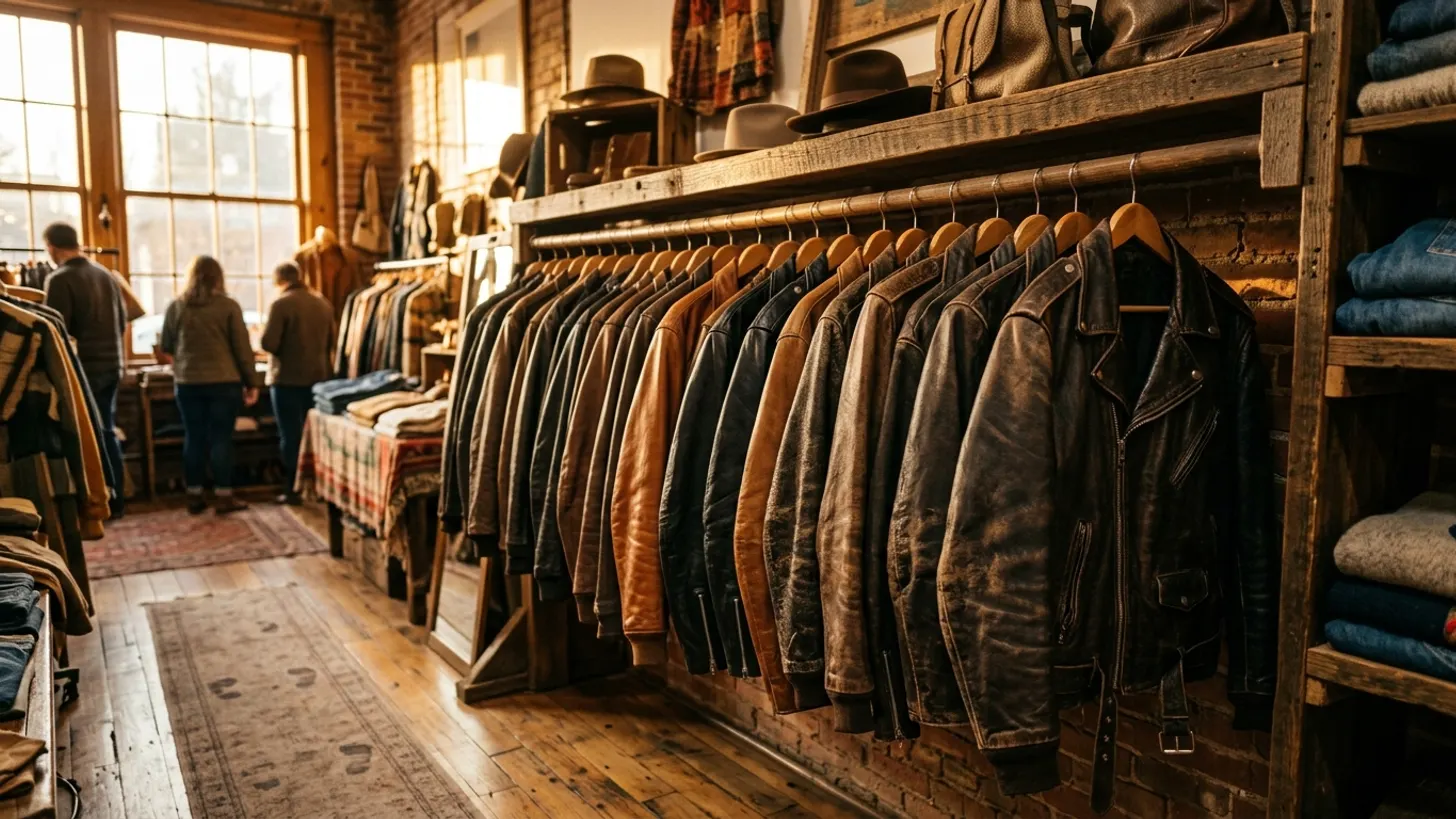
Last winter a buyer wrote in: how do I know this Schott isn't a 2010 reissue? Fair question. Vintage leather jacket authentication is a craft of reading small things: the way a Talon zipper sits in its tape, the weight of a union label, the chrome bleed under a snap. No laboratory work needed. Just hands, a loupe, and an hour with the garment. The patterns repeat once you know where to look.
Vintage leather jacket authentication starts with the label
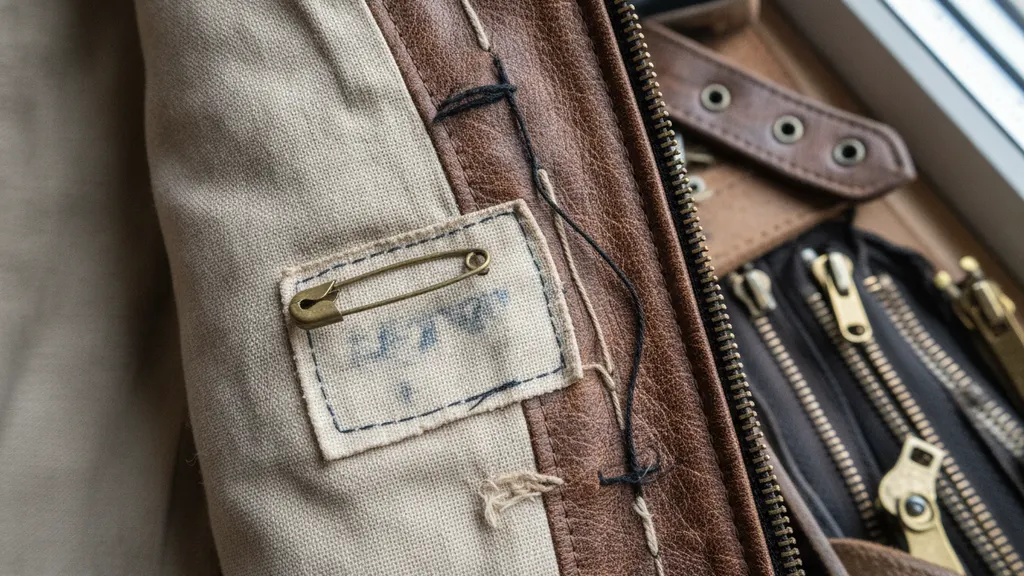
Open the jacket. Find the main brand label first, then the care label, then the union label. The brand label tells you who made it; the care label tells you when; the union label tells you where. Vintage leather jacket authentication that skips this three-tag inspection misses 80% of the easy tells.
Schott Bros labels changed at least four times between 1928 and 1989. The earliest is woven black on cream silk with a gothic font. By the mid-1950s the cream silk gives way to printed acetate. Bermans of London used a heat-pressed gold-on-black foil tag from 1968 to 1976, then switched to embroidered satin. The font weight thins noticeably after 1980. Sears Putnam (the Roebuck house label) printed in red ink on a white woven tag until 1972, when the brand was retired entirely. A reproduction will often use a generic gothic font that looks right at a glance but renders too clean. Vintage tags fade unevenly. The thread bleeds into the cream backing after fifty years in a closet.
The Vintage Fashion Guild fashion timeline photographs more than 8,000 garment labels with date ranges. If your jacket's tag is not in their archive, there is a reasonable chance the manufacturer never existed or the label was printed in a workshop in the last decade. Cross-reference, do not trust a single source. For deeper label-dating practice, see our guide to dating vintage by label fonts.
Reading the RN number: the federal trail
Every garment sold in the United States after 1959 must carry an RN (Registered Number) or WPL (Wool Products Labeling) identifier. The RN points to a specific manufacturer registered with the Federal Trade Commission. Pull up the number on the FTC's free RN lookup tool and you get the company name, address, and registration year.
WPL numbers ran from 1941 to 1959 before the FTC switched the scheme. So a jacket with a WPL number under 10000 is almost certainly pre-1950. A WPL between 10000 and 14000 falls between 1950 and 1959. From 1959 onward, RN numbers begin at 13670 and climb chronologically. RN 30000 means roughly 1965; RN 70000 means roughly 1991. The numbering is sequential, which makes it one of the cleanest dating tools in the field. Once the RN gives you a date range, vintage leather jacket authentication moves to the union label test for confirmation.
An absent RN on a jacket sold as 1972 is suspicious. Either the label was cut out (sometimes legitimately, for resale), the jacket predates the rule, or the seller never had one to begin with. Coverage in The New York Times fashion archive on mid-century American outerwear notes that legitimate 1960s-70s leather jackets almost always retain their RN tag in the interior side seam.
Union labels and the ILGWU decade map
The International Ladies' Garment Workers' Union and the Amalgamated Clothing Workers of America issued union labels with a specific colorway for each contract period. Knowing the sequence lets you date a jacket to within a five-year window without any other evidence.
The ILGWU red, white, and blue label sequence runs as follows. Pre-1955 labels show a red banner across the top with black serif text. 1955 to 1963 introduces the white-on-blue oval that most collectors recognize. 1964 to 1974 retains the oval but adds a small gold border. 1975 to 1985 simplifies the design to two-color red and white. The Amalgamated Clothing Workers used a different palette: green and white pre-1976, then green-red-white after the merger with the Textile Workers Union of America. Researchers at the FIT Museum published the definitive colorway-by-decade reference in 1995, and it remains the working standard.
A jacket sold as 1968 should carry the gold-bordered ILGWU oval, not the post-1975 simplified design. This is one of the cleanest catches in vintage leather jacket authentication because the labels were not widely reproduced until the late 2010s.
Vintage leather jacket authentication through hardware: zippers and snaps
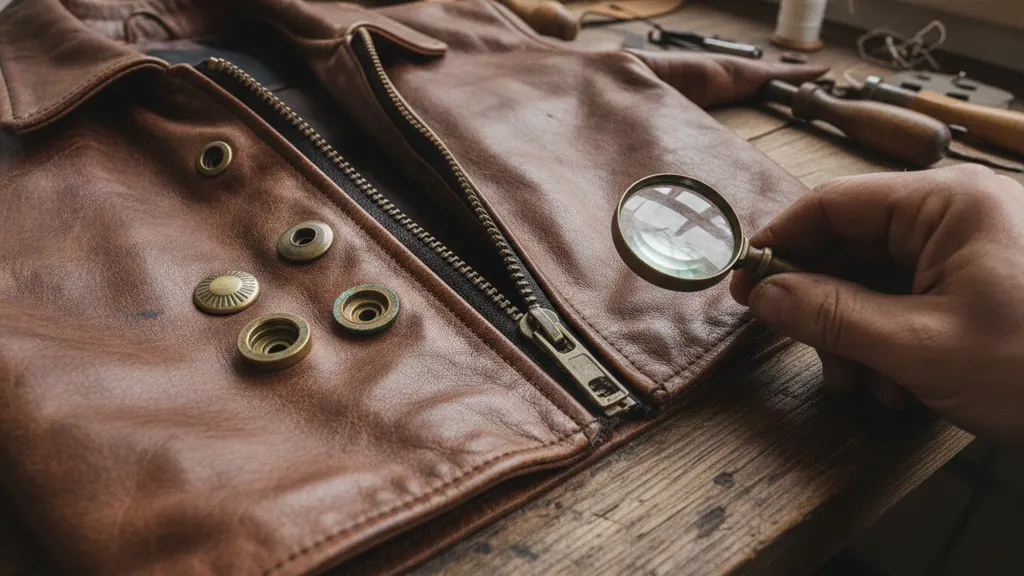
Hardware is the most forensic part of the inspection. Zippers, snaps, rivets, and grommets each carry a maker mark and a date range. Vintage leather jacket authentication through hardware alone can place a jacket within a five-year window when the labels are missing or cut.
Talon zippers ran the American market from 1893 through the 1970s. The classic Talon brass slider stamps the company name on the puller. Early Talons (pre-1948) used a hollow-back slider; the 1948 redesign introduced the solid-back slider that runs through 1965. After 1965 Talon shifts to lighter aluminum sliders for cost. Conmar (Connecticut Manufacturing) was the second-largest US supplier and stamped CONMAR on every slider from 1933 onward. Crown made the budget zippers found on Sears and Penney's house brands. For a fuller zipper-by-zipper map, see our vintage Talon zipper history.
YKK enters the US market in 1960 and overtakes Talon by 1969. Any jacket with a YKK zipper cannot be older than 1960. The YKK font on the slider changes in 1974 from serif to sans-serif. A 1965-dated jacket with a sans-serif YKK puller is a reproduction or a re-zip; either case is a flag.
Snaps are the second tell. Scovill Mfg dominated US snap production from 1850 through 1985 and stamped SCOVILL on the underside of every gripper. Universal Fastener used a smaller font and a five-pointed star mark. Klikit (made in Waterbury, CT) entered the leather market in 1968 and stamps a stylized K on the gripper face. A 1955 leather jacket with Klikit snaps is impossible. Hardware that is too bright is another giveaway: real chrome from the 1960s patinas to a warm grey with brown bleed along the leather contact edge, per cataloging notes from Christie's vintage fashion department. In vintage leather jacket authentication, hardware patina is treated as primary evidence; labels are secondary.
For a closer look at this, see How to date a vintage handbag: hardware, lining, and maker marks.
Stitching, lining, and construction tells
Once the hardware confirms the era, the inside has to match. Construction is where vintage leather jacket authentication closes the loop. Lining materials, thread type, seam allowance, and stitch density all shifted over the twentieth century, and reproductions almost always trip on at least one.
Linings tell the cleanest decade story. Quilted satin (often with diamond stitch pattern) appears in better-made jackets from 1968 onward. Plaid wool linings dominate the 1950s and early 1960s, especially in cossack and varsity styles. Pre-1955 jackets often used moleskin or heavy cotton drill. Polyester linings appear after 1972 on budget jackets and become standard in mass production by 1979. A 1955 jacket lined in polyester satin is a frankenjacket at best.
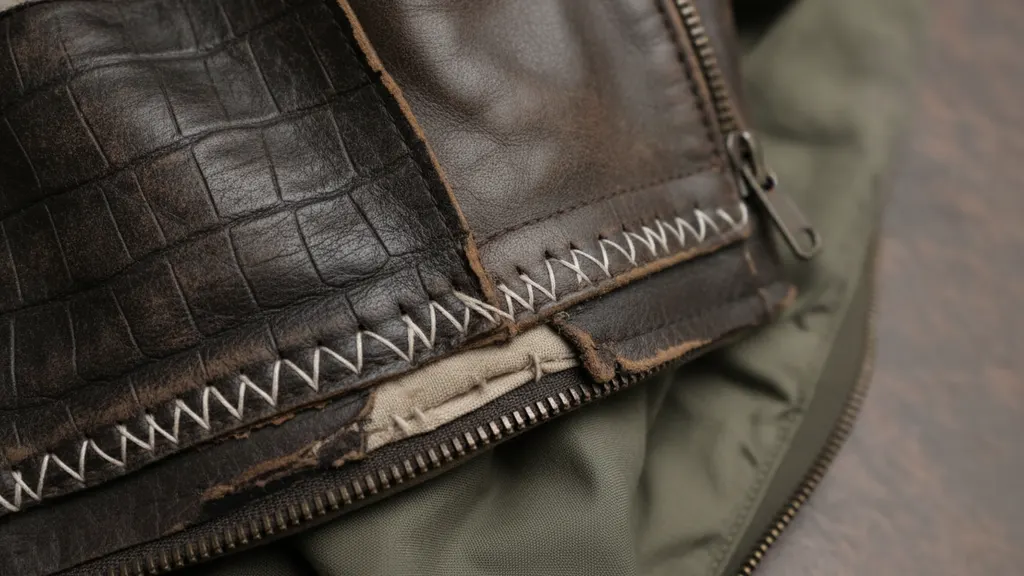
Thread is harder to read but worth checking. Pre-1965 stitching is almost always cotton, which has gone slightly tan with age and shows micro-fraying under a loupe. Polyester thread (smooth, bright white, no fraying) appears after 1965 and dominates by 1973. The needle holes are also different: industrial cotton needles of the 1950s left a 0.8mm puncture; modern needles leave 0.4mm. Look at the inside seam under magnification.
| Decade | Common lining | Thread type | Avg leather weight (men's 40) |
|---|---|---|---|
| 1950s | Plaid wool, moleskin | Cotton | 1.8 kg |
| 1960s | Quilted satin, plaid wool | Cotton | 1.6 kg |
| 1970s | Quilted satin, acetate | Cotton-poly blend | 1.4 kg |
| 1980s | Polyester satin | Polyester | 1.3 kg |
| 2020s repro | Polyester (often unlined) | Polyester | 0.8 kg |
Reference points: the V&A Museum fashion collection dates several thousand garments by lining and thread analysis alone, with most attributions falling within a five-year window.
Vintage leather jacket authentication red flags: reproductions and frankenjackets
Most fakes fall into three buckets. Modern reproductions are made from scratch with bad materials. Frankenjackets are real vintage shells with replaced linings, zippers, or labels. Relabels are modern jackets with a stolen or counterfeit period label sewn in. Vintage leather jacket authentication has to catch all three.
Modern reproductions tell on themselves through weight (under 1 kg in a men's 40), thread (polyester throughout), and zipper choice (almost always YKK with sans-serif puller, even on a 1965 jacket). The leather feel is wrong too: split hides have a flat plasticky drape; full-grain vintage hide drapes heavier and softer. A simple smell test catches the worst offenders: industrial new leather smells of chrome and ammonia, while vintage leather has a warm musk that fifty years in a closet produces.
Frankenjackets are harder. A real 1968 Schott shell may carry a 1995 replacement lining, a re-installed YKK zip, and original Scovill snaps. Read the inside carefully. If the lining is newer than the shell, the stitch line will not align with the original seam tunnel. Old needle holes will be visible above or beside the new stitching. Sellers should disclose re-lining, but many do not. Smithsonian Magazine's fashion-history coverage has documented the rise of frankenjacket sales since 2018, particularly on resale apps where listing volume rewards quick turnaround over disclosure. Our walkthrough on spotting frankenjacket relines goes deeper.
Relabels are the most fraudulent. A modern Pakistan-made motorcycle jacket with a counterfeit Schott label sewn behind the original tag is the standard scheme. The giveaways: counterfeit labels use modern thread (polyester, smooth, bright), the stitch holes do not match the original tag's pattern, and the label sits flat against the lining instead of sinking into worn seam allowance. Sourcing Journal reporting on counterfeit apparel tracks the major workshops; most counterfeit Schott labels currently circulating come from a single Karachi operation active since 2019.
Frequently asked questions
Common questions that come in from buyers and sellers most often. If your jacket isn't covered by these examples, send a photo to Erin's inbox and she will walk through the tells for that specific piece. Provenance disclosure is part of every listing on the Sol Siren site.
Can I do vintage leather jacket authentication from photos alone?
Partially. Photos can confirm the label era, the zipper brand, and rough lining material if the seller provides macro shots. Photos cannot confirm leather weight, thread type, or smell, all of which are forensic. Request a photo of the brand label, RN tag, union label, zipper slider, and one snap underside before any purchase over $300. If the seller refuses, walk. The Vintage Fashion Guild label database can confirm or rule out the brand tag from a single macro photo, which is enough to flag obvious counterfeits but not enough to catch a frankenjacket. For provenance disclosure standards, see Christie's vintage outerwear cataloging notes.
What is the difference between an RN number and a WPL number?
WPL (Wool Products Labeling) numbers were issued by the FTC from 1941 to 1959 under the Wool Products Labeling Act. They identify the manufacturer or importer of wool-containing garments. RN (Registered Number) replaced WPL in 1959 and covers all textile manufacturers regardless of fiber. WPL numbers under 10000 indicate 1941-1950 manufacture; 10000-14000 indicates 1950-1959. RN numbers begin at 13670 and climb chronologically through the present (RN 100000+ is post-2005). Use the free FTC RN lookup tool to confirm any number against the registered company name in the Federal Trade Commission's public database.
Are all vintage leather jackets made of real leather?
No. Vinyl and pleather jackets were widely sold in the 1970s and 1980s, especially through Sears, Penney's, and Montgomery Ward house brands. Pleather of that era yellows and cracks visibly by year fifteen, but mint-condition examples still appear in resale. A 1975 vinyl jacket is a legitimate vintage piece, just not a leather one. Check the inside grain (real leather shows uneven follicle pattern; vinyl shows a uniformly regular pebble) and the cut edge (leather shows fiber; vinyl shows a backing fabric). Listings should disclose, but many do not, particularly on cross-border resale platforms.
How do I tell if a vintage jacket has been re-lined?
Look at the original lining seam tunnel from the inside. A re-lined jacket will show old needle holes that do not align with the new stitching, usually 1 to 3mm above or beside the current seam. The new lining will also feel and look newer than the shell: brighter color, no bleeding into the leather along the seam allowance. Run a finger inside the sleeve cuff; original linings show wear at the cuff edge while replacement linings do not. Sotheby's cataloging notes classify re-lined jackets as partially original and discount accordingly. Re-lining is one of the most common findings in careful vintage leather jacket authentication, and honest disclosure protects buyer trust.