May 2026
Vintage clothing size conversion guide: old labels vs modern fit
A vintage clothing size conversion guide explaining why a 1965 size 14 fits like a modern size 6, with decade charts and measuring tips from Sol Siren Vintage.

Last month a customer asked why a 1968 wool coat labeled size 14 fit her like a modern size 6. She had bought three vintage coats from other shops and returned all of them, frustrated. This vintage clothing size conversion guide exists because the number stitched into a 1965 garment label and the number printed on a 2026 hangtag describe two different bodies. The Met Costume Institute has the receipts. So does anyone who has tried on a 1970s dress at a Brooklyn estate sale.
Why a vintage clothing size conversion guide refuses to trust the label
The number on a vintage label is a historical artifact, not a fit prediction. American women's sizing migrated through three distinct regimes between 1958 and now. The 1958 US Commercial Standard CS 215-58, drafted by the National Bureau of Standards, fixed body measurements for misses sizes 8 through 18, based on a 1939 anthropometric study of about 15,000 women. That standard went voluntary in 1971 and was withdrawn entirely in 1983.
After 1983, every American brand wrote its own size chart. Reporting from Smithsonian Magazine traces what happened next: brands began labeling larger bodies with smaller numbers to flatter shoppers, a practice the press eventually called vanity sizing. Department stores led the drift. Designer ready-to-wear followed within a decade.
The result for vintage buyers today is brutally simple. A 1965 wool coat marked size 14 fits closer to a modern size 6. A 1972 leather jacket marked size 10 fits closer to a modern size 2. This is not a curiosity for collectors. It is the central problem any vintage clothing size conversion guide has to solve before it can help a buyer click purchase on a coat she cannot try on.
What the 1958 standard actually said
CS 215-58 published bust, waist, and hip measurements in two-inch increments across misses sizes. Size 12: 34-inch bust, 25.5-inch waist, 36-inch hip. Size 16: 38-inch bust, 29-inch waist, 40-inch hip. These were body measurements, not garment measurements.
Vintage manufacturers added between 2 and 4 inches of ease at the bust depending on garment type, per documentation hosted by the Vintage Fashion Guild. The 1971 successor, PS 42-70, kept the same numbering but the industry quietly began to ignore it. By the late 1970s, many brands had already shifted their size 12 down by one or two true inches. The V&A Museum traces this shift in its collection of US ready-to-wear samples from 1965 to 1985.
By the 1990s, ASTM had stepped in with its D5585 voluntary standard, which itself has been revised upward more than once. The current ASTM D5585-11 puts a size 12 at roughly a 39-inch bust and 31.5-inch waist. That is a five-inch jump from the 1958 baseline at the same label number, as covered in New York Times reporting on women's sizing history.
Decade by decade: the vintage clothing size conversion guide chart
The vintage clothing size conversion guide below uses size 12 as the reference point because it appears most often on labels from the 1950s through 1980s. To find your equivalent vintage size, take the modern size you wear now and add roughly four sizes for anything pre-1980, three sizes for 1980s pieces, and two sizes for early 1990s.
| Era | Size 12 bust | Size 12 waist | Modern label equivalent |
|---|---|---|---|
| 1958 CS 215-58 | 34 inches | 25.5 inches | Modern 4 to 6 |
| 1970 PS 42-70 | 34 inches | 25.5 inches | Modern 4 to 6 |
| 1990s ASTM | 37 inches | 29 inches | Modern 8 to 10 |
| 2011 ASTM D5585-11 | 39 inches | 31.5 inches | Modern 12 |
The pattern from the Met Costume Institute sample tags shows the same drift inside designer ready-to-wear: a 1972 Halston dress marked size 10 measures the body of a current size 2 to 4. The 1970s house labels at Business of Fashion archive references confirm this drift across Bill Blass, Anne Klein, and Bonnie Cashin.
How to measure your body for a vintage clothing size conversion guide that works
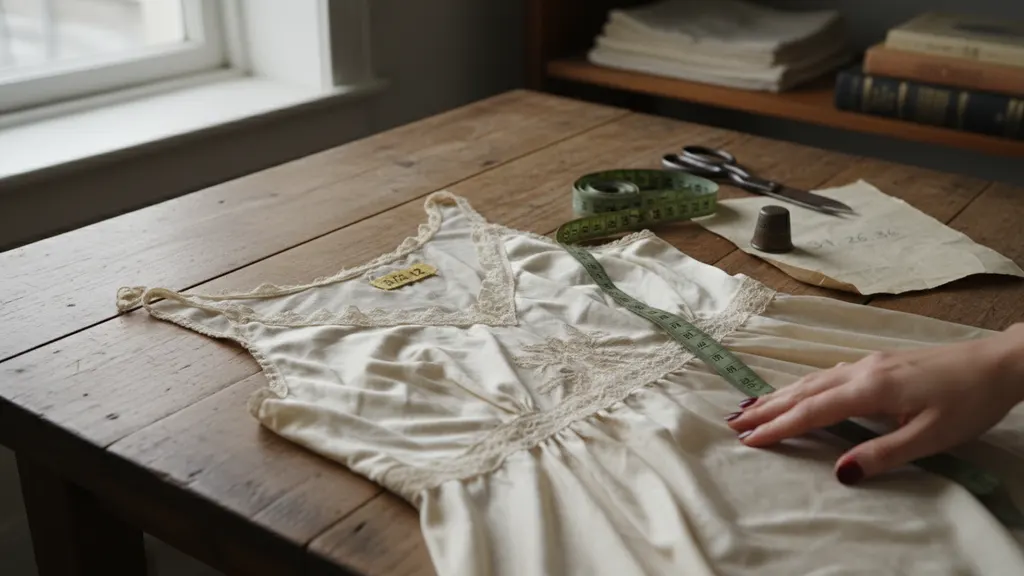
An accurate vintage clothing size conversion guide always starts with your real measurements, taken today, in your underwear, with a soft tape. Stand normally. Do not suck in. Do not adjust posture for the camera. The numbers you write down are the numbers that decide whether a 1965 coat will close or not.
Measure five points. Bust at the fullest part. Underbust at the band. Waist at the natural waist, above the hip bone where you bend sideways. High hip three inches below the waist. Full hip at the widest part. For coats and jackets, also measure across the back from shoulder seam to shoulder seam, and from shoulder to wrist for sleeve length. Write each one on paper. Keep that paper in a note on your phone for future vintage shopping. The FIT Museum publishes guidance for vintage buyers that emphasizes garment flat measurements over labels.
Once you have your numbers, ignore the size label entirely. Compare the seller's flat measurements against your body, then add or subtract for ease based on what the garment is. My full measuring walkthrough covers each point with photos.
For a closer look at this, see How to remove musty smell vintage clothing: safe methods that work.
Outerwear, furs, and shearling: what changes
Coats break the standard size chart. A vintage clothing size conversion guide for outerwear has different rules because mid-century coats were cut for layering. A 1965 wool overcoat marked size 12 might fit over a tailored size 8 jacket and dress, meaning the coat itself measures closer to a modern size 10 through the chest, despite the size 12 label representing a much smaller body underneath.
Shearling and fur compound the problem. The shell of a 1970s shearling sits about 1.5 inches further out from the body than a wool coat at the same nominal bust measurement, per fit research published by The Cut in its vintage outerwear shopping guides. Penny Lane coats in particular were cut for a slim teen silhouette through the waist, with a fuller swing through the hem.
When a Sol Siren listing reads "bust 40, waist 38, hem 56," that's the garment flat. If your bust measures 36 inches, you have four inches of ease at the bust, which is right for an overcoat. Two inches would be tight. Six would be sloppy. Read the flat numbers, not the label. A working vintage clothing size conversion guide depends entirely on those flat numbers, which is why every coat in the Sol Siren collection ships with six measured points.

Frequently asked questions
How accurate is any vintage clothing size conversion guide?
Roughly accurate, never exact. The 1958 standard set body measurements at specific numbers, but individual manufacturers added their own ease and made grading decisions that varied house to house. Business of Fashion archives document that Bonwit Teller, Saks, and department-store labels could differ by a full size for the same year and number. The vintage clothing size conversion guide above gives you a starting point. The final decision still depends on the seller's flat measurements compared against your own. Always ask for bust, waist, hip, and shoulder seam to shoulder seam if the listing does not show them.
Should I size up or down when buying vintage?
Neither, exactly. Stop thinking in size labels and start thinking in inches. If your bust measures 36 inches, a vintage coat with a flat bust of 40 inches gives four inches of ease, which is right for outerwear. A vintage dress at 38 inches gives two inches of ease, which is right for a fitted shift. The Harper's Bazaar style desk recommends knowing your exact measurements and treating the label as a curiosity. Sol Siren lists every flat measurement on every garment because the label number alone is unreliable, especially in heavy outerwear from the 1970s.
Do vintage menswear sizes have the same problem?
Less, but yes. Men's vintage suiting has held more consistent because it was sold by chest measurement and inseam, not arbitrary numbers. A 1970s 42R chest is genuinely close to a modern 42R chest. The drift shows up in vintage sportswear and casual outerwear, where small, medium, and large labels followed similar vanity-sizing pressures. Men's 1970s small shirts often measure a 38-inch chest and 27-inch sleeve, where modern small often measures 41-inch chest with longer sleeves. The vintage clothing size conversion guide for menswear holds best in tailored pieces and breaks down in shirts and sweaters.
How do I measure a vintage coat I cannot try on?
Ask the seller for six flat measurements: bust across the chest at the underarm seam, waist at the narrowest point, hip at the hem if fitted, shoulder seam to shoulder seam across the back, shoulder seam to sleeve cuff, and back length from collar seam to hem. Then lay your favorite well-fitting coat on the floor and take the same six measurements. Compare. If your reference coat measures 42 inches at the bust and the vintage piece measures 41, expect a slightly closer fit. Two-inch swings in either direction usually work. Four-inch swings almost never do, per fit notes from long-time vintage dealers quoted in the New York Times.