November 2026
Vintage men's suits guide: how to read labels, weave, and cut
Learn how to date vintage men's suits by reading maker labels, wool weaves, canvas, and cut, plus the flat measurements and condition flaws worth paying for.
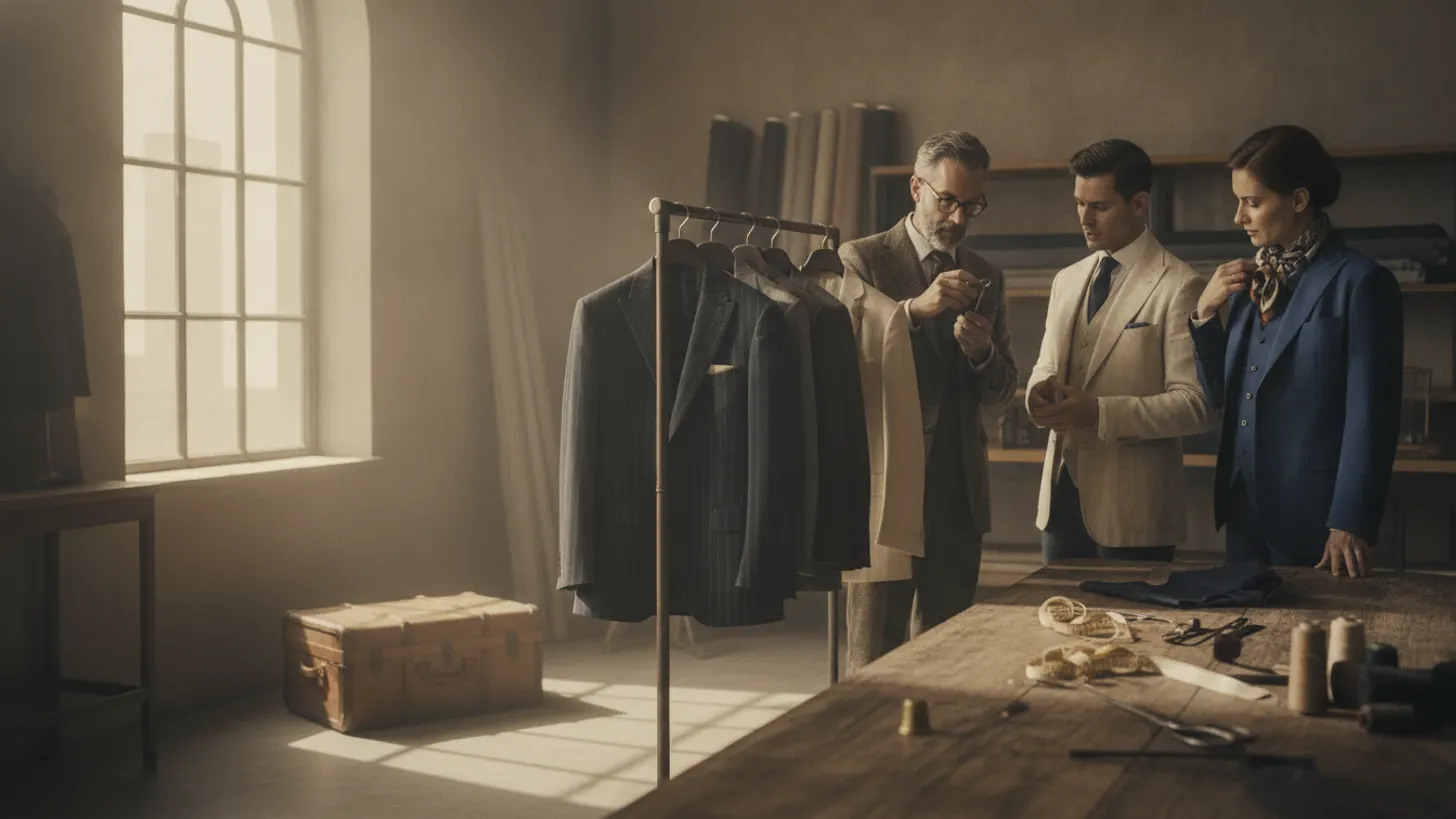
In a church basement sale outside Macon, Georgia, in April 2026, a charcoal three-piece hung between two polyester blazers with no maker label at all, trousers still deeply cuffed. The cuffs dated it before anything else did. That is how vintage men's suits usually give themselves up: not through a signature, but through construction. Lapel roll, armhole height, trouser rise, and the weight of the cloth say more than a seller's story ever will.
How to date vintage men's suits from jacket and trouser details
Start at the shoulder, then look at the trouser rise. A soft, unpadded shoulder with a high armhole and a fuller chest reads early twentieth century. A wide, squared shoulder with a low button stance reads 1940s or 1980s. Both answers arrive before you find a label, and with vintage men's suits the label is often the least reliable evidence anyway.
The shape has a short history. The Victoria and Albert Museum menswear collections identify the lounge suit as a major development in modern men's dress, the loose matched three-piece that pushed frock coats out of daily wear. Early twentieth-century tailoring kept a natural shoulder line and a generous cut, a pattern the Metropolitan Museum of Art Costume Institute documents across its menswear holdings. By the 1930s that fullness became the drape cut: cloth gathered at the chest and blade, a high trouser rise, a long soft lapel.
Vintage men's suits: decade tells in the jacket
After that, the decades separate cleanly. Wartime American restrictions trimmed cuffs, patch pockets, and matching vests out of production, which is why a true early 1940s jacket often looks plainer than the decade's reputation suggests, as Smithsonian Magazine reporting on wartime clothing rationing describes. The 1950s Ivy sack arrived undarted and straight through the body, with a three-roll-two front and a short center vent. The 1960s shortened the jacket, raised the button stance, and narrowed everything, the silhouette in our 1960s mod fashion guide. The 1970s widened lapels until they crowded the shoulder seam and brought in patterned linings. The 1980s squared the shoulder and dropped the stance again. Vents moved too: the sack's short center vent gave way to the 1970s double vent on both sides, a tell that is almost as fast as the shoulder line itself.
Trousers rarely lie
Trousers hold the clearest evidence in vintage men's suits. A rise that sits at the natural waist, side adjuster tabs, a button fly, and no belt loops point to mid-century or earlier. Belt loops with a low rise and a metal zipper move you forward. Zipper pulls stamped Talon, Conmar, or Scovill indicate American manufacture before nylon zippers took over, and the Vintage Fashion Guild label resource catalogs that hardware alongside maker tags.
How wool weaves, linings, and canvas shape vintage men's suits
Cloth decides whether a suit survives. Worsted holds a crease and eventually shines; woolen flannel and tweed trade crispness for warmth and loft. The lining and the interlining decide whether a jacket keeps its shape after fifty years, and both can be judged by hand in about a minute.
Wool announces itself. The Museum at FIT explains that wool fibers have a natural crimp, the waviness that gives the fiber loft and a dry, springy handle, which is what separates it from many smooth synthetics. Crush a corner of the jacket skirt in your fist and release it. Wool relaxes into soft creases that fall out; acetate and early polyester hold a hard wrinkle or feel slick and cool. Good On You's material guide to wool covers the same properties from a durability angle.
The weaves you meet most often in vintage men's suits sort into four families.
Linings date a jacket as reliably as tags. Bemberg and viscose rayon feel cool and dry and shred at the underarm and seat first. Acetate carries a faint plastic sheen. Novelty prints and heavy satin read late 1960s and 1970s. Earlier jackets often carry a plain cream or grey rayon body lining with a quilted sleeve head, while a half lining that stops at the waist usually signals a lighter-weight summer suit built for warm-weather wear rather than a cheaper one assembled to save cloth. A shredded lining is a repair, not a defect, since a tailor can replace body lining without touching the shell. Keeping the shell clean matters more, and the sequence in our guide to cleaning a vintage wool coat applies to tailored jackets too.
Canvas is the last check. Pinch the front between the buttonhole and the lapel edge and roll the layers between your fingers. Three layers that move independently mean a floating canvas interlining, stitched rather than glued. One stiff board that moves as a single piece means fusing, and fused fronts bubble after years of dry cleaning. Full canvas is the reason a 1950s lapel still rolls instead of lying flat.
What maker labels and union tags reveal about vintage men's suits
Labels answer two questions: who made it, and roughly when. Maker and retailer tags give the house. Union tags, fiber content panels, and registered identification numbers give the window. Read them together, because any single tag can have been swapped during an alteration.
Union labels are the fastest bracket available on American tailoring. The Amalgamated Clothing Workers of America tag runs until the 1976 merger that produced the Amalgamated Clothing and Textile Workers Union, which became UNITE in 1995. A tag naming the earlier union puts vintage men's suits on one side of that line; a later tag puts them on the other.
Maker labels carry their own chronology. Hart Schaffner & Marx, Brooks Brothers, and regional department store houses changed logo type, label shape, and fiber wording across the decades. A woven label sewn through all four edges generally predates a printed or adhesive-backed tag, since the switch to cheaper printed labels became common across the menswear trade through the 1960s and 1970s. Department store private labels add another layer: a store brand sewn alongside a maker's union tag usually means the department store commissioned the suit from a contract manufacturer rather than making it in house. Custom work is better still: bespoke and made-to-measure jackets often carry a tailor's label inside the breast pocket with a customer name and an order date in ink, which is as close to a birth certificate as vintage men's suits ever get.
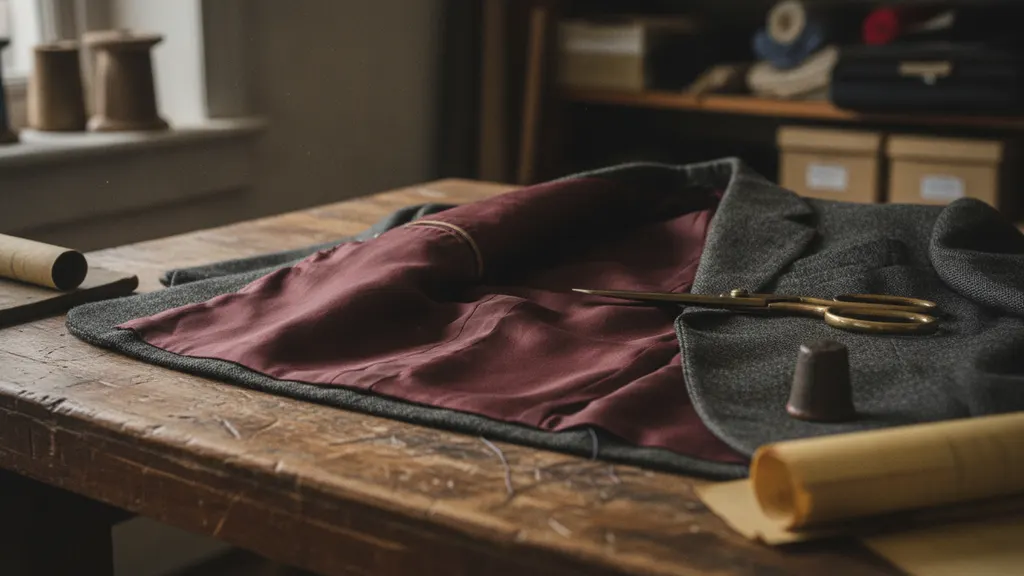
Fiber content and care labels narrow the window further. A sewn-in content tag with a printed care panel suggests the 1970s or later. WPL numbers were issued to American makers before RN numbers replaced them at the end of the 1950s, so a WPL tag sits earlier. The same reading order works on outerwear; see our notes on authenticating a vintage trench coat.
There is a full breakdown of this topic in How to buy vintage cashmere: fiber tests, labels, and condition.
We cover the details separately in How to identify vintage 1920s dresses: beading, bias, and labels.
We cover the details separately in Vintage French workwear guide: moleskin, chore coats, and labels.
Related reading: Vintage 1960s mod dresses: a guide to shift shapes and labels.
How measurements and past tailoring change vintage men's suits
Vintage sizing printed on a tag is a starting point and nothing more. Most suits that stayed in use were altered at least once, so the number may describe a garment that no longer exists. Measure the thing flat, then compare it against a jacket that already fits you.
Take chest pit to pit, shoulder seam to shoulder seam across the back, sleeve from shoulder seam to cuff, and back length from the bottom of the collar. For trousers: waist flat, rise, inseam, hem opening. Lay the reference jacket you already own flat on top of the vintage piece, shoulder seam matched to shoulder seam, so any gap at the chest or sleeve shows itself in seconds rather than after a tape measure argument with yourself. Then look for past work. Pressed-out creases above a cuff, stitch holes along a let-out side seam, and uneven sleeve button spacing all say the garment has moved once already. The flat-measurement habit that makes shopping vintage online workable matters twice as much with vintage men's suits.
Alteration room is not evenly distributed. This is the order I check, hardest case first.
| Measurement | How to take it | Alteration room |
|---|---|---|
| Jacket shoulder | Seam to seam across the back | None worth paying for; a shoulder reset is major surgery |
| Jacket chest | Pit to pit, buttoned and flat | Limited, and only if the side and back seams hold inlay |
| Jacket length | Collar seam to hem | Possible, but it changes the proportion of the whole jacket |
| Jacket sleeve | Shoulder seam to cuff edge | Good, unless the cuff has working buttonholes |
| Trouser waist | Flat across the top, then doubled | Usually some, from the center back seam |
| Trouser inseam | Crotch seam to hem | Good if the original cuff depth is still intact |
Priced right, vintage men's suits with a clean shoulder line and a long sleeve inlay are the best buys on any rack, because the two hardest fixes are already correct.
Collectible vintage men's suits: which condition problems are acceptable
Separate the reversible from the permanent in vintage men's suits. Shredded lining, missing buttons, a loose pocket, and a dropped hem are ordinary repairs. Moth grazing in the face cloth, underarm wear, sun fade along one shoulder, and old perspiration damage are not, because they live in the shell itself.
Moth damage is the one to learn by sight. Grazing thins the nap in a soft halo without going through. Clean small holes with a slightly fuzzy edge are feeding damage, and a scatter of them across a lapel means the cloth was stored with the eggs in it. Case-making moths leave frass, a fine sandy residue, in pocket corners and along the inside of the waistband, and that residue is often the first sign a buyer notices before the holes themselves. A black light run quickly over the shell in a dark room can also flag old urine or perspiration staining that daylight hides, which matters because stained fibers are the ones larvae return to first. Reweaving closes one or two holes in a dense patterned worsted almost invisibly, but the cost per hole makes it rational only on something rare.
Condition language from the auction world is worth borrowing. Fashion sales at Christie's and Sotheby's publish condition reports that name wear by location and type instead of grading a garment with one adjective, which is how a listing for vintage men's suits should read. Ask for photographs of the underarms, the seat, the inside of the collar, and the trouser hem before anything else.
Odor is its own category. Smoke and mildew in a wool shell usually air out and respond to cleaning, while mildew that has already stained is permanent. Storage prevents most of it, and our guide to storing vintage outerwear covers the cedar and breathable cover routine.
Frequently asked questions
Buyers ask the same handful of questions about vintage men's suits once they start shopping seriously, so here are direct answers to the ones that come up most often.
How can I tell if an old suit is wool or polyester without a label?
Use your hands before your eyes. Wool fibers carry a natural crimp, the waviness behind their dry, springy handle, and the Vintage Fashion Guild fabric resource describes the same handling tests fiber by fiber. Crush a corner of the hem in your fist for five seconds and let go: wool relaxes into soft creases that drop out, while polyester and acetate either snap back flat or keep a hard wrinkle. Wool feels dry and faintly warm against the inside of your wrist. Synthetics feel cool and slick. Held to the light, a cut edge of wool shows a hairy halo.
Do union labels really help date an American suit?
They do, faster than anything else sewn in. A tag reading Amalgamated Clothing Workers of America cannot postdate the 1976 merger that created the Amalgamated Clothing and Textile Workers Union, and ACTWU gives way to UNITE in 1995, a chronology kept in the Vintage Fashion Guild label resource. That brackets a decade or two in seconds. Two cautions: union tags were sometimes cut out during alterations, and they only appear on union-made American goods, so an absent tag proves nothing about European or custom tailoring.
Is a fused jacket always worse than a canvassed one?
Not always, though usually for collecting. A floating canvas interlining is stitched to the jacket front so the layers can move, which is why a mid-century lapel rolls instead of lying flat; the tailoring held in collections like the Victoria and Albert Museum menswear archive is built that way. Fused fronts glue the interlining to the shell, and heat, age, and dry cleaning can separate that glue into bubbles along the lapel and chest. A clean, well-cut fused jacket still wears well. A bubbled one is finished, because the shell cannot be unglued.
How much can a vintage suit actually be let out?
Less than people hope in the jacket, more than they expect in the trousers. Side seams and the center back seam move only if the original tailor left inlay, and the shoulder is effectively fixed; New York Times reporting on tailors and alterations covers the same limits. Sleeves shorten easily unless the cuffs have working buttonholes. Trousers are friendlier: the center back seam usually gives at the waist, legs taper cleanly, and an original deep cuff can be let down. Buy for shoulder and chest, then correct everything below the waist.
Are moth holes a dealbreaker when buying a vintage suit?
It depends where they sit. A scatter of small holes across a lapel face or one shoulder is damage in the most visible place, and I price those as study pieces rather than wearables. Holes hidden under a collar, inside a vent, or on the back of a trouser leg can be rewoven, and dense patterned worsted hides the repair well. The live question is whether larvae are still present, so isolate and freeze anything suspect before it meets your closet. Good On You's wool fiber guide explains why the fiber attracts them: it is protein.
What is the difference between a sack suit and a drape cut?
The sack is American and undarted: straight sides, soft shoulder, a three-button front rolling to the middle button, little waist suppression. The drape cut is English and shaped, with extra cloth through the chest and shoulder blade falling in soft vertical folds over a nipped waist. Both sit on the natural shoulder line the Metropolitan Museum of Art Costume Institute documents in early twentieth-century menswear, so the shoulder will not separate them on its own. Look at the side seam: straight from armhole to hem is sack, curved in at the waist is drape.