November 2026
Vintage 1960s mod dresses: a guide to shift shapes and labels
A guide to vintage 1960s mod dresses: shift and A-line shapes, union labels, metal zippers, and the fabric clues that date a dress to the mod decade with care.
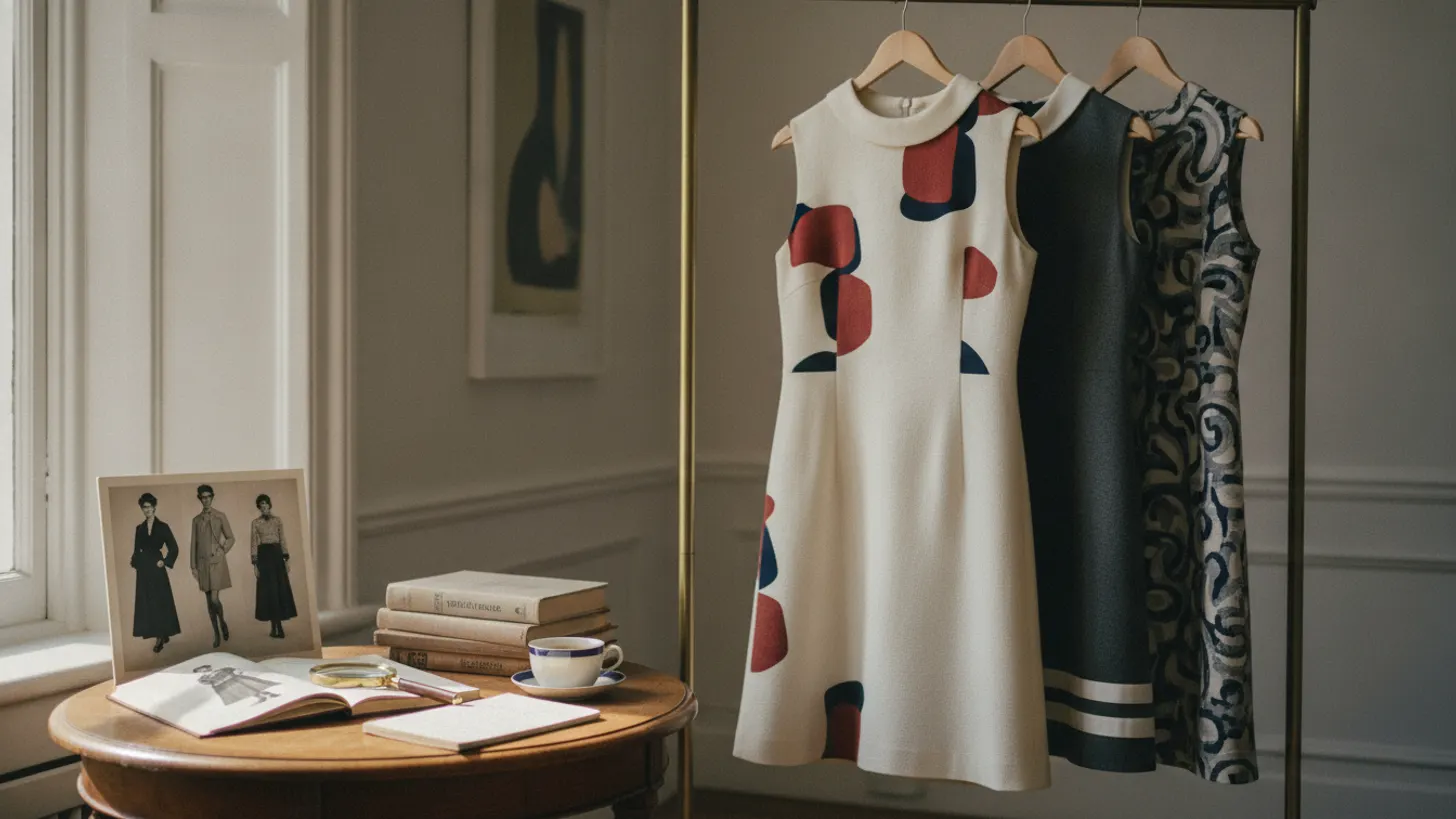
A navy wool shift came in from an estate lot outside Hartford last spring: label hand-stitched, zipper metal, hem turned by hand. It took four minutes to place it in 1964. That is the quiet pleasure of vintage 1960s mod dresses, because the garment tells you when it was made if you know where to look. Shape first, then label, then hardware, then fabric.
What actually makes vintage 1960s mod dresses mod?
Mod is a set of design decisions, not a decade stamp. The dress hangs from the shoulder instead of the waist, the hem sits at or above the knee, and the surface carries flat geometry: blocks, bands, circles, op-art stripes. The V&A fashion collection records place the shift dress and the geometric print at the middle of the sixties look.
Plenty of early-sixties dresses are not mod at all. A 1961 cotton day dress with a nipped waist, a full skirt, and a shelf bust is a 1950s silhouette living in a new decade. Genuine vintage 1960s mod dresses take the waist out of the equation and let the body underneath be implied rather than described.
The youth-led change in hemline and attitude is tied to Mary Quant in materials from The Museum at FIT, whose exhibition and research program tracks how London boutiques pulled fashion off the couture calendar. Paris answered in its own register: Andre Courreges showed his Space Age collection in 1964, and Vogue archive coverage of 1960s designers records how quickly white, flat-fronted, knee-skimming shapes moved from runway to high street.
A three-part test for vintage 1960s mod dresses
Ask where the dress is held up, where it ends, and whether the print behaves like a diagram rather than a bouquet. Shoulder, knee, geometry. If all three read modern for 1965, the shape is right, and the label and hardware work that follows becomes confirmation rather than guesswork.
Which silhouettes define vintage 1960s mod dresses?
Five shapes carry the decade: the shift, the A-line, the trapeze or tent, the mini, and the empire-seamed baby-doll. All of them drop the waist as a structural line and differ mainly in how much air sits between fabric and hip. The hang on a hanger tells you most of it before a tape measure comes out.
| Silhouette | How it hangs | Commonly seen | Construction tell |
|---|---|---|---|
| Shift | Straight from shoulder to hem, no waist seam | 1960 to 1969 | Bust and shoulder darts, short side zip early in the decade |
| A-line | Narrow shoulder widening steadily to the hem | 1963 to 1970 | Panel or princess seams, long center-back zip |
| Trapeze or tent | Sharp flare from a high yoke | 1964 to 1968 | Yoke seam, often unlined, keyhole or button back |
| Mini | Any of the above, hem well above the knee | 1965 to 1970 | Shallow hem turn, sometimes faced instead of turned |
| Empire baby-doll | Seam under the bust, soft fall below | 1966 to 1970 | Lined bodice, zip ending at the empire seam |
The trapeze has the oldest paperwork of the group: Yves Saint Laurent showed his Trapeze line for Dior in 1958, and the shape was absorbed into mainstream vintage 1960s mod dresses once boutiques cut it shorter. The baby-doll arrives late and reads softer, which is why a 1968 empire dress in a small floral is so often mistaken for 1970s.
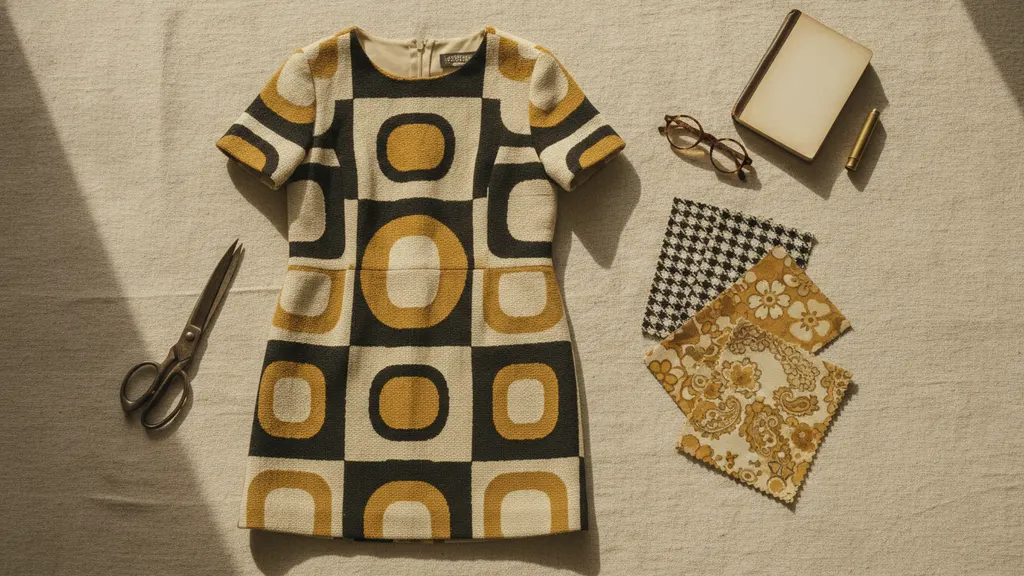
Dating also depends on what paperwork existed at the time. The chart below counts the labelling and hardware anchors available to you across the period, from fiber content tags at the start of the decade to the care instructions rule of the early 1970s.
How labels, zippers, and seams date vintage 1960s mod dresses
Hardware and paperwork are harder to fake than shape. A metal zipper, a maker tag in period typeface, a deep hand-finished hem, and no care instructions put a dress before the 1970s. The Vintage Fashion Guild label resource archive matches a tag to a date window by wording and union markings.
Work the closures first. Brass and aluminium zippers with stamped pulls read early to mid decade, while nylon coil tape spreads through the late 1960s and takes over in the 1970s. A short side zip under the arm belongs to a fitted bodice, so it points earlier than a long center-back zip. I once listed a navy shift as 1968 because the zipper was nylon coil, only to find a 1962 union label folded under the waistband facing when a buyer asked for extra photos; someone had replaced the original metal zip decades earlier, and the tag was the evidence I should have checked first. Replaced zippers are common and not disqualifying, but they move the evidence from hardware to seam allowance, and I no longer let a zipper carry a date on its own.
Then read the insides, since construction details are harder to fake than a label. Mid-market sixties dresses show pinked or raw edges rather than overlock serging, often with a single-ply facing at neck and armhole, and the facing is usually understitched by machine even when the hem itself is finished by hand. Hems are turned deep, two inches is common on a wool shift, which is also why so many vintage 1960s mod dresses can be let down an inch or two for a taller buyer. Rayon and acetate linings were cut separately and tacked at the shoulder and side seam, never fused the way a cheap modern lining is, and a fused lining in a dress sold as sixties is the fastest tell of a later remake or a reproduction.
Labelling sequence is the last tiebreaker. United States garments carried fiber content from the opening of the decade, while care instructions became standard only in the early 1970s. Content with no care tag is a strong sixties signal, and both together usually means 1972 or later.
The grid below sets the main construction tells against three windows, so you can see which ones actually separate an early dress from a late one.
Filled markers show the feature is usual for that window, open markers show it would be unexpected.
Which fabrics and prints turn up in sixties dresses?
Expect wool crepe, bonded jersey, acetate, rayon, cotton pique, and early polyester double knit. Prints run flat and graphic rather than painterly: checkerboards, concentric circles, hard stripes, and florals abstracted into shapes. Fiber identification does more dating work than print identification, because weaves changed on a schedule.
The reference point for color blocking sits in a museum. The Met collection includes Yves Saint Laurent's 1965 Mondrian dress, a wool jersey shift with the color fields set into the seams so the grid does not break over the body. That construction detail is the tell on strong period copies: the blocks are pieced, not printed.
Hand tests get you most of the way on fiber. Acetate feels cool and dry and creases sharply, rayon drapes heavier and wrinkles soft, early polyester springs back with a slight bounce. The Vintage Fashion Guild fabric resource describes each one in period terms, and our guide to identifying vintage fabrics covers the checks that risk no damage.
Print and hemline moved together as a cultural story, not only a commercial one, and Smithsonian Magazine reporting on the miniskirt traces how fast a shorter hem became ordinary. The practical upshot for buyers of vintage 1960s mod dresses: a bold flat print cut to the knee is usually earlier than the same print cut four inches shorter.
How to judge fit, condition, and what a dress can still do
Buy vintage 1960s mod dresses on five flat measurements and two condition checks: bust, waist, hip, shoulder to shoulder, and back neck to hem, then an inspection of the underarms and every stress seam. Sixties armholes sit high and the back waist is short, so shoulder width predicts comfort better than bust does.
Condition problems cluster in predictable places, and checking them takes under a minute once you know where to look. Acetate grows brittle with age and splits along pressed folds and stress points, a flaw that sets in slowly and cannot be repaired invisibly once it starts. Underarm areas carry old antiperspirant damage that reads as a stiff yellow patch against the lining and tears the moment the fabric is stretched, so press a thumb into the underarm seam before buying. Wool crepe hides moth grazing until the panel is held up to a window, where small round holes show as pinpricks of light. Bonded jersey delaminates into soft bubbles across the shoulders and upper back as the adhesive layer ages and separates from the knit, and once bubbling starts there is no fix short of replacing the panel.
Shop in a way that makes returns unnecessary. Ask for measurements taken flat on a table rather than on a mannequin, ask where seams have been let out, and read the condition note twice. Our notes on shopping vintage online and on cleaning vintage clothing cover what to ask and what should never meet water.
Value follows documentation. Signed designer pieces trade on recorded history, which is why Christie's fashion and accessories sale results make a useful reality check before paying a premium for a tag. For everyday wearing, a well-kept unlabelled shift is both cheaper and, as Good On You secondhand shopping guidance argues, the lower-impact choice.
Frequently asked questions
How can I tell if a dress is really from the 1960s?
Read the garment in four passes: shape, label, hardware, finish. A dress that hangs from the shoulder with no waist seam, ends at or above the knee, closes with a metal zipper, and carries a fiber content tag but no care instructions is almost certainly earlier than 1972. Then match the maker tag against the Vintage Fashion Guild label resource archive, which dates tags by typeface, wording, and union markings. Reproductions usually give themselves away at the hem, where you find machine-serged edges and a shallow turn instead of a deep hand-finished one.
What is the difference between a shift dress and an A-line dress?
A shift falls straight from shoulder to hem, with the body shaped by darts rather than a waist seam, so the side seam reads nearly vertical. An A-line keeps the same high shoulder but widens steadily toward the hem, usually through panel or princess seams. The V&A fashion collection records treat the shift as the defining sixties shape and the geometric print as its companion. In wearing terms, the shift suits a straighter frame, while the A-line gives hip room without adding bulk at the waist. Both were cut short through the second half of the decade.
Do vintage 1960s mod dresses fit modern sizes?
No. A sixties label number sits well below the same number today, and the ease is cut differently: narrow shoulders, higher armholes, a shorter back waist. Ignore the tag and work from flat measurements, taking bust, waist, hip, shoulder to shoulder, and back length, then compare them against a garment you already wear. The Smithsonian's National Museum of American History costume collection explains how period sizing was drafted, and our vintage clothing size guide shows how much ease each silhouette needs. Shifts forgive waist differences and punish narrow armholes; empire styles forgive hips and punish a full bust.
Why does my vintage dress have a metal zipper in the side seam?
Side zippers were standard on fitted and semi-fitted dresses into the early 1960s, because a short metal zip under the arm let a dressmaker close a bodice without breaking the back of the garment. As shapes loosened and shoulders squared, the closure moved to a long center-back zip, and by the late sixties nylon coil tape had largely replaced metal. A side metal zip therefore reads early in the decade. The Vintage Fashion Guild label archive is the fastest cross-check once you have the maker tag in hand.
Which fabrics should make me cautious when buying a 1960s dress?
Acetate pieces and acetate linings are the ones to inspect hardest, because the fiber grows brittle with age and splits along stress lines, and no cleaning reverses it. Bonded jerseys can delaminate into soft bubbles across the shoulders. Early polyester double knit is tough but holds odor. Wool crepe is usually the best survivor if moth grazing is absent. The Vintage Fashion Guild fabric resource describes how each fiber ages in period garments, and a careful look at the seam allowance in daylight tells you most of the rest.
Is a designer label from the 1960s worth paying more for?
Sometimes. Courreges, Rudi Gernreich, Pucci, Quant's Ginger Group, and Paris house pieces hold value because the design history is documented, and Christie's fashion and accessories sale results show how specific names behave over time. The anchor for the whole color-blocked category is the Met holding of the 1965 Yves Saint Laurent Mondrian dress. For wearing rather than collecting, an unlabelled dress in the right shape and condition often beats a damaged signed piece, since condition and fit outrank the tag for most buyers.