November 2026
How to buy vintage cashmere: fiber tests, labels, and condition
A hands-on guide to buying vintage cashmere: fiber tests you can run in a shop, label and era clues, condition triage, measuring, and long-term care at home.
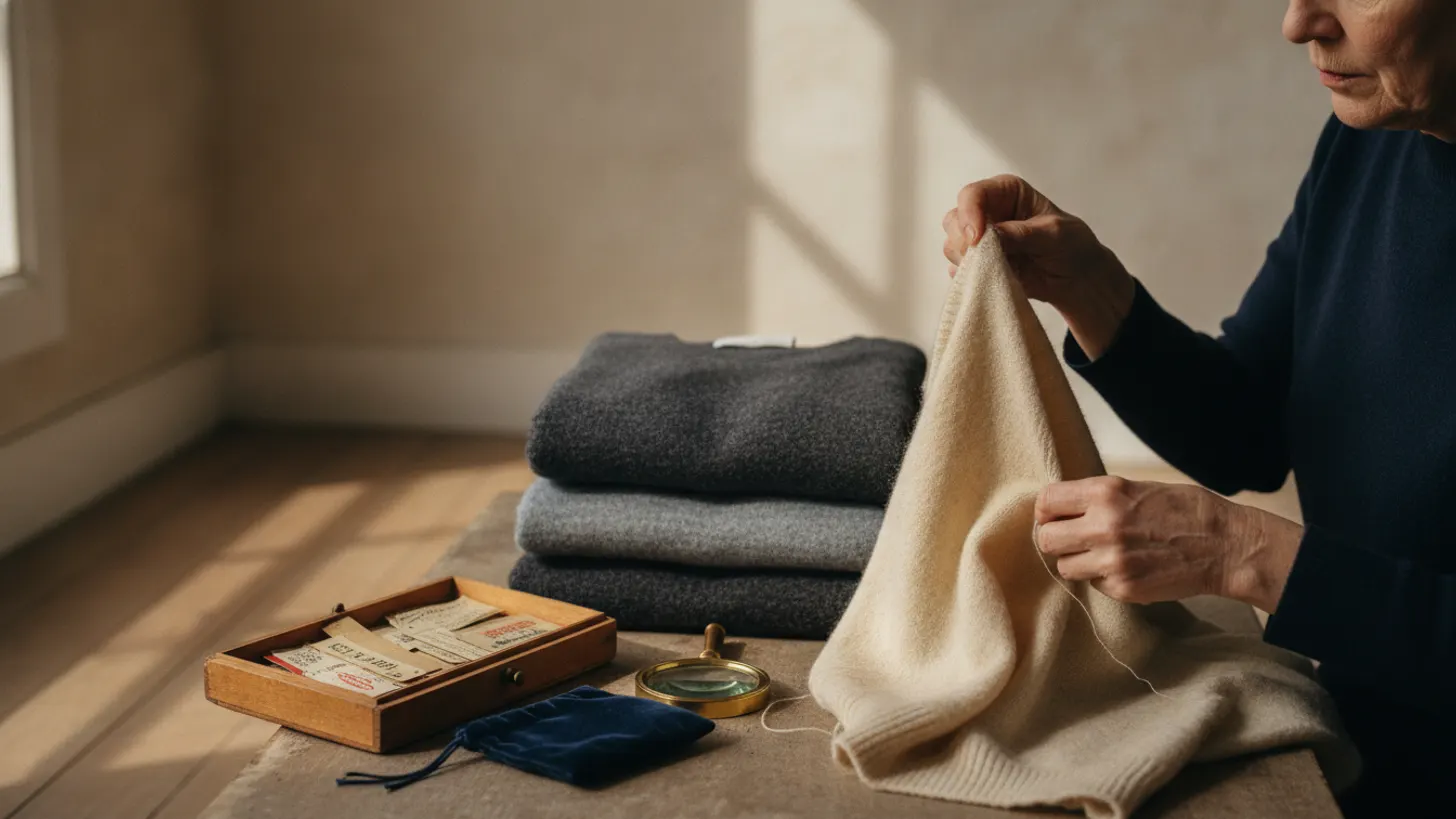
Cashmere is measured in microns, and the undercoat the Woolmark Company names as its source sits near the fine end of the scale. That thinness is why vintage cashmere feels different in the hand from wool, and why it pills, thins, and tears differently too. The tests below are the ones that work on a shop floor, with no laboratory, no certificate, and sometimes no label at all.
How to tell vintage cashmere from wool and synthetic blends
Work in order: look, touch, then rub. Cashmere reads matte with a short, soft halo, feels cool for a moment before it warms in your palm, and recovers slowly when stretched. Wool is springier and slightly squeaky. Synthetic blends feel slick, warm instantly, and raise static under a dry hand.
The difference starts in the goat. The Woolmark Company's cashmere fiber guidance explains that cashmere is the fine undercoat of cashmere goats, separated from the coarse guard hair growing above it, which is why the yarn is light for the warmth it gives. A sound piece of vintage cashmere carries that lightness: hold the sweater by the shoulders and it should feel substantial without hanging like a wet towel.
Three checks travel well. Pinch a few millimeters of knit and release it: cashmere relaxes back with a slow memory while acrylic snaps flat and stays flat. Run a dry palm across the chest for ten seconds: a polyester blend crackles and clings. Breathe through the fabric: a dense, well spun knit resists the air. Skip burn tests on anything you do not own yet, and treat a seller's visual identification as what it is, an informed opinion made without laboratory testing.
Fineness is the reason all of this works, and the trade talks about it in microns. The bands below are the approximate figures published by wool and cashmere bodies, including the Woolmark Company and the International Wool Textile Organisation. They overlap, which is why a fine merino can fool a hand for a second or two.
Approximate fiber diameter bands in microns. Overlap at the fine end is why hand feel alone is never proof of fiber.
Reading labels on a vintage cashmere sweater
Labels carry two kinds of information: what the law required at the time, and what the maker chose to brag about. Read the fiber content, then the identification number, then the care instructions, then the country of origin. Each one narrows the decade a little further.
The Federal Trade Commission's textile labeling rules require U.S. labels to disclose fiber content and the manufacturer or dealer identity, which is why percentages and an identification number sit on the inside seam. The Vintage Fashion Guild label resource dates WPL numbers to 1941 through 1959 and RN numbers to 1959 onward, so a WPL with no RN is an early marker worth trusting. Care instructions became a labeling requirement in the early 1970s, which makes their absence another clue.
Then read the construction. A vintage cashmere sweater knitted in a Scottish border mill usually says so and names itself: Johnstons of Elgin, Pringle, Ballantyne, Braemar, Barrie. Fully fashioned panels, a hand linked collar, two ply yarn and a saddle shoulder all point earlier than a cut and sewn body. I found my own proof of that rule in March 2019, pulling a Pringle of Scotland crewneck out of a donation bin outside Hudson, New York: a two ply hand linked collar, a union label, and no RN number anywhere in the seam, which put it solidly before 1959 once I matched the construction to the label. Country of origin shifts toward China and Mongolia from the late 1980s. Museum records teach you what period labels look like, and the Metropolitan Museum of Art Costume Institute collection and the Museum at FIT collection database both publish detail photography of dated garments. The same reading habits date vintage men's suits.
| Label clue | Likely era | What to check next |
|---|---|---|
| WPL number, no RN | 1941 to 1959 | Cross-check the number against the Vintage Fashion Guild resource |
| RN number present | 1959 onward | Look up the holder, then compare label typography |
| No care label at all | Often before the early 1970s | Confirm with seams, collar linking, and ply |
| Union label in the seam | Mid-century into the 1990s | Logo wording and style shifted over time |
| Made in Scotland with a mill name | 1950s into the 1980s | Mill history, two ply yarn, saddle shoulder |
| Made in China or Mongolia | Late 1980s onward | Judge ply and knit density, not origin |
We cover the details separately in How to identify vintage 1920s dresses: beading, bias, and labels.
We cover the details separately in Vintage French workwear guide: moleskin, chore coats, and labels.
We cover the details separately in Vintage 1960s mod dresses: a guide to shift shapes and labels.
What condition faults to accept in vintage cashmere
Accept surface pilling, relaxed ribbing, and small closed repairs. Hesitate at open holes in high stress places, at thinning you can see daylight through, and at grazed patches where larvae have shaved the nap. Price should follow condition, and condition should be disclosed in writing before money moves.
Pilling is short fiber working loose under friction, so on vintage cashmere it gathers where arms meet the body, where a bag strap crosses, and along cuffs. It is cosmetic and it is reversible: a sweater comb or a pumice stone lifts the pills and the knit underneath is unchanged. Thinning is the fault that matters, because the yarn itself has gone.
Moth damage looks different from wear. Clothes moth larvae eat the protein in the fiber, and the tells are irregular holes with slightly fuzzy edges, grazed areas where the surface has been shaved, fine webbing, sandy frass, and pale casings tucked into seams. Victoria and Albert Museum textile care guidance puts cleaning and isolation first, because soils and body oils are what draw larvae to a garment. If vintage cashmere arrives with any of those signs, seal it, freeze it, and wash it before it goes near the rest of a wardrobe.
Repairs are not automatically a fault. A re-knit closed in matching yarn, a darn tucked into ribbing, or a rebuilt cuff can all be sound work; what matters is that the repair is stable and declared. Budget for mending if the piece is otherwise right, because repairing vintage knitwear is ordinary work.
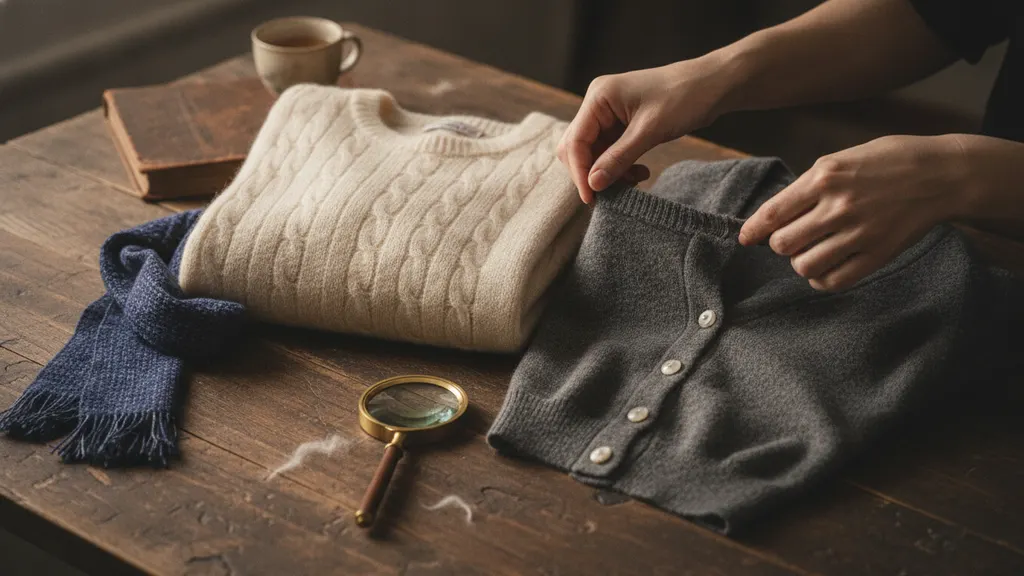
Surface faults are priced in. Structural faults and live infestations are reasons to pass.
In my own triage, vintage cashmere sorts into the same three calls every time. Buy through surface pilling, relaxed ribbing at the hem, and a closed re-knit done in matching yarn, since those are either cosmetic or already mended. Negotiate on irregular holes with grazed, shaved nap, since larvae did real damage but a few mendable spots do not sink a good sweater. Walk away from a sheer, thinned underarm or chest, because that is yarn worn through rather than fiber that can be repaired back.
How to measure vintage cashmere for a modern fit
Ignore the number on the tag. Measure flat and compare against a sweater you already wear well. Four numbers settle it: pit to pit, total length from the shoulder seam, sleeve from shoulder seam to cuff, and shoulder seam to shoulder seam across the back.
Ask for relaxed measurements rather than stretched ones, because knit gives under a tape and a seller in a hurry can add two inches without meaning to. Cut history matters as much as size: a 1960s vintage cashmere crewneck often measures narrow through the shoulder and short in the body because that was the line of the decade, while 1980s knitwear drops the shoulder and lengthens the body. Vogue's vintage shopping coverage keeps returning to the same point, that fit in old clothes is a question of measurement rather than labels.
Shrinkage leaves a signature: a dense, slightly felted surface, ribbing that no longer springs back, puckered seams, sleeves short against a normal body length. Photograph your own best fitting sweater flat with a tape beside it and keep those numbers on your phone. The rest of the online routine, from photo requests to return windows, sits in how to shop vintage fashion online.
Storage and cleaning that protect the fiber
Hand wash in cool water with a wool safe detergent, press the water out without wringing, and dry flat. Never hang a wet sweater. Store it clean, folded, dark and sealed, on the understanding that a dirty garment is the one moths find first.
The International Wool Textile Organisation notes that wool fibers can absorb moisture vapor while remaining relatively breathable, which is also why rest works: a day flat on a shelf lets vintage cashmere give up moisture and recover its shape instead of holding creases. Air between wears and you will wash far less often, and every wash carries a small risk.
Fold rather than hang, use a breathable cotton bag or a lidded box instead of thin plastic, and vacuum the shelf. Cedar and lavender are deterrents, not controls, so do not lean on them alone. Reporting in the New York Times on clothes moth infestations and in Smithsonian Magazine on museum textile pests lands on the same habits: inspect often, clean before storage, act fast. Longer notes on cleaning vintage clothing at home and on storing a vintage wool coat cover the rest.
Keeping a sweater alive is also the quietest option for the fiber itself. Good On You's cashmere material guide and Sourcing Journal's reporting on the cashmere trade both describe grazing and supply pressure behind new production, which is an argument for mending what already exists.
Frequently asked questions
How can I tell if a sweater is really cashmere without a label?
Use your hands and eyes in sequence. Cashmere shows a short, soft halo rather than a shine, feels cool for a moment before it warms, and recovers slowly when you stretch and release a cuff. Wool feels springier and a little squeaky; acrylic feels slick, warms instantly, and builds static when rubbed. The Woolmark Company describes cashmere as the fine undercoat of cashmere goats, and that fineness is what makes the fabric light for its warmth. None of these checks are proof on their own, so pair them with the label, the knit density, and the seller's written description of the piece.
Is it safe to buy a cashmere sweater with small moth holes?
Often yes, if the damage is finished and the garment is clean. Clothes moth larvae eat the fiber, so the real question is whether anything is still living in the seams. Look for fine webbing, sandy frass, and pale casings, which point to an active problem rather than old damage. Victoria and Albert Museum textile care guidance puts cleaning and isolation first. Seal the sweater, freeze it for several days, wash it, then repair. Two or three closed holes in a mid-body panel are mendable; grazed, sheer areas across a shoulder are rarely worth the asking price.
Does older cashmere pill more than newer cashmere?
Not necessarily, and it often pills less. Pilling comes from short fibers working loose under friction, so the variables are fiber length, ply, and knit density rather than age. A two ply vintage cashmere sweater from a mill that spun long fiber can stay smoother than a loosely knit new one, a difference the Woolmark Company ties back to fiber quality. Pills that do appear are cosmetic: a sweater comb or a pumice stone removes them without thinning the knit. What age changes is where friction has already landed, so check cuffs, underarms, and the strip a bag strap crosses.
What should I look at in online photos before buying?
Ask for daylight photos of the inside of the garment, not just the front. You want the label stack, both cuffs, both underarms, the hem ribbing, any repair, and a backlit shot that shows thin spots. Then ask for flat measurements taken relaxed: pit to pit, length, sleeve, and shoulder. Harper's Bazaar's second-hand shopping coverage makes the same case, that condition and measurement questions belong in the conversation before payment. If a seller will not photograph the inside of a sweater, treat the silence as the answer and keep looking.
Can I wash cashmere at home or does it need dry cleaning?
Hand washing at home is usually kinder than repeated dry cleaning. Use cool water and a wool safe detergent, move the garment gently without rubbing or wringing, rinse, press the water out between towels, and dry flat away from heat. Hanging a wet sweater pulls the shoulders out of shape. The International Wool Textile Organisation notes that wool fibers take up moisture vapor while staying relatively breathable, which is why airing often does the work a wash would. Save professional cleaning for structured pieces, heavy soiling, or anything with a lining you cannot reach.
How do I keep moths out of stored cashmere?
Store it clean, dark, dry, and sealed. Body oils and food traces are what draw larvae, so wash or air a sweater before it goes away for the season. Fold rather than hang, keep it in a breathable cotton bag or a lidded box instead of thin plastic, and vacuum the drawer or shelf. Cedar and lavender are deterrents, not controls, so do not rely on them alone. Museum textile guidance, including the Victoria and Albert Museum's, leans on regular inspection rather than one annual check, and a look every few weeks catches an infestation while it is still two holes.