November 2026
How to shop vintage fashion online: measurements, photos, returns
How to shop vintage fashion online without fit surprises: the four measurements to request, what photos reveal about condition, and the returns to confirm.
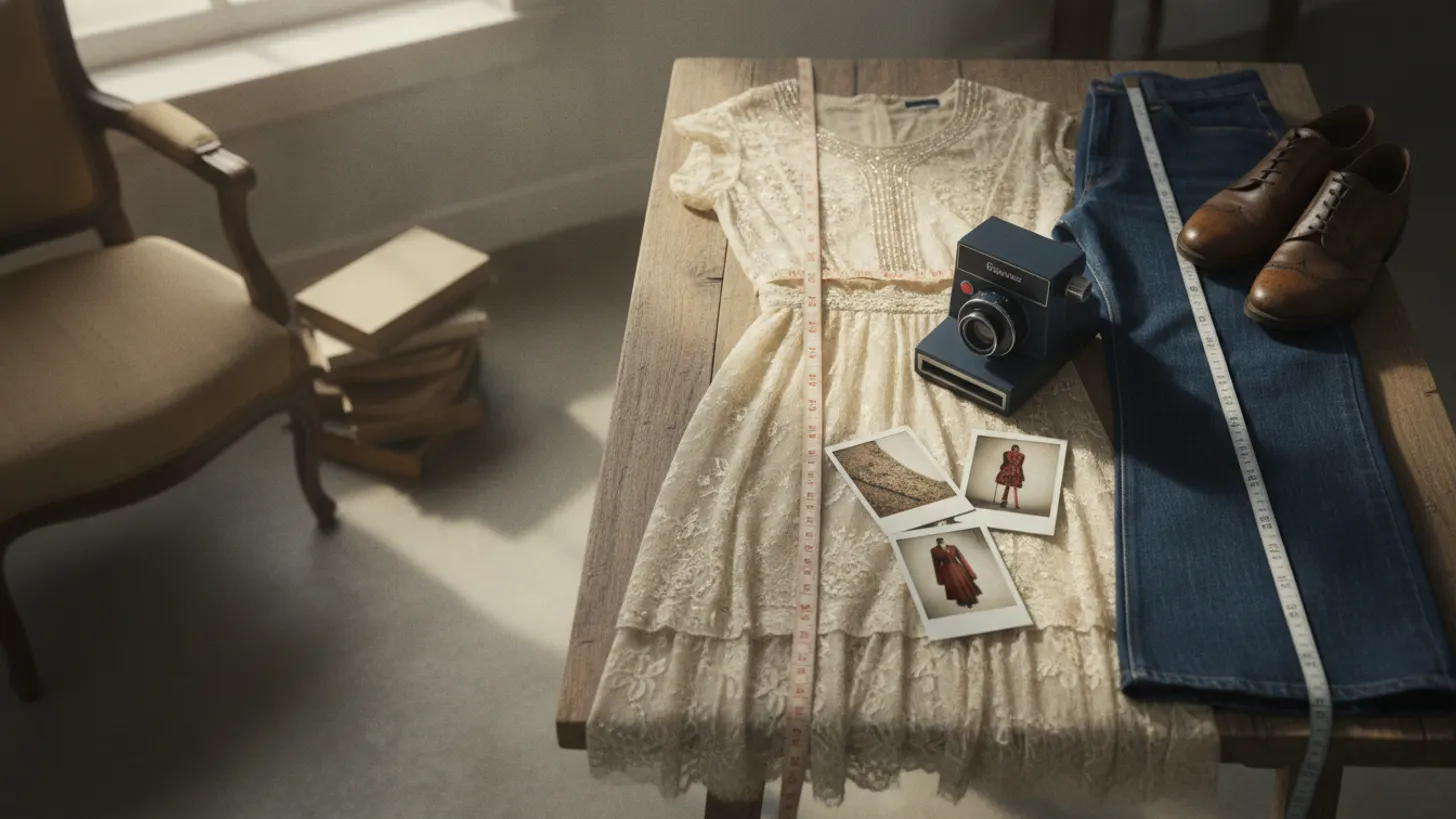
"Will this fit me?" arrives in my inbox more often than any question about price. It is also the one question a label cannot answer, which is why how to shop vintage fashion online comes down to flat measurements, honest photographs, and a seller who replies in numbers. A 1970s coat marked size 12 can measure smaller than a modern 6. Here is the routine I run on every garment before it goes live.
The measurements that decide fit when you learn how to shop vintage fashion online
Four numbers settle most purchases: flat chest across the garment, shoulder seam to shoulder seam, sleeve from shoulder seam to cuff edge, and total length from the base of the collar to the hem. Ask for all four in inches, measured flat, with the coat closed and lying still.
A flat measurement means the garment lies closed and untouched on a table while you measure it, not pulled taut and not doubled around the body. Sellers who do not say which convention they used are the most common source of a bad fit.
A size label is a historical document, not a fit promise. The V&A collection records describe garments by their actual dimensions and construction, because a labeled size tells you little once you cross decades, makers, and national systems. The Vintage Fashion Guild label resource shows the same problem from the other direction: one brand can run three different size systems inside twenty years. Our vintage clothing size conversion guide works through that old label math in detail.
Add ease over a garment you own, not over your body. If the coat you reach for every November measures 21 inches flat across the chest, a shearling at 19 inches will not close over a sweater no matter what the tag promises. The rule I use when working out how to shop vintage fashion online is plain: measure flat, then add for the layer underneath.
Those allowances are my own measuring standard, written down so a customer and I can argue about one number instead of a feeling.
I did not always get this right. I learned to tape a flat measurement properly from Nadia Volkov, a tailor who ran alterations out of a shop in Burlington, Vermont, where I apprenticed two days a week starting in 2011, three years before Sol Siren opened in 2014. In 2019 I still slipped: I listed a cropped shearling flight jacket with a chest measurement I had estimated by eye instead of taping it flat, a buyer who layered it over a wool sweater found it would not close, and I covered the return shipping and the fix myself. Every measurement I quote now gets taped twice before it goes in a listing.
Reading the photographs is half of how to shop vintage fashion online
Photographs carry the condition report. Ask for six frames before you commit: the lining laid open, the underarms, the hem edge, the fastenings, the label photographed flat, and one shot of the cloth held against a window. Light passing through a panel shows thinning that studio lighting hides.
Construction reads in close images too. Pattern matched across a seam, a bound or taped edge, a pocket bag cut from a different cloth, a chain hanger at the collar: these are the details museums record. The Costume Institute at The Met publishes garment records pairing close images with written condition notes, and that pairing is the standard to expect from a seller. Online discovery has become a default route into vintage, a shift The New York Times has reported on as resale moved onto digital marketplaces, so photographs now do the work a shop floor used to do.
Zoom on hardware. Zippers, snaps, and stamped buttons date a garment and often reveal replacements, the approach behind our guide to authenticating a vintage leather jacket. If an image is blurry at exactly the place you want to look, that is information too.
The questions to ask a seller are central to how to shop vintage fashion online
Five questions do most of the work, and each one should come back as a number or a plain sentence. Ask them before payment, in writing, and keep the thread. A seller who answers in specifics is describing a garment they have actually handled.
| Question to ask | What the answer tells you |
|---|---|
| Is the chest number flat or doubled? | Whether the coat is 20 inches across or 40, the most common misread in vintage listings. |
| Has anything been altered or replaced? | Shortened sleeves, a replaced lining, or moved buttons, all of which change the cut you see. |
| How does it smell, honestly? | Smoke and mildew are the two conditions a photograph never shows. |
| What is the return window, in days? | Whether an inspection period exists at all, and when the clock starts. |
| Who pays return shipping, and is the parcel insured? | Your real downside on a one-of-one garment. |
The written answer matters more than any platform badge. Resale has professionalized quickly, as Vogue Business has documented across platform growth, and The Business of Fashion covers the same consolidation from the trade side, which means service terms differ sharply between a marketplace listing and an independent shop. For fur and shearling, ask about hide condition and era, the ground covered in our guide to dating a vintage fur coat. Asking well is most of how to shop vintage fashion online.
Comparing your own garments is the more accurate way to size vintage clothing
Stop converting sizes and start comparing garments. Take the piece in your closet that fits the way you want this coat to fit, lay it flat, and measure the same four points. Those numbers become your reference, and they travel with you to every listing.
Write them on a card and keep a photo of it in your phone. Then set a tolerance. For a structured coat I would not go below your reference shoulder width, since shoulders are the one measurement a tailor cannot easily add to. Length and sleeve can be altered. Chest can be let out only if the seam allowance exists. The teaching collection at the Fashion Institute of Technology catalogs garments by cut and dimension for the same reason.
Different garments hang on different numbers, which is why how to shop vintage fashion online rewards knowing the silhouette you are buying. A vintage Penny Lane coat lives or dies on shoulder and total length; a slip dress on bust and hip.
Returns, repairs, and shipping are part of how to shop vintage fashion online
Confirm three things in writing before checkout: the return window and who pays return shipping, whether a repair or alteration voids that window, and how the parcel is insured and tracked. One-of-one stock means no replacement is waiting if a coat arrives damaged.
Ask what happens to a garment that arrives with an undisclosed flaw, and ask before you need the answer. Keep the packaging until you have measured the coat against your reference numbers, and photograph the parcel on arrival. For international orders, confirm who covers duties. Transparency standards published by Good On You and the material guidance in the Vintage Fashion Guild resource library give you fair language for all of these questions.
Then plan for care. Most vintage wants a clean and a small repair in its first year, which is ordinary for something that has already lived decades. Our guide to cleaning vintage clothing covers what to do before the first wear. Return terms, repair budget, and shipping cover are the unglamorous third of how to shop vintage fashion online, and they are where the money is actually at risk.
Frequently asked questions about how to shop vintage fashion online
What measurements should I ask for when buying vintage clothes online?
Ask for four, measured flat with the garment closed: chest from underarm to underarm, shoulder seam to shoulder seam, sleeve from shoulder seam to cuff, and total back length from the collar base. For dresses add waist and hip at the fullest point; for denim add waist, front rise, and inseam. State whether the chest number is the flat measurement or already doubled, because that single ambiguity causes most returns. The way the V&A collection records describe garments by dimension rather than by size is the habit worth borrowing when you work out how to shop vintage fashion online.
Can you tell if vintage fabric is damaged from photos alone?
Often yes, if the photographs are the right ones. Thinning wool reads as a lighter halo when light passes through a held-up panel. Dry leather shows fine cracking at the elbow and the collar fold. Weak silk splits along the shoulder seam before it shows anywhere else. Moth damage clusters near old grease marks, so ask for the underarm and the inside hem. What photographs cannot show is odor, stiffness, and how a lining behaves in motion, which is why the Costume Institute at The Met records condition in writing alongside its images.
Do vintage sellers usually accept returns?
Policies vary widely, because most vintage is one-of-one and cannot be restocked from a warehouse. Many independent shops offer a short inspection window, some sell final sale, and larger platforms sit somewhere between with their own buyer protection terms. Read the written policy before checkout rather than assuming the platform covers you, and keep the original packaging until you have measured the garment yourself. Reporting by Vogue Business on resale platform professionalization tracks how quickly these terms change as marketplaces compete on service rather than on stock.
Why does my vintage size never match my modern size?
Because size labels drifted. A 1960s size 14 and a current size 14 were cut for different bodies, different undergarments, and different ease conventions, and national systems diverged on top of that. Labels were also reused, relabeled, and altered by previous owners, so the tag may not describe the garment in front of you. Measure instead. Teaching collections such as the one at the Fashion Institute of Technology treat dimension and cut as the record, which is the same reason how to shop vintage fashion online always starts with a tape measure.
Is it safe to buy a vintage fur or shearling coat online?
It can be, with disclosure. Ask the seller to describe the pelt or skin in plain words: suppleness at the seams, any dryness or splitting in the hide, shedding when the fur is stroked against the nap, and whether the lining is original. Ask for a photograph of the inside shoulder, where old skins crack first. Expect identification made through visual and tactile evaluation with provenance disclosed, not certification. Guidance on material claims and transparency from Good On You is a fair standard to hold any seller to.
How do I know a vintage seller is being honest about condition?
Honest listings name flaws before you ask. Look for a condition line that mentions a specific repair, a missing button, a replaced lining, or a small hole with its location given. Ask one question you already know the answer to from the photographs and see whether the reply matches. Sellers who answer in numbers and send extra images are describing a garment; sellers who answer in adjectives are describing a mood. Resale coverage in The Cut and the shift to online discovery documented by The New York Times point the same way: reputation now lives in the written description, which is the heart of how to shop vintage fashion online.