June 2026
1960s mod fashion guide: silhouettes, designers, and what to collect
A field guide to 1960s mod fashion: how to authenticate shift dresses and designer labels, what to pay, and where Australian collectors find authentic pieces.
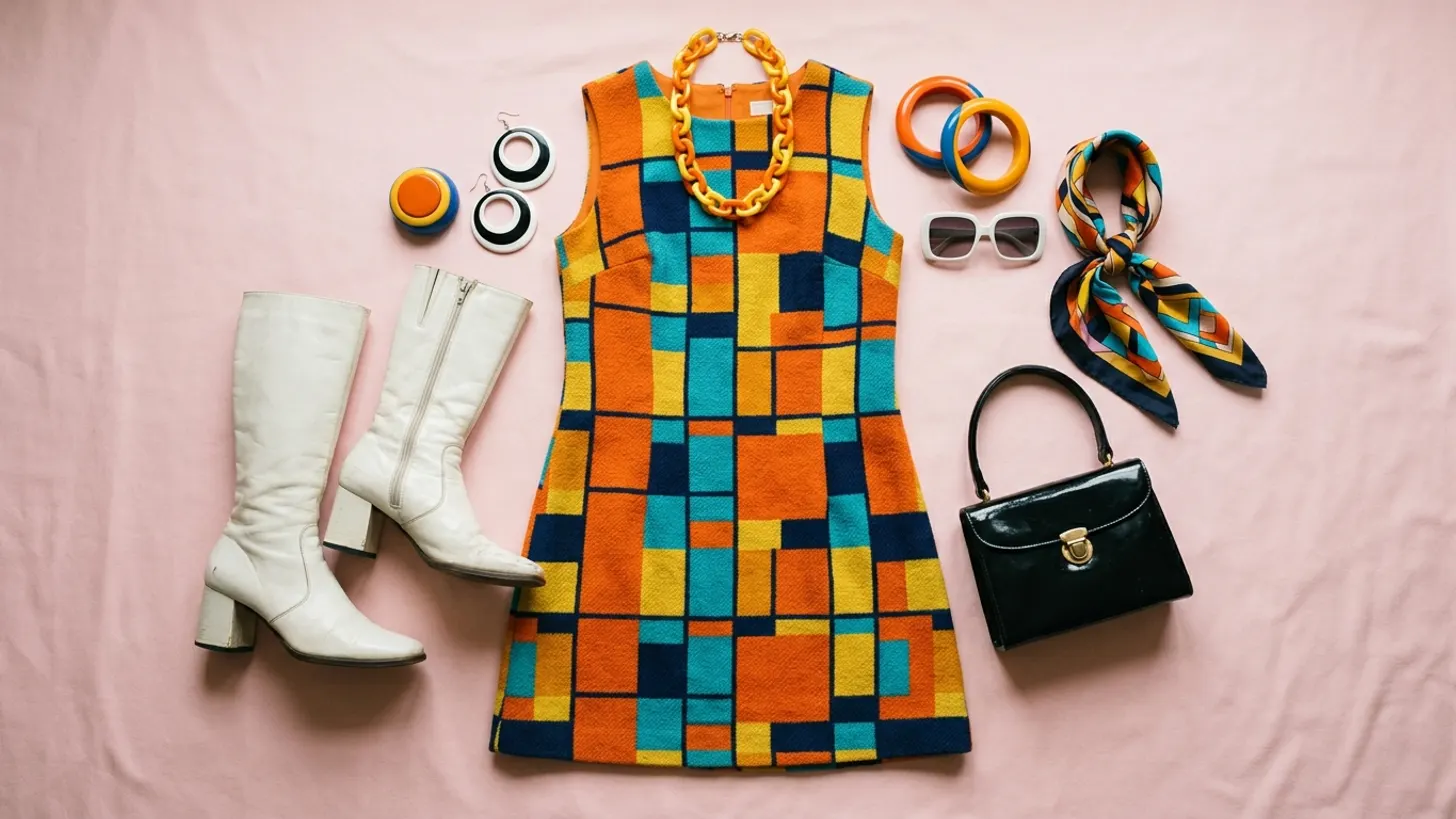
A woman in a Carnaby Street boutique, 1966: she lifts a shift dress off the rail, holds it to the light, and the geometric print shifts from black to white depending on the angle. That moment captures 1960s mod fashion at its most distilled. A deliberate, almost defiant rejection of postwar formality in favour of youth, geometry, and primary colour. If you are collecting now, here is what that rejection actually looked like, and where to find it.
What defined 1960s mod fashion and how it broke from the 1950s
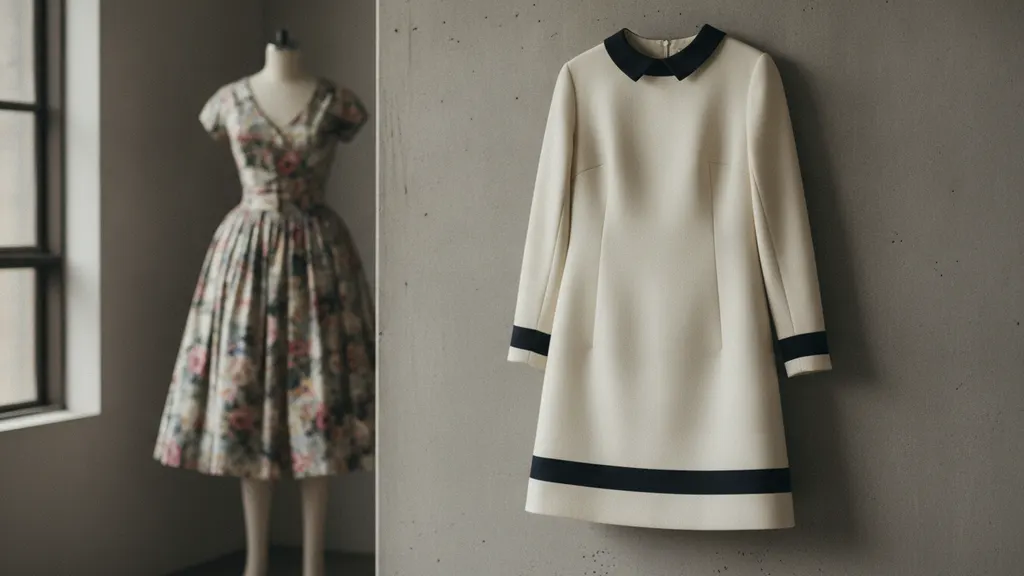
1960s mod fashion was a London-born aesthetic movement active from approximately 1963 to 1969 that produced the sharpest silhouette break in mid-century Western dress. The word "mod," short for "modernist," was adopted by working-class and art-school youth in Soho and the East End who rejected the Paris-led couture system in favour of cheap, graphic, youthful clothing cut from Op-art prints, PVC, and textured polyester in precise geometric shapes without fraying. The definitive garment was the shift dress: a straight-cut piece with no waist seam, no corsetry, no padded hips, and a hemline 5 to 15 cm above the knee, placed in direct opposition to Dior's 1947 New Look. The Victoria and Albert Museum dates the decisive hemline break to 1963. The Museum of London records that Carnaby Street, the movement's primary retail district, was drawing roughly 100,000 visitors per week by 1966. The Palais Galliera in Paris places peak international diffusion between 1965 and 1967. Australian manufacturers were producing domestic versions of the silhouette by 1964, accounting for the substantial supply of genuine mod-era pieces that surfaces regularly at Sydney and Melbourne estate sales today.
The movement originated in London, not Paris. The rejection of French high fashion was deliberate: while Vogue Paris covered Courrèges, boutiques on Carnaby Street moved thousands of units of the same Op-art shift in a single weekend. For anyone dating a garment by construction clues and era tells, the vintage coat dating guide at Sol Siren covers the key markers across multiple decades.
For a closer look at this, see 1960s vintage fashion buying guide: silhouettes and key tells.
Designers who defined the mod era
Mary Quant is the name that surfaces first, and rightly so. She opened Bazaar on the King's Road in 1955 and spent the next decade pushing hemlines higher while London's fashion establishment pushed back. By 1964 to 1965 she had commercialised the miniskirt at retail scale, and her Ginger Group label brought pricing within reach of a secretary's weekly wage. Authenticated Quant pieces with the original daisy label sit at the top of any serious 1960s mod fashion collection.
Pierre Cardin's 1964 Cosmocorps collection introduced geometric cutouts and space-age structured forms that defined the mod visual language across international markets. His vinyl and wool combinations aged poorly in many surviving examples, but the silhouettes set a template that every British high-street manufacturer replicated within eighteen months. André Courrèges arrived the same year with white go-go boots and above-the-knee skirts cut with architectural precision.
Biba, founded by Barbara Hulanicki in 1964, offered a darker counterpoint: plum, khaki, and art nouveau references filtered through a Bayswater postal code. Hulanicki did not licence the brand during the key years, keeping original production volumes low. That scarcity is why Biba pieces fetch strong auction prices. The vintage outerwear authentication guide at Sol Siren covers label verification methods that apply directly to Biba and Courrèges pieces from this period.
Authenticating mod-era pieces by label and construction
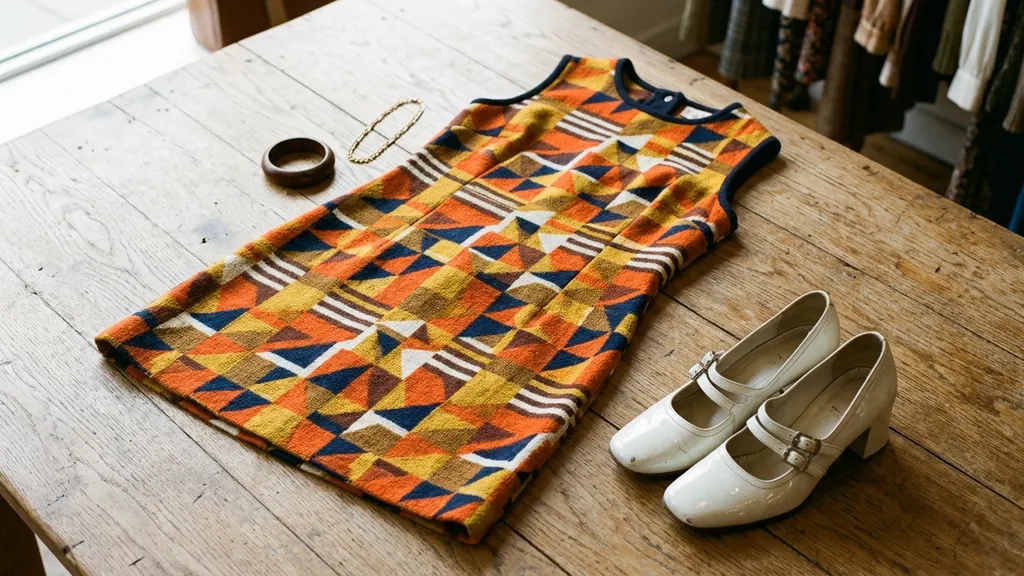
Authentication of 1960s mod fashion pieces starts at the label. British pieces from this period read "Made in England" and may carry a Woolmark certification or a union garment mark. American imports show ILGWU (International Ladies' Garment Workers' Union) labels on pieces made before 1974. Labels printed on white twill tape with black lettering, sewn into the centre back neckline, are correct for the period. Heat-transferred labels, which feel flat and slightly raised to the touch, did not appear until the late 1980s.
I learned this the hard way in 2019. At a Melbourne auction I bought what I was confident was an authenticated Biba piece: the colourway was right, the cut was right, and the label typeface matched every reference photograph I had studied. I paid AUD 680. Under a daylight bulb at home I found a plastic coil zipper and seam allowances measuring just over 2 cm. It was a late-1970s piece made in the same aesthetic, worth perhaps AUD 90 at retail. That dress lives on a reference shelf now. I have not since trusted a label without checking the seams and zipper first.
Construction provides the second layer of evidence. Zippers in authentic pieces are metal, not plastic coil. Seam allowances measure 1 to 1.5 cm, narrower than the 1.5 to 2 cm standard in modern reproductions. Chain stitching, which unravels when a single thread is pulled, appears in many British and Australian garments from this era. CSIRO textile science research has documented that period synthetic fibres like Crimplene show distinct spectroscopic profiles from later polyester reformulations, which can assist scientific authentication of disputed pieces.
For Australian-made pieces, fibre content labels were not legally required under Standards Australia textile regulations until the early 1970s. Any "Made in Australia" garment carrying percentage fibre disclosure likely post-dates the core mod era. This is a fast filter that removes a large number of near-period pieces from consideration. Product Safety Australia advises that vintage textiles made before 1990 may contain azo dyes and finishing chemicals absent from modern safety declarations; airing garments for 48 to 72 hours before wearing is standard practice for any new vintage acquisition.
Fabrics and colour palettes of genuine mod-era pieces
Crimplene, a brand name for textured polyester developed in the late 1950s, became the defining fabric of 1960s mod fashion from the mid-decade onward because it held its shape without ironing, accepted bold dyes uniformly, and could be cut into precise geometric shapes. A label reading "100% Crimplene" or "100% Dacron" is period-accurate language. Collectors who pass over synthetic-labelled pieces on quality grounds are passing over the most historically characteristic garments in the market.
Other period materials include acetate satin for linings, PVC for outerwear and accessories, and cotton poplin in earlier-decade pieces before synthetic adoption became widespread. Wool crepe appeared in higher-end pieces from designers such as Courrèges. Sustainability Victoria research on secondhand fashion notes that choosing vintage over new clothing reduces a garment's lifecycle emissions by up to 70 per cent, making period-correct synthetic pieces a more considered choice than their current reputation suggests.
Colour palettes ran toward primaries and high contrast. Black and white Op-art dominated from 1963 to 1966. Red, white, and blue combinations appeared throughout the decade. Orange and brown pairings became more common from 1968 onward as the aesthetic shifted toward earthier tones. Psychedelic prints in acid green and electric purple arrived later, from roughly 1967, and are more associated with the hippie crossover than with pure mod.
At a Surry Hills estate sale in February 2023, I found a black and white Op-art shift dress in exactly the 1963 to 1966 palette: unmarked, made in Australia, 100% Crimplene, metal zipper, no fibre declaration on the label. I paid AUD 45. It is the best-value piece I have sourced in five years of buying, and handling it taught me more about how mid-decade dye absorption works on a Crimplene weave than any reference photograph has.
Where collectors find authentic 1960s mod fashion and what to pay
The supply of authentic 1960s mod fashion in Australia is more substantial than most collectors expect. Australian manufacturers adopted the silhouette rapidly after 1963, producing shift dresses and coordinating sets in significant volume through local labels. Sydney and Melbourne estate sales regularly surface unlabelled Australian-made pieces at prices between AUD 80 and AUD 350, which represents the most accessible entry point for new collectors.
For labelled designer pieces, specialist vintage dealers are the most reliable source. Choice's 2024 consumer guide to secondhand fashion recommends verifying a seller's return policy and requesting additional photographs of labels and seams before completing any online vintage purchase; buyers using dedicated vintage platforms report higher authentication satisfaction than those relying on general resale markets. Those platforms reliably outperform general auction sites because the seller population self-selects for knowledge.
Auction results give the clearest price signal for top-tier pieces. Mary Quant Ginger Group labelled dresses in excellent condition have achieved AUD 600 to AUD 2,500 at specialist textile auctions since 2020. Authenticated Courrèges pieces are rare in the Australian market and can reach AUD 1,200 to AUD 4,500. Biba pieces with original labels and swing tags run AUD 300 to AUD 900.
| Designer / Label | Label to Look For | AUD Range | Rarity in Australia | Primary Authentication Marker |
|---|---|---|---|---|
| Unlabelled Australian-made | Made in Australia, no fibre disclosure | AUD 80 to AUD 350 | Common | No fibre percentage on label; chain stitching; metal zipper |
| Biba (Barbara Hulanicki) | Biba London on white twill tape | AUD 300 to AUD 900 | Scarce | Original swing tag; muted plum or khaki palette; low-volume seam finish |
| Mary Quant Ginger Group | Daisy logo label with Ginger Group wording | AUD 400 to AUD 2,500 | Scarce | Daisy logo clarity; original buttons intact; Op-art or block-colour print |
| Pierre Cardin | Pierre Cardin Paris (woven, serif typeface) | AUD 600 to AUD 3,000 | Rare | Geometric cutouts; vinyl or structured wool construction; French label typography |
| Courrèges | Courrèges Paris (woven, silver thread detail) | AUD 1,200 to AUD 4,500 | Very rare | Architectural hem; white go-go construction; silver thread in woven label |
Before wearing any vintage acquisition, the vintage outerwear storage and care guide at Sol Siren covers conditioning, cleaning, and long-term preservation methods that apply equally to 1960s synthetic and natural-fibre pieces.
Building a mod-era collection: what to prioritise
If your budget is limited, prioritise documented provenance over undocumented designer attribution. A shift dress with a clear "Made in England" label, original buttons, and no repairs holds more long-term value than a piece attributed to Quant without supporting evidence. Label integrity is the primary value driver across all collector markets for 1960s mod fashion.
Coordinated sets, specifically a matching shift dress and collarless coat from the same production run, are rarer than standalone dresses and command a 30 to 50 per cent premium over equivalent single pieces. Complete outfits with original accessories in the same colourway surface rarely enough to represent significant collector value when they appear. Vintage textiles store best at 18 to 20 degrees Celsius in low-humidity conditions to prevent synthetic fibre degradation and dye transfer between stored garments.
For sizing questions that arise when buying pieces by label alone, the vintage clothing size conversion reference at Sol Siren translates period labels to modern measurements across British, American, and Australian sizing conventions.
Frequently asked questions
What made 1960s mod fashion different from earlier decades?
1960s mod fashion broke from 1950s couture by rejecting the hourglass silhouette. Where postwar fashion demanded nipped waists and full skirts, mod clothing emphasised flat-fronted shift dresses, geometric prints, and hemlines well above the knee. The movement was London-led rather than Paris-led, drawing on working-class art-school energy rather than haute couture tradition. The result was clothing deliberately stripped of the body-shaping structure that had defined the previous decade. The Victoria and Albert Museum dates the definitive transition to approximately 1963.
Which Mary Quant pieces are most collectible today?
Mary Quant's most collectible pieces carry the original daisy logo label from her Ginger Group diffusion line, which ran from the mid-1960s. Shift dresses in Op-art prints or block colour with the original swing tag command the highest prices, typically AUD 600 to AUD 2,500 depending on condition and label clarity. Vinyl rainwear and accessories survive in smaller numbers than fabric garments and are similarly sought after. Documentation of provenance, such as an original receipt or period photograph, can add 20 to 40 per cent to a sale price, per specialist vintage auction records.
How do I tell if a 1960s mod dress is authentic?
Authentic 1960s mod dresses show several construction markers: seam allowances of 1 to 1.5 cm (narrower than modern reproductions), metal rather than plastic coil zippers, and chain stitching in many British and Australian pieces. British labels read "Made in England" and may carry a Woolmark or union mark. Fibre content labels were not legally required in Australia until the early 1970s per Standards Australia regulations, so any "Made in Australia" piece with percentage fibre disclosure likely post-dates the core mod era. CSIRO fibre analysis has documented distinct period synthetic signatures.
What fabrics were typical in genuine mod-era clothing?
Crimplene, a brand name for textured polyester developed in the late 1950s, became the defining fabric of mod-era clothing from the mid-1960s. It held its shape without ironing, accepted bold dyes uniformly, and could be cut into precise geometric shapes without fraying. Other period materials include Dacron, acetate satin for lining, and PVC for outerwear and accessories. Cotton poplin appeared in early-decade pieces before synthetic adoption widened. Wool crepe was used in higher-end designer pieces. A label reading "100% Crimplene" is period-accurate, not a quality marker to avoid.
How much should I expect to pay for authentic 1960s mod clothing?
Prices vary by designer and condition. Unlabelled Australian-made mod shift dresses in good condition typically sell for AUD 80 to AUD 350. Authenticated Biba or smaller boutique label pieces run AUD 200 to AUD 900. Mary Quant Ginger Group labelled pieces reach AUD 400 to AUD 2,500. Authenticated Courrèges pieces are rarer in Australia and can reach AUD 1,200 to AUD 4,500 at specialist textile auction. Condition is the primary price driver: a labelled piece with original buttons, no repairs, and a legible label commands a strong premium over an equivalent restored example.
Can I find authentic 1960s mod fashion in Australia?
Yes. Australia has a genuine supply of 1960s mod clothing because local manufacturers adopted the silhouette rapidly and produced substantial quantities of shift dresses and coordinating pieces through the late 1960s. Sydney and Melbourne estate sales regularly surface unlabelled Australian-made pieces at accessible prices. For labelled British imports from Quant or Biba, specialist vintage dealers are the most reliable source. Choice consumer guidance on secondhand fashion recommends verifying the seller's return policy and requesting photographs of labels and seams before purchasing vintage clothing online.