November 2026
Vintage French workwear guide: moleskin, chore coats, and labels
A buyer's guide to vintage French workwear: how to read moleskin and twill, date labels and buttons, judge condition, and style a chore coat with care.
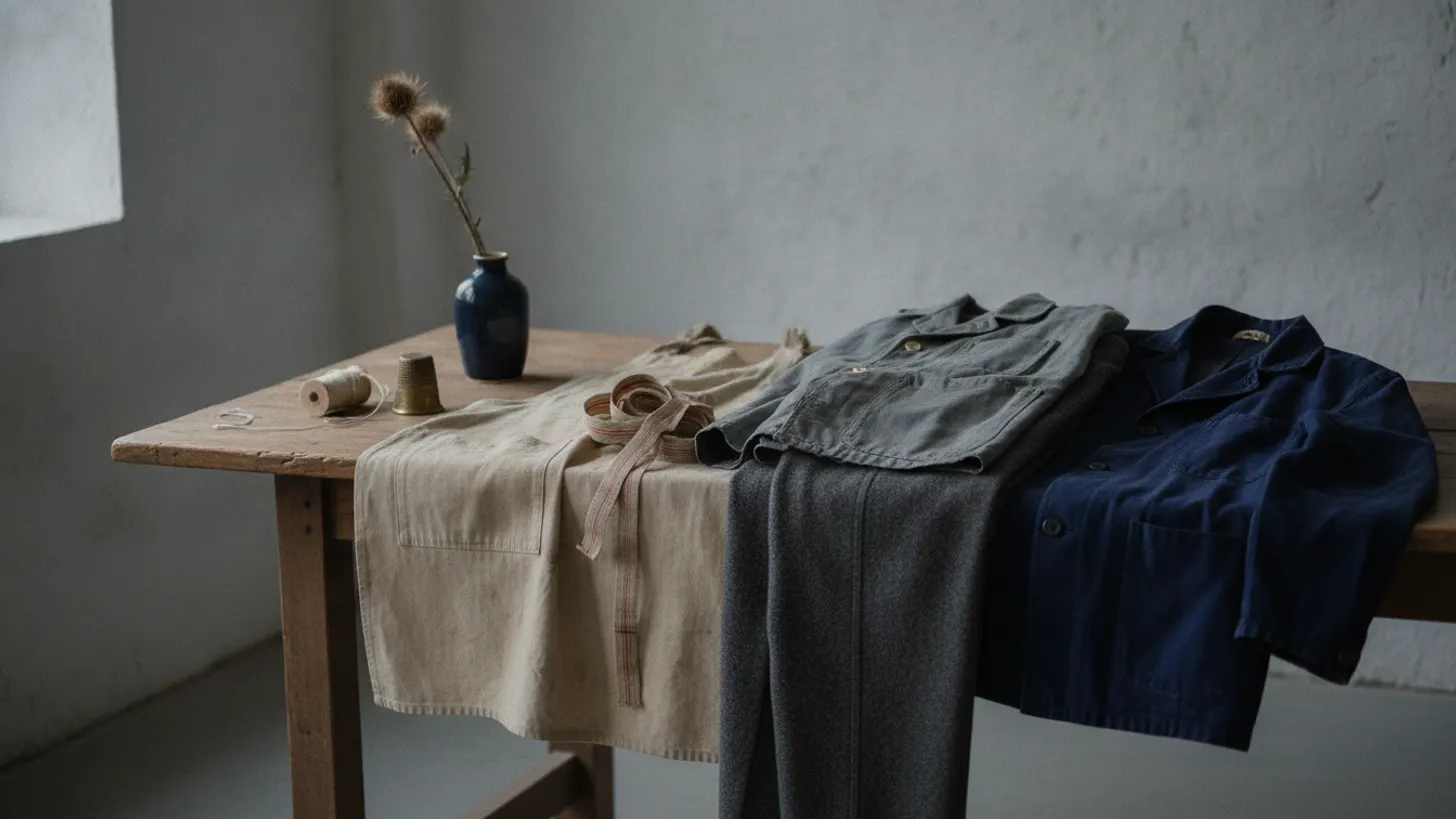
In a barn outside Lyon last spring, a dealer pulled a faded indigo jacket off a rail and handed it over without a word. Three patch pockets, a spare button stitched inside the hem, cotton worn soft as paper. That is the appeal of vintage French workwear: the wear is the record. Learn to read the fabric, the buttons, and the label, and the garment will tell you roughly when and where it was made.
What makes a piece of vintage French workwear authentic?
Authentic here means documented origin rather than a certificate. A genuine shell carries French-language marking, metric sizing, and factory construction built for movement: patch pockets set low, flat-felled seams, a boxy body, and a cut that ignores the waist entirely. You read provenance on the garment; nobody proves it for you. I inspect every coat that comes through Sol Siren by hand before it's photographed or listed, typically 30 to 40 pieces a month, and the French ones are usually the fastest to clear because the tells are so consistent once you know where to look. Fabric, buttons, label generation, and seam finish either agree with each other or they don't, and that agreement is the whole test. No single feature closes the case on its own.
Museum cataloguing gives you the method. Victoria and Albert Museum collection records index garments by country of manufacture and garment type, so an object logged as French, cotton, jacket becomes a reference you can hold a candidate against. The Museum at FIT catalogues along similar lines. Neither will authenticate your jacket, but both show what a defensible description looks like: material, origin, type, and a date range stated as a range.
On the garment, the French tells. Look for fabriqué en France, a size given as a bare number rather than S or M, and maker names that recur on French labels: Adolphe Lafont, Le Laboureur, Vetra, Molinel, Le Mont St Michel. Plenty of jackets carry no brand at all, because they were issued rather than bought. An unbranded shell is not a fake; it is a jacket that came out of a depot. What should make you pause is a crisp woven label on a shell with prewar wear, serged seams where a French factory would have felled them, or sizing in inches. The same cross-checking drives dating a vintage denim jacket, where hardware and label generation also have to agree with each other.
How moleskin, cotton twill, and linen differ in vintage French workwear
Moleskin is napped cotton with a dense, suede-like face. Cotton drill and twill are smooth diagonal weaves that fade to chalk blue. Linen and métis blends are older, cooler, and more fragile. Weight and surface, not colour, tell you which one is in your hands.
The Vintage Fashion Guild fabric resource is blunt about the first point, and it matters at the till: moleskin is a densely woven cotton with a brushed, napped surface, not animal leather and not suede. The name describes the hand, nothing more. A vintage moleskin jacket feels dry and soft under the thumb, turns faintly shiny at the cuffs, and holds a crease instead of hanging loose.
Indigo cotton drill is the cloth behind the phrase bleu de travail. It abrades at the high points and goes pale in a way that maps a body onto fabric. Métis, a linen and cotton mix, shows up on earlier shells: lighter, cooler, slubby, and inclined to tear rather than thin. Anyone reading vintage French workwear for the first time should pinch the cloth and hold it to a window, because the weave structure shows itself in a second.
| Fabric | Surface and hand | Where it turns up | What fails first |
|---|---|---|---|
| Moleskin, napped cotton | Dense weave, brushed face, dry and faintly furred | Hunting and estate jackets, winter chore coats | Nap rubs bald at cuffs, elbows, pocket mouths |
| Cotton drill or twill | Smooth diagonal rib, crisp new, chalky once faded | Factory, rail, and farm shells; the classic French chore coat | High points abrade, then shoulder cloth thins |
| Linen and métis blends | Slubby, cool, slightly stiff, pale or undyed | Earlier shells, smocks, summer jackets | Tears at stress points rather than wearing thin |
Which labels, buttons, and pockets date vintage French workwear?
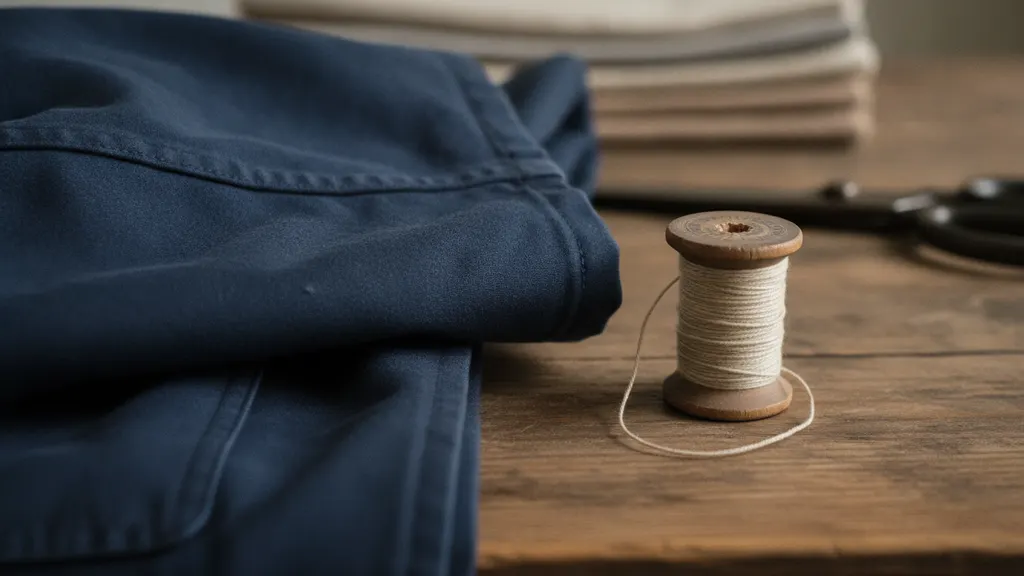
Four things do most of the work: label generation, button material, pocket count, and seam finish. None of them dates a jacket alone, but together they can bracket a shell to a single decade, and sometimes tighter. A cut that reads 1950s paired with a 1980s moulded button is the classic mismatch, and it usually means a later reissue rather than a true outlier. Dating vintage French workwear means finding the narrowest window in which all four features could plausibly coexist.
Labels move from stamped or printed cotton tape to woven brand labels, and later to printed care labels with fibre content and wash symbols. A shell with no label, or with a faint rubber-stamped size inside the collar, generally sits earlier than one with a glossy woven tag. The Costume Institute at the Metropolitan Museum of Art publishes object records showing how institutions bracket garments by construction when no label survives, and that logic transfers straight to a market stall.
Buttons are the fastest read. Early shells carry metal buttons, pressed tin, or four-hole corozo nut; later ones carry the moulded cat-eye button in chalk or dark brown; later still, plain polyester. Count pockets while you are there: two at the hip and one on the chest is the familiar three-pocket French chore coat, and a spare button stitched inside the hem is a factory habit worth finding. The same feature-by-feature approach drives dating vintage military jackets.
Read those bands as overlapping ranges rather than dates. One feature on its own narrows nothing; agreement between three or four is what gives you a decade.
We cover the details separately in How to identify vintage 1920s dresses: beading, bias, and labels.
We cover the details separately in Vintage 1960s mod dresses: a guide to shift shapes and labels.
How should you judge condition before buying vintage French workwear?
Sort what you see into three piles: honest wear, sound repair, and structural failure. Fade, shine at the cuffs, and a period darn sit in the first two and should not stop a purchase. Cloth gone thin and papery sits in the third, and no amount of mending fixes it.
Hold the shell up to a light. Sun rot and long abrasion show as a faint glow through the fabric at the shoulders, the outer elbows, and the pocket mouths. That glow is the one finding that should end a purchase, because the yarn has lost its strength and the next stitch you put in will pull through. I learned that lesson the hard way. In 2019 I listed a piece of vintage French workwear, a bleu de travail jacket, as light wear from four photographs alone, and missed a four-inch underarm split that had been papered over from the inside with a scrap of fusible interfacing. The buyer found it in better light than mine, and I refunded the full 165 dollars plus return shipping. I now hold every seam up to a window before it goes online and treat that check as non-negotiable. The repairable garment, patched or darned in the open, is the one worth owning; the one with something hidden under the cloth is not.
Stains divide by type. Oil and grease on a pale shell will probably stay, rust from a button or a nail rarely lifts, and water marks and general grime almost always come out. Check the pocket bags, which shred first and are cheap to replace, and check the underarm and centre back seam, where a jacket worn hard for twenty years splits. A shredded pocket bag is a five-dollar fix; a split centre back seam with rotted thread on both sides of it can run past fifty dollars at a tailor. Price any piece of vintage French workwear against the repair it needs rather than against the photographs.
Only one row in that grid is a hard stop. The rest are conversations about price.
How to style vintage French workwear without losing its character
Treat the jacket as the plainest thing in the outfit and let everything around it stay quieter still. These shells were cut for layering, so they sit well over a knit, a flannel shirt, or a second jacket. What flattens them is a hot iron and a partner piece that shouts back.
The crossover is not new. The V&A's account of British club style notes that workwear fabrics and industrial textures helped define early 1990s club dressing in Britain, which is roughly the moment the chore coat stopped reading as a uniform and started reading as a choice. Fashion coverage has circled back to the same silhouette every decade since, most recently in the 2020s utility-wear cycle.
Three ways to wear vintage French workwear now
Over a heavy knit with the sleeves pushed up and one button closed, so the boxy line looks deliberate. Open over a white shirt and wide trousers, letting the fade do the contrast work. Or under a larger coat as a mid-layer, which is how these jackets were worn in the first place. Keep the patches. Keep the ink stamp if there is one. Our guide to styling vintage clothing across eras goes further on proportion.
Frequently asked questions
Is moleskin fabric made from animal skin?
No. Moleskin is cotton, woven densely and then brushed so the face lifts into a short, soft nap. The name describes the hand, not the content. The Vintage Fashion Guild groups it with napped cottons, which is why a moleskin chore coat can be washed at home while a suede jacket cannot. Hold the cloth to a window: you will see a regular woven grid, never the irregular fibre structure of hide. If the label reads coton and the surface feels dry and faintly furred rather than slick, it is napped cotton.
What does bleu de travail actually mean?
It translates as work blue, and it names the indigo cotton drill jacket worn across French industry and farming for most of the twentieth century. The phrase describes a colour and a role, not one pattern, so it attaches to two-pocket and three-pocket shells, short jackets, and long coats alike. Smithsonian Magazine has covered how industrial dress became shorthand for labour itself. The practical consequence: bleu de travail is not a brand and not a date. Judge weave, buttons, label, and seam finish, and treat the phrase as a category.
How can I tell if a chore coat was really made in France?
Start with the marking: French-language size or care stamps, metric measurements, and maker names that recur on French factory labels such as Adolphe Lafont or Le Laboureur. Then check that the construction agrees with the label generation. The revival documented in New York Times Style coverage of workwear means modern reproductions now share rails with originals, so an unmarked listing stays unproven until you see the inside. A piece of vintage French workwear sold honestly comes with photographs of the label, the felled seams, the buttons, and the wear.
Is a chore coat with patches already on it still worth buying?
Often it is the better buy. A period darn or a square of contrast cloth over an elbow was put there by someone who wanted more years out of the jacket, and it belongs to the garment's record. Sourcing Journal tracks the repair and resale economics now pushing that same habit back into new clothing. What matters is what sits under the patch: lift an edge if you can, and feel whether the cloth around it is sound or has gone papery. Patches over thinning fabric spread the problem; patches over a clean tear hold.
How do I wash a vintage moleskin jacket without ruining it?
Cold water, inside out, mild detergent, short cycle. Moleskin is cotton and can be washed, but heat and agitation flatten the nap, and an indigo shell keeps releasing dye for several washes. Line dry out of direct sun, then lift the nap with a soft clothes brush once it is dry. Harper's Bazaar has made the general case for washing vintage less often and spot-cleaning more. Anything with original paint, oil, or a stamped maker's mark should stay dry and be brushed only. Our guide to cleaning vintage clothing covers drying and storage.
The size tag says 48. What does that mean?
Treat it as a factory code, not a measurement. French workwear sizing varied by maker and era, and these shells were cut boxy to go over a shirt and a knit, so the tag number will not map onto a modern chest size. Measure flat instead: pit to pit, shoulder to shoulder, back length, and sleeve from the shoulder seam, then compare against a jacket you already wear over a layer. The Business of Fashion has reported on how measurement disclosure drives resale trust. If a seller will not give those four numbers, skip it; see shopping vintage fashion online.