November 2026
How to identify vintage 1920s dresses: beading, bias, and labels
Learn to identify vintage 1920s dresses by silhouette, beadwork, labels, seams, and closures, with museum references and condition checks before you buy.
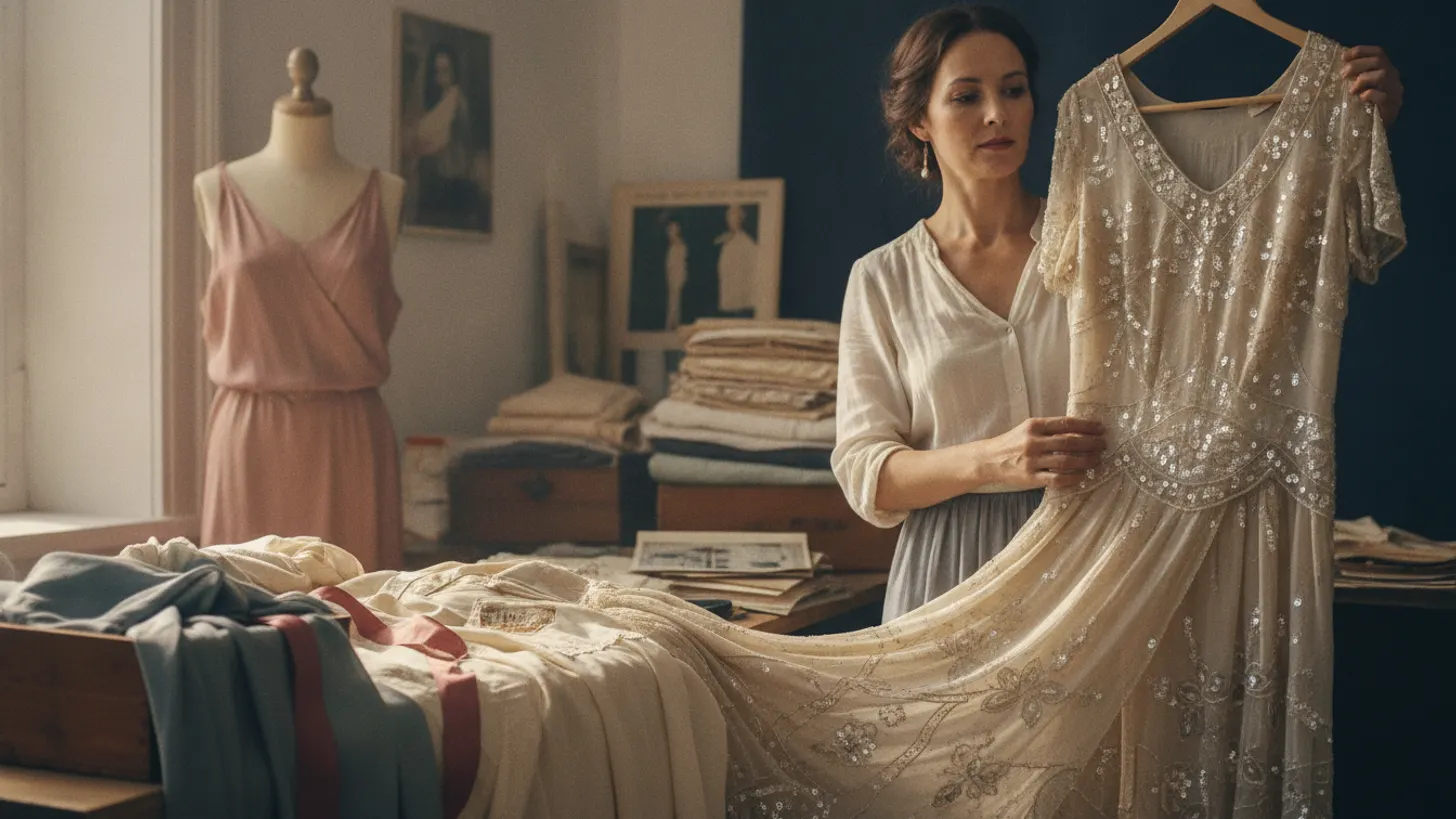
In 1924 Jean Patou cut an evening dress called Byzance, now held by the V&A in London, and it carries nearly every tell a buyer needs: a straight column, no seam at the natural waist, and beadwork that follows the grain instead of fighting it. Museums date vintage 1920s dresses the same way you can, by where the waist sits, how the embellishment is anchored, and what the seams admit.
What silhouette defines authentic vintage 1920s dresses?
A straight column. The Metropolitan Museum of Art describes the 1920s silhouette as columnar, with the waistline positioned around the hips, and that single fact resolves most listings. Authentic vintage 1920s dresses hang from the shoulder with no shaping at the natural waist, no bust darts, and no nipped side seam.
The drop waist carries the weight of the identification. If there is a horizontal seam, a sash, or a hip band, it should fall at or below the hip bone, not at the smallest part of the torso. The Metropolitan Museum of Art costume collection is the fastest free reference for calibrating your eye, because its dated evening dresses let you compare where a 1923 waist sits against a 1928 one.
The foundation garment matters as much as the cut. The Met identifies the bandeau brassiere as a defining foundation garment of 1920s dress, which explains why an original hangs oddly on a modern body in a modern bra. A dress that only reads correctly when the bust is flattened and the hip line is unbroken is usually telling the truth about its date.
Revivals and the Gatsby problem
Revival pieces from the 1960s and the 1980s copy the fringe and skip the engineering. They tend to have darts, a zipper up the center back, and a waist seam that creeps upward toward the natural waist. I learned this one the expensive way: early in my sourcing, I paid full price for a "flapper original" at an estate sale outside Atlanta because the fringe moved right and the beading looked dense enough to be convincing. I did not check the zipper until I got it home. It was a 1983 remake, not a 1920s dress, and that loss is why I now check the center back before anything else sells me on a piece. Fashion archives from the period are useful for seeing how the flapper line was redrawn in later decades rather than reproduced, but nothing replaces opening the garment yourself.
There is a full breakdown of this topic in Vintage French workwear guide: moleskin, chore coats, and labels.
There is a full breakdown of this topic in Vintage 1990s minimalist dresses: slip silhouettes, fabric, fit.
We cover the details separately in Vintage 1960s mod dresses: a guide to shift shapes and labels.
Which fabrics and embellishments appear in vintage 1920s dresses?
Silk chiffon, silk georgette, net, velvet, lamé, and rayon in the later years, loaded with glass seed beads, bugle beads, sequins of gelatin or metal, and silk fringe. Fabrics in vintage 1920s dresses are light and unstable by design, because the whole effect depends on a cloth that moves when the wearer does.
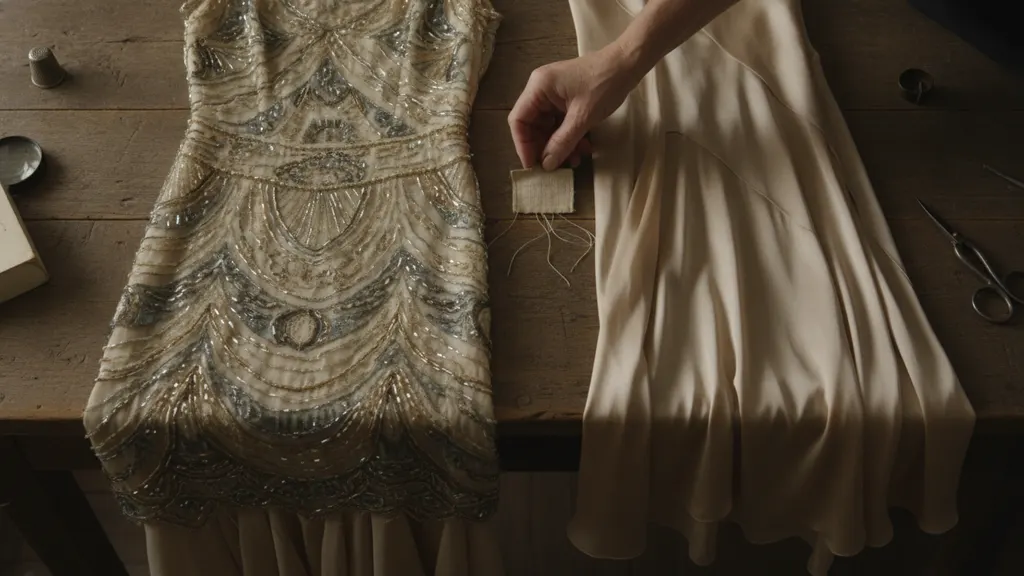
Beading is anchored, not glued. Glass seed beads and bugle beads were sewn row by row onto net, georgette, or chiffon, and sequins of gelatin or coated metal were stitched individually. The V&A catalogue record for Jean Patou's Byzance evening dress dates that piece to 1924, which gives a firm museum reference point for how dense and how geometric period beadwork could be.
Bias appears, but not the way it does a decade later. The 1920s used bias in godets, handkerchief points, and inserted panels, while the full bias-cut sheath belongs to the 1930s. The Vintage Fashion Guild fabric resource is the quickest way to separate early rayon from silk by hand and by eye, and the same logic applies when you are choosing between vintage wedding dress fabrics.
There is a full breakdown of this topic in How to identify vintage fabrics: rayon, acetate, nylon, polyester.
How labels, seams, and closures reveal a dress's age
Closures are the quickest date check. Zippers are rare in dresses before the mid-1930s, so a period dress closes with metal snaps, hooks and eyes, small side buttons, or nothing at all because it pulls over the head. Seam finishing should be pinked, bound, or hand-overcast, never machine overlocked.
Labels help less than people hope. Many period dresses were made by dressmakers or at home and never carried one, and woven name tapes were often cut out of the neckband. The Vintage Fashion Guild label resource is the reference dealers use to match typeface and weave against documented date ranges, and it is the one tool I would not try dating vintage 1920s dresses without. Printed fiber-content labels are a later habit, so their presence moves a dress forward in time, not back. The same reading method carries over to vintage 1940s dresses, where rayon and printed labels do most of the dating work.
| Clue | 1920s original | 1930s and later |
|---|---|---|
| Closure | Snaps, hooks and eyes, side buttons, or pull-on | Metal zipper at center back or side |
| Shaping | No bust darts, waist seam at hip or absent | Bust darts, bias panels, waist at the natural waist |
| Seam finish | Pinked, bound, or hand-overcast | Machine overlocked |
| Label | Woven name tape, often absent or cut out | Printed care and fiber content labels |
Thread matters too. Cotton and silk thread yellow and weaken with age, while polyester thread stays bright and strong. A single modern repair does not condemn a dress, but modern thread running through the construction seams does.
What condition problems matter most in beaded vintage 1920s dresses?
Shattering silk and bead loss, in that order. Most vintage 1920s dresses arrive with some bead loss, which is repairable, but a ground cloth that splits under light finger pressure is not. Check shoulders, underarms, the hip seam, and any area where bead weight concentrates.
Shattering is the term for silk that has gone powdery from age, light, and old dye chemistry, and it is the one damage type that ends a dress's wearable life for good. It shows up as fine vertical splits that open the moment the cloth is flexed, and no cleaning or stabilizing treatment reverses it once it starts. Weighted silk, which mills of the period treated with metallic salts to add body and drape, goes first and often fails within 60 to 80 years rather than lasting a full century; across the beaded 1920s dresses I have personally inspected and listed, something close to one in three with a weighted-silk ground already shows some degree of shattering by the time it reaches a buyer. The Museum at FIT publishes exhibition and object notes that describe this exact damage, and that vocabulary, shattering, splitting, powdering, is worth having in hand before you trust a stranger's condition report.
Bead loss is a different problem. Missing beads can be replaced if you can source a match, and a seller who includes a small envelope of original beads is doing you a favor. Cleaning is where most damage happens, so read how to clean vintage clothing before any attempt, and never put a beaded dress in water.
We cover the details separately in How to buy vintage cashmere: fiber tests, labels, and condition.
How to measure, style, and store vintage 1920s dresses
Measure flat, style low, store flat. Because vintage 1920s dresses were cut to skim a flattened bust and an unbroken hip, the hip measurement decides fit and nothing about the garment stretches. Styling follows the same logic: long ropes of beads, a low heel, and a cloche or bandeau.
Take the measurements yourself or ask for them flat: shoulder to shoulder, bust, hip, waist if a seam exists, and length from shoulder to hem. The hip number is the one that fails. If you are buying remotely, the discipline described in how to shop vintage fashion online applies here, with extra photographs of the inside shoulders.
Styling is a matter of restraint. Long ropes of glass or paste beads, a bandeau or cloche, a low heel, and nothing cinched. The vintage costume jewelry guide covers how to tell period paste from later reproduction, and Smithsonian Magazine's reporting on 1920s social history is a good corrective to the costume-party version of the decade.
Storage is the last step and the one most often got wrong. Flat, boxed, acid-free, tissue in every fold, no hangers and no plastic.
Frequently asked questions
How can I tell if a 1920s dress is original or a later reproduction?
Look at three things in order: the waist, the closures, and the inside finishing. An original hangs from the shoulder with any horizontal seam at hip level, closes with snaps, hooks and eyes, or a few side buttons, and shows hand-finished or pinked seam allowances rather than overlocking. A center-back zipper, bust darts, or polyester thread points to a revival piece. The Met's online collection of dated 1920s evening dresses lets you compare a listing photograph against catalogued originals from the same years before you commit any money to a purchase.
Can I actually wear a beaded 1920s dress to an event?
Sometimes, and the answer is in the shoulders. Beadwork is heavy, aged silk is brittle, and the weight hangs from the narrowest part of the garment, so a dress with sound shoulder seams and a stable ground cloth can be worn carefully for a seated evening. One with powdering silk or split seams should be displayed instead. Auction condition reports from houses such as Christie's describe this exact failure pattern in beaded 1920s lots, and that language is a good model for the questions you put to a seller.
Why do so many vintage 1920s dresses have no label at all?
Labels were not standard practice. Many dresses were made by dressmakers or at home, and even house-made garments often carried only a woven name tape that has since been cut out of the neckband. Absence of a label is not evidence against age, and the presence of one proves little on its own unless the typeface, weave, and wording match the period. The Vintage Fashion Guild maintains the reference most dealers use for cross-checking label styles against documented date ranges.
What size will a 1920s dress be on a modern body?
Smaller than you expect, and not in the way modern sizing implies. The cut assumes a flattened bust and an unbroken hip line, so the hip measurement is the limiting one, not the bust. Measure the garment flat, compare hip and shoulder width, and allow nothing for stretch, since vintage 1920s dresses in silk have no give and beaded grounds cannot be let out. Harper's Bazaar and other period archives show how the line was meant to skim rather than fit, which is the standard to judge against.
Is an authentic 1920s beaded dress worth buying as a collectible?
As an object, yes. Dated, documented, wearable beaded dresses from the decade are finite, and the market for them is reported alongside other collecting categories by houses such as Sotheby's. Buy condition and documentation rather than a label alone, because a sound unlabelled dress holds interest better than a damaged signed one. I would not treat any garment as a financial instrument, though. Provenance notes, clear photographs of the beadwork ground, and an honest condition disclosure are what keep a piece worth owning over time.
What is the right way to store vintage 1920s dresses?
Flat, dark, and supported. Hanging is the main cause of loss in beaded garments, because the beads pull on brittle silk until the shoulder gives. Store vintage 1920s dresses flat in an acid-free box, with unbuffered tissue rolled at every fold, and no plastic anywhere near them. Keep the box away from light and from attic or basement temperature swings. Textile care reporting in The New York Times repeats the same advice museums follow, and the rule is simple: never let a beaded dress carry its own weight on a hook.