November 2026
How to identify vintage fabrics: rayon, acetate, nylon, polyester
Learn how to identify vintage fabrics by hand, drape, and label: rayon, acetate, nylon, and polyester tells, plus safe tests that never risk the cloth.
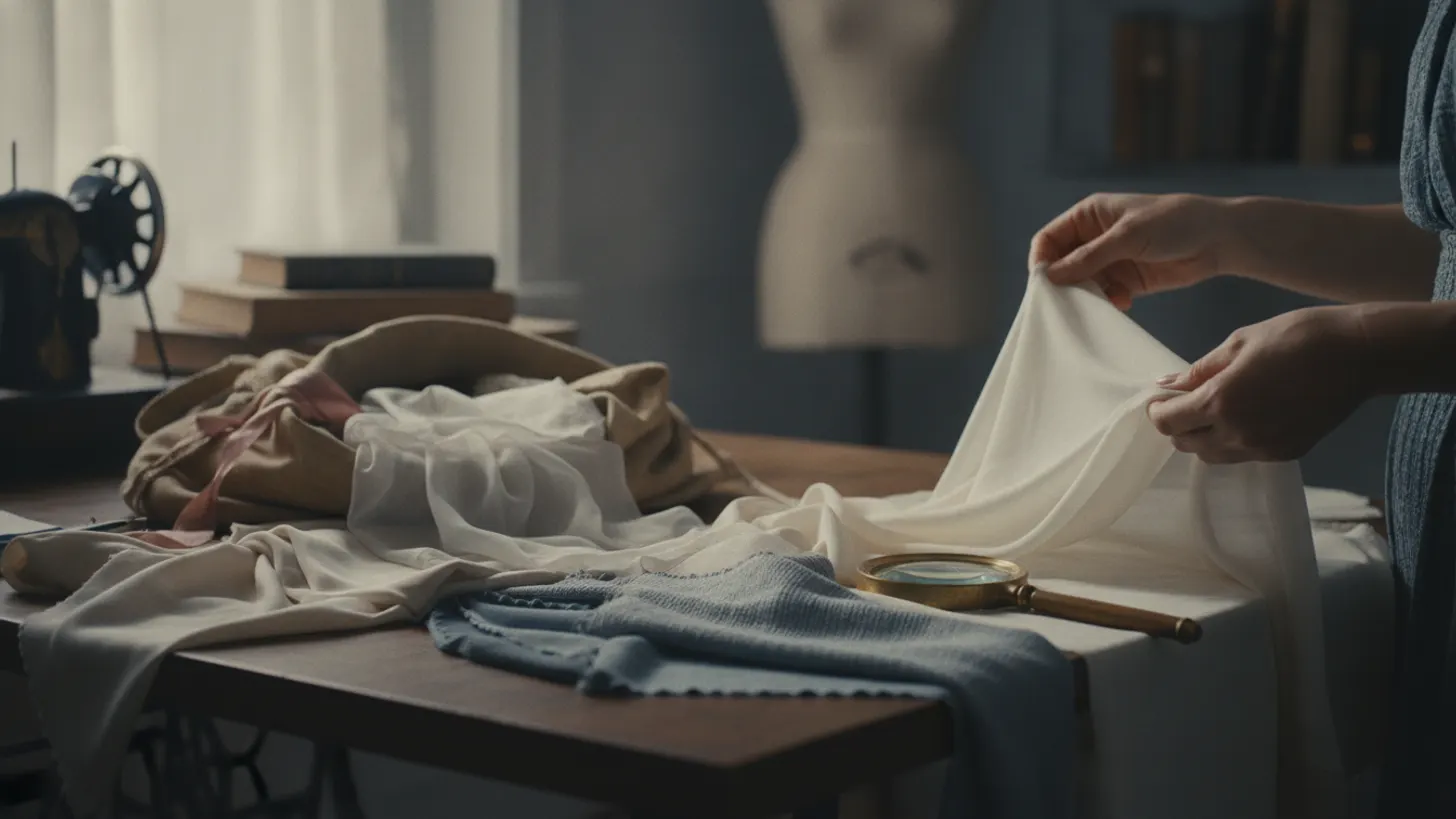
a woman in Asheville sent me three photos of her grandmother's 1947 dress and one question: silk, or something else. The seam allowance answered before the label did. Learning how to identify vintage fabrics is less about chemistry than about reading the small evidence a garment carries, the hand of the cloth, the shine at the hem, the typography on the tag. Here is the order I work in, and what each clue rules out.
How to identify vintage fabrics without a laboratory
Work from the outside in: weight in the hand, how the cloth falls, how a crushed corner recovers, then the label. Natural fibers wrinkle softly and hold a crease. Early synthetics stay cool and slick, spring back fast, and collect static. That first sort does most of the work.
Cotton and linen crush and stay crushed. Wool recovers slowly and gives off a faint animal warmth when you hold it in your palm. Silk warms to the skin almost at once and makes a dry whisper when rubbed against itself, the sound dealers call scroop. Rayon copies that shine without the warmth, which is the oldest confusion in the trade. The Smithsonian explains that rayon was developed as a silk substitute from chemically processed wood pulp, so it was built to pass this exact test.
The second half of the work is chronology, and it is unforgiving. A fiber cannot sit in a garment made before that fiber reached the market, so dates alone rule out whole families of error. Anyone practicing how to identify vintage fabrics should hold four years in mind: rayon in US commercial production from 1910, acetate from 1924, nylon from 1939, and polyester, sold here as Dacron, from 1951.
Those spans are why a 1930s bias-cut gown can be rayon but never polyester, and why a dress with a polyester label and 1940s construction is usually a later copy. My notes on identifying rayon in 1940s dresses work through that overlap in more detail.
How to identify vintage fabrics by hand: what rayon, acetate, nylon, and polyester feel like
Touch is faster than any chart once you know what each fiber does. Rayon falls heavy and cool. Acetate shines hard and creases sharply. Nylon feels thin, slippery, and slightly electric. Polyester springs back from a crush almost instantly and holds body heat against the skin.
Rayon has a weight that surprises people. A 1940s rayon crepe dress hangs like liquid, wrinkles across the lap after an hour of sitting, and darkens where water touches it. Pull a damp seam allowance gently and you can feel it give, because rayon loses strength when wet. I learned that the hard way on a 1946 rayon crepe dinner dress: I rinsed a faint deodorant stain at the underarm, and the wet seam tore before I could blot it dry. That dress is why I now quote every client a no water policy before a rayon piece leaves my hands.
Acetate reads as satin from across a room and as plastic in the hand. Its shine is flat and glassy, its folds break into permanent lines, and a warm iron plate will melt it outright. Midcentury linings, taffeta underskirts, and ribbon are often acetate even when the shell is silk or wool, and the two age at different speeds.
Nylon changed the pace of everything. The Smithsonian's history coverage of DuPont nylon notes that the fiber became a household word within a year of its introduction to the consumer market, debuting in stockings in 1940 and selling out within hours in some cities. Wartime demand then pulled nylon away from fashion almost entirely: mills converted to parachutes, tents, and rope, so almost no nylon garments date from 1942 through 1945. Civilian supply resumed after the war, and by the early 1950s nylon slips, blouses, and linings were common in ordinary closets. In the hand it is light, cool, faintly rustling, and quick to hold static, and unlike rayon it keeps most of its strength when wet, which is one of the fastest ways to rule rayon out. Study holdings such as The Museum at FIT teaching collection are a good place to see how differently nylon drapes from silk at the same weight.
Polyester is the one most people misdate. It arrived in 1951, not 1972, and its early forms were thin and crisp rather than the thick double knits of the disco years. Squeeze a handful for five seconds and release: polyester opens almost flat, where rayon keeps the memory of your fist. Learning how to identify vintage fabrics means separating a fiber's first year from its famous decade, a distinction I use constantly when dating 1970s disco dresses.
Read that matrix as a sorting tool, not a verdict. Two fibers can pass the same check. Three agreeing checks plus a plausible date is what makes an identification worth writing into a listing.
The same four checks read cleanly in table form too.
| Fiber | First US year | Crush recovery | Water marks | Heat risk |
|---|---|---|---|---|
| Rayon | 1910 | Slow | Yes, darkens | Chars |
| Acetate | 1924 | Poor | Yes, spots | Melts at low heat |
| Nylon | 1939 | Fast | No | Melts |
| Polyester | 1951 | Fast | No | Melts |
How to identify vintage fabrics from labels and dates
Labels date garments faster than fiber does, when they survive. US law has required fiber content on most clothing since 1960, so an unlabeled dress is often older, a cheap copy, or simply missing its tag. Registration numbers, union labels, and care symbols each carry their own date range.
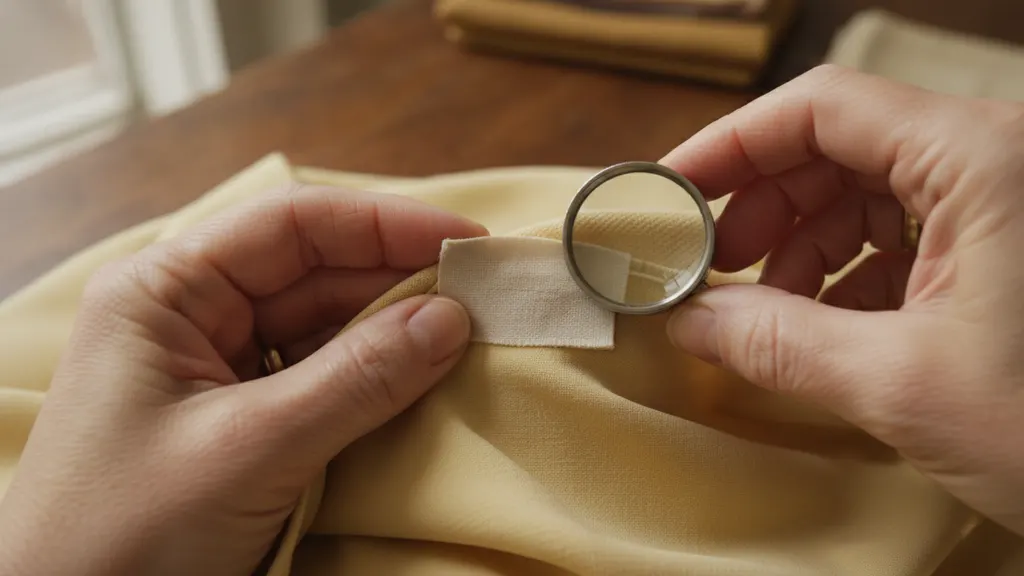
Four label clues do most of the dating. A WPL number points to roughly 1941 through 1959; an RN number begins in 1959 and continues today; printed fiber percentages follow the 1960 labeling requirement; and sewn-in care instructions became standard in the early 1970s. The Vintage Fashion Guild label and fabric resources are what I check first, and museum catalogues such as the Metropolitan Museum of Art costume records show how often early synthetics were listed by trade mark rather than fiber. Much of how to identify vintage fabrics is really learning that vocabulary.
| Trade name | Fiber | In use from | What it signals |
|---|---|---|---|
| Avisco, Viscose | Rayon | 1910s | The earliest manufactured fiber you will meet |
| Bemberg | Cupro rayon | 1920s | Fine linings and sheer blouses |
| Celanese, Acele, Estron | Acetate | 1924 | Glassy shine, melts under a warm iron |
| Nylon, Antron | Nylon | 1939 | Light, slick, static-prone |
| Dacron, Terylene | Polyester | 1951 | Fast crush recovery, sheds water |
| Arnel | Triacetate | 1954 | Pleats that hold their shape |
| Qiana | Nylon | 1968 | A reliable late-1960s to 1970s marker |
How to identify vintage fabrics safely, and why burn testing is not the way
Identification and burn testing are not the same activity. A flame tells you something about a thread and nothing you can undo. For a garment you plan to wear, sell, or keep, the goal is a reading built from several non-destructive checks that agree with each other.
Heat and flame damage vintage textiles for good, and they do it where it shows: acetate melts, nylon shrinks into a hard bead, rayon chars and takes the weave with it. A singed hem is a condition note forever. Treat how to identify vintage fabrics as observation first, and keep any destructive check for a loose thread already shed inside a seam allowance, taken with the owner's knowledge and recorded in the listing.
My order runs like this: hold the cloth to the cheek for warmth; let it fall over one hand and watch the fold; crush it and count how long recovery takes; listen while rubbing it against itself; look at a single thread under a ten-times loupe for filament uniformity; place one drop of water on a hidden allowance; then read every label, stitch, and closure. The same sequence works on knits, which is why it turns up again in my guide to buying vintage cashmere.
How to identify vintage fabrics before you clean, store, or resell
Care follows fiber, so how to identify vintage fabrics is a practical question before it is a scholarly one. Rayon weakens in water. Acetate dissolves in acetone and spots in rain. Nylon yellows with light and age. Polyester keeps oils and odors. One wrong wash undoes seventy years.
Wash nothing you have not identified. Rayon and acetate go to a cleaner who is told exactly what they are holding; nylon and polyester tolerate cool hand washing and no heat at all. Storage is where value disappears quietly: the V&A textile care and conservation guidance favors stable temperature, padded hangers or flat boxes, acid-free tissue, and no plastic bags. My routine for cleaning vintage clothing at home follows the same logic.
At resale, fiber belongs in the description rather than in a promise. Auction houses including Christie's, through its published condition reports, describe what has been observed and leave room for doubt, which is the right model for a one-of-one listing. Say what you believe the fiber is, say how you reached that view, and photograph the label. Buyers who have read this far will check your reasoning, and the honest listings are the ones they return to. The same holds for choosing vintage wedding dress fabrics, where fiber decides what a fitting can safely alter.
Frequently asked questions
Is rayon a natural fabric or a synthetic?
Rayon sits between the two, which is why it confuses people. It begins as cellulose, usually wood pulp, then goes through a chemical process that reforms it into filament, so it is called regenerated or manufactured rather than synthetic. The Smithsonian account of rayon's invention explains that it was developed as a silk substitute from chemically processed wood pulp. In the hand it drapes heavily, takes dye brilliantly, wrinkles like linen, and loses strength when wet, which is why a 1940s rayon dress should never be wrung out or soaked.
How do I tell acetate from silk in a 1950s dress?
Acetate has a glassy, almost plastic shine where silk has a softer one, and it stays cool against the palm while silk warms within seconds. Acetate also creases into sharp fold lines that will not shake out, and it water-spots, so check hems and underarms for pale rings. Construction helps too: acetate linings and taffeta skirts were common by midcentury, and the Vintage Fashion Guild fabric and label resources date many trade names printed on those tags. A thread from a seam allowance looks flat and uniform under a loupe rather than irregular.
When did nylon start showing up in everyday clothing?
Nylon arrived at the end of the 1930s and moved quickly. Smithsonian history reporting on nylon records that DuPont nylon became a household word within a year of its introduction to the consumer market, first through stockings, then through wartime uses that pulled it away from fashion and back again after 1945. So a nylon blouse or slip is plausible from about 1940 onward and very common by the 1950s. If a garment with pre-1939 construction tests as nylon, the fiber is telling you the piece was altered, relined, or dated wrong.
Does polyester always mean the garment is from the 1970s?
No. Polyester reached US shoppers in the early 1950s under the Dacron name, two decades before the double-knit era that gave it a reputation. What changed in the 1970s was volume and weave, not availability. The Good On You fiber guides describe polyester as a petroleum-derived fiber, and that chemistry is what you feel: it sheds water, holds body heat, and springs back from a crush at once. Read the label typography, the zipper, and the seam finishes, because how to identify vintage fabrics is never one signal on its own.
What is the safest fiber test I can do at home?
The water drop and the warmth test, in that order, because neither one changes the garment. Put a single drop of water on a hidden seam allowance, wait a minute, and watch: rayon and acetate darken and can mark, while nylon and polyester bead and shed it. Then hold the cloth to your cheek for ten seconds and judge warmth. V&A collections and conservation practice is a useful model, since it rests on observation and documentation. Any home approach to how to identify vintage fabrics should start there, with flame and solvents left out.
Does fiber content change what a vintage piece is worth?
Often, though less than condition and cut. Silk, wool, and cashmere still carry the most weight at resale, while early rayon and acetate are valued for print, drape, and era rather than fiber prestige. Trade reporting in Sourcing Journal's fiber market coverage tracks how thoroughly polyester now dominates global fiber production, which is part of why scarce natural-fiber pieces read as special. The practical point for sellers is disclosure: name the fiber you believe you have, say how you reached that view, and photograph the label and every flaw.