October 2026
Vintage wedding dress fabrics: how to choose silk, satin, or lace
A curator's guide to vintage wedding dress fabrics: how silk, satin, lace, and rayon differ in drape, wear, and care, plus how to date a gown without damage.
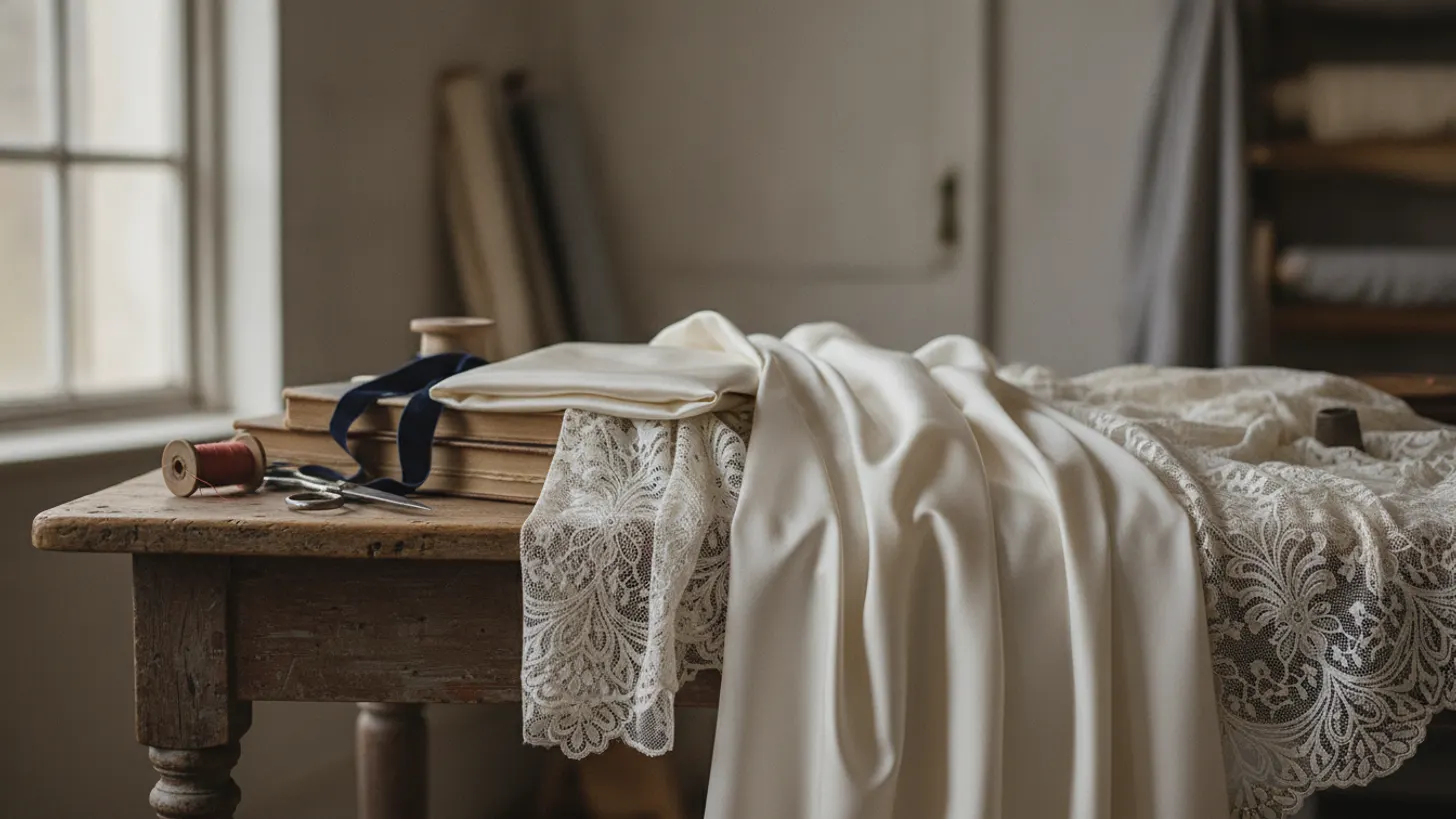
In February 1840 Victoria married Albert in cream Spitalfields silk satin trimmed with Honiton lace, and white became the bridal default for anyone who could afford it. Almost two centuries on, the same short list of cloths still decides what a gown can do. Learning to read vintage wedding dress fabrics tells you how a dress will move at the hip, what a seamstress can let out, and how many more wearings it has left.
How silk, satin, lace, and rayon differ in vintage wedding dress fabrics
Silk is a fiber, satin is a weave, lace is a structure, and rayon is a manufactured cellulose fiber that can imitate all three. Sorting those four categories does most of the work of reading vintage wedding dress fabrics, because one 1940s gown often carries three at once: a silk bodice, a rayon slip, a cotton lace yoke.
Silk reaches bridal sewing as satin, charmeuse, crepe, faille, and organza, and each has its own weight and its own failure mode. Silk satin is dense and reflective, holds a sculpted line, and shows every pin hole. Silk crepe is matte, falls close to the body, and carried the bias cutting Madeleine Vionnet made standard in the 1930s. The Costume Institute holdings at The Met trace silk satin, lace, and embroidered textiles through historic bridal and formal dress, which is the shortest way to see how narrow the real palette has always been.
Lace is not one material either. Handmade bobbin laces such as Honiton and Brussels are worked in cotton or silk thread without a ground cloth, while machine nets from the mid nineteenth century onward carry applied motifs. The V&A wedding dress collection notes record how Victoria's 1840 Honiton order read as patronage as much as decoration, which is why so much later trim copied it.
Rayon is the fiber most often mistaken for silk among vintage wedding dress fabrics. It entered bridal sewing in volume from the 1920s and stayed common for decades, and the Vintage Fashion Guild fabric resource remains the clearest free reference for separating the two. Rayon loses strength when wet, spots readily, and goes limp rather than crisp with age. A dress sold as satin from 1935 may be rayon satin, and that one fact changes every cleaning decision after it.
| Era | Cloth you usually meet | What to check first |
|---|---|---|
| 1890s to 1900s | Silk faille, cotton net lace, organza | Underarm shields, boned bodice tape, hook closures |
| 1920s | Silk charmeuse, beaded net, metallic lamé | Bead threads, shoulder seams, hem weight |
| 1930s to 1940s | Bias silk crepe, early rayon satin | Hem stretch, water marks, side zipper type |
| 1950s | Heavy satin, nylon tulle, Chantilly-style lace | Brittle tulle, waist stay, underarm staining |
| 1960s to 1970s | Cotton lace, light blends, crepe | Yellowed lace, union label, care tag |
Which vintage wedding dress fabrics are most durable and wearable today
Heavy silk satin and woven silk faille survive the most wearings. Cotton net lace sits in the middle. Bias silk crepe and early rayon satin are the two that fail during a long day rather than in storage. Weight, seam allowance, and underarm condition predict wearability far better than age does.
A wedding day stresses vintage wedding dress fabrics the same way every time: a long stretch of standing, sitting, hugging, and lifting arms overhead, and the places that give way are predictable. The underarm comes first, where old perspiration salts have already weakened fiber. Then the waist stay, which carries the whole skirt. Then the shoulder seams of a lace overlay, where thread was never the strong part. Christie's textiles and couture sale records show condition rather than label setting the value of historic dress, and the same logic should set your buying ceiling.
Bias gowns from the 1930s deserve both their reputation and their caution. Cut on the diagonal, the cloth stretches under its own weight, so a dress that fits at noon can hang long by the toasts. With original beading, assume the thread is older than the beads look and ask for a condition note in writing. Reporting on the vintage bridal market in the New York Times has followed buyers toward older gowns for cost and character, which has made plain condition disclosure the thing actually worth paying for.
How to identify vintage wedding dress fabrics without damaging the gown
You can get most of the way there with light, touch, and the inside of the garment. Hold a hem to a window, scrunch a seam allowance, read the stitching and the selvedge. No burn test, no solvent, no pulled thread, because those cost more than the answer is worth on a gown you intend to wear.
Hand, light, and scrunch tests for vintage wedding dress fabrics
Silk warms to the hand within seconds and lets a crease go slowly. Rayon stays cool, creases sharply, and keeps the crease. Held to a window, silk shows slight irregularity along the filament while rayon looks uniform and faintly glassy. Cotton lace feels dry and a little sandy. Nylon tulle from the 1950s feels springy and turns brittle at the fold lines. Smell counts as evidence: a sour note at the underarm means perspiration damage that will not come out, and a listing should say so rather than crop around it.
What the interior tells you
Turn the gown inside out. Pinked seam allowances, a metal side zipper, a waist stay with a hook, hand-finished hem facings, and a union label each narrow the date. The museum and study collections at FIT show bridal silhouettes shifting substantially from the nineteenth century through the twentieth, and interior construction moved with them. The reading habits in my notes on dating a vintage handbag by hardware and lining carry over directly: the outside is styled, the inside is honest.
Which historical silhouettes suit silk, satin, or lace
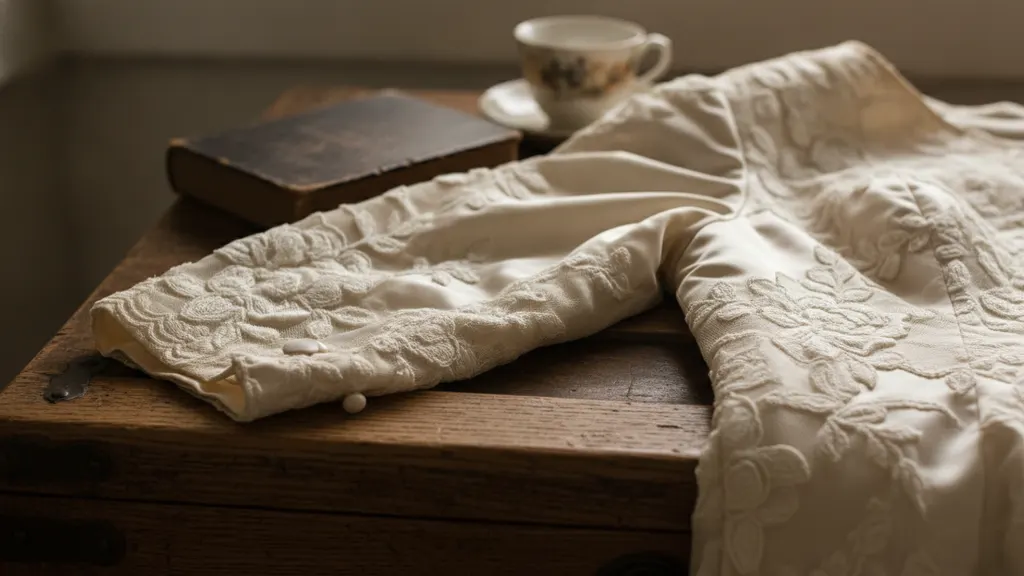
Cloth and silhouette were designed together, so the vintage wedding dress fabrics you choose narrow the shapes available to you. A 1950s satin bodice resists being slimmed into a 1930s line, and a bias crepe gown refuses a crinoline. Pick the decade that already made the shape you want, then alter inside that logic.
The 1890s gave structured silk faille with leg-of-mutton sleeves over a boned bodice. The 1920s dropped the waist and wanted charmeuse or beaded net that could hang straight. The 1930s moved to bias silk crepe against the body. Post-war years brought heavy satin over nylon tulle and the full skirt that still reads as bridal at a glance. The 1970s revived cotton lace and high necklines, the same Edwardian romance behind the penny lane coat silhouette. Vogue's bridal archive is a fast way to confirm which decade you are drawn to.
For a sleeveless column, shop 1930s crepe. For a defined waist and volume, shop 1950s satin. For sleeves and softness, shop 1900s or 1970s lace. Buying outside those pairings usually costs more in alterations than choosing the right vintage wedding dress fabrics for your shape would have, and the fashion and textiles listings at Sotheby's are free to study for the pairings. Measure before you fall in love, since old labels and modern sizes disagree; this vintage size conversion guide explains the gap.
How to clean, store, and travel with vintage wedding dress fabrics
Treat the gown as one object made of several different vintage wedding dress fabrics, each with its own tolerances. Identify the fiber first, then choose the mildest possible intervention. Most of the damage I see arrived through a well-meant wash, a warm attic, or a plastic garment bag rather than through wear. I learned this the expensive way on a 1938 bias silk crepe gown I dated by eye instead of testing: I logged it as silk, steamed a soft fold out of the skirt the way silk tolerates, and watched the hem stretch two inches by the next morning because the cloth was rayon-blend crepe, not pure silk, and heat plus its own weight did the rest. The gown recovered with rest and a flat re-fold, but I never skip the hand test again, not even on a dress I am certain about.
Most vintage wedding dress fabrics tolerate careful storage better than they tolerate cleaning. Do not wet-clean rayon or beaded silk at home. Spot test on a hidden seam allowance, use cool distilled water, and blot instead of rubbing. Smithsonian Magazine's reporting on textile conservation is a good primer on why conservators prefer doing less, and the home-safe cases for other garments are in my guide to cleaning vintage clothing at home.
Store flat where you can, or hang briefly on a padded hanger with the weight carried by twill tape at the waist stay. Use unbuffered acid-free tissue in the folds, a cotton sheet rather than plastic, and a cool dark closet rather than an attic or a basement. The method matches my notes on storing vintage outerwear. For travel, carry the dress on, lay it flat in the overhead bin with tissue in the folds, and refold it at the hotel within the hour. On fiber choices more broadly, the fiber guides at Good On You explain why the older cloth is usually the lower impact purchase.
Before any cutting, ask the tailor three questions: is the change reversible, does the original seam allowance give room, and what happens to the lace repeat at the join. A gown that answers all three well is worth more than a prettier one that answers none.
Frequently asked questions
Is vintage satin always silk?
No. Satin names a weave, not a fiber, so a gown described as satin can be silk, rayon, acetate, or polyester depending on when it was sewn. Among vintage wedding dress fabrics, satin is the most misread label on a listing. Rayon satin appears in bridal sewing from the 1920s and stays common through the 1950s, and viscose rayon is still a major textile story, as reporting at Sourcing Journal shows. Test by hand: silk warms fast and releases a crease slowly, while rayon stays cool and holds a sharp crease. If the seller cannot say, ask for close photos of the seam allowance and selvedge.
Can a vintage lace wedding dress be altered to fit me?
Usually yes, but within limits set by the lace repeat. A good tailor can take in side seams, shorten from the shoulder, and rebuild a bodice lining, though a motif cut through at the waist shows the join forever. Ask three things before any scissors: is the change reversible, does the original seam allowance give room, and where does the pattern land at the join. Letting out is much harder than taking in, which is why vintage bridal coverage in Harper's Bazaar leans toward buying slightly large. Price the tailoring as part of the dress, not as an extra.
How can I tell if a vintage wedding dress was stored badly?
Look for a hard yellow line along fold creases, rust-colored spots near metal fastenings, brittle tulle, and a sour note at the underarm. A hard fold line means the gown sat folded under weight and the fiber has already broken there, which does not reverse. Plastic garment bags trap moisture and leave a sheen or a smell. Sun damage shows as uneven fading on one shoulder and one sleeve. Secondhand shopping coverage at The Cut is a good reminder to ask how a piece was kept, because storage history predicts condition better than age does.
What is the safest way to clean a vintage wedding dress?
Do as little as possible, and identify which of the vintage wedding dress fabrics you own before anything touches water. Rayon weakens when wet, silk water spots, and beading hangs on thread as old as the gown. Spot test on a hidden seam allowance with cool distilled water, then blot rather than rub. For an heirloom piece, a conservation-minded specialist beats a standard dry cleaner, and wedding dress care guidance at Marie Claire makes the same point about asking which solvent will be used. Store it clean and dry rather than cleaning it twice.
Which decade of vintage wedding dress is easiest to wear today?
The 1970s first, then the 1950s. Seventies gowns were cut for an un-corseted body in cotton lace and light blends, so they sit on modern proportions with less work and they surface often. Fifties satin is sturdy and alters well, although the waists run small. Thirties bias silk is the most beautiful and the least forgiving, since it wants a body close to the original measurements and grows longer as the day goes on. Styling notes at Who What Wear are a fast way to see which decade suits your line before you commit.
Is buying a vintage gown cheaper than buying new?
Often, but condition is the variable. A 1950s satin gown in wearable shape can cost a fraction of a new designer dress, while a documented couture piece can cost far more than one. Resale and secondhand demand has kept climbing, as Business of Fashion has reported, which has pushed good vintage bridal prices up rather than down. Factor in alterations, cleaning, and any restoration before you compare, because the honest number is total cost on the day. Ask what has already been repaired and what the seller would not attempt.