July 2026
How to date a vintage handbag: hardware, lining, and maker marks
How to date a vintage handbag: a collector's field guide to reading hardware finishes, lining materials, maker marks, stitching, and resale value signals.
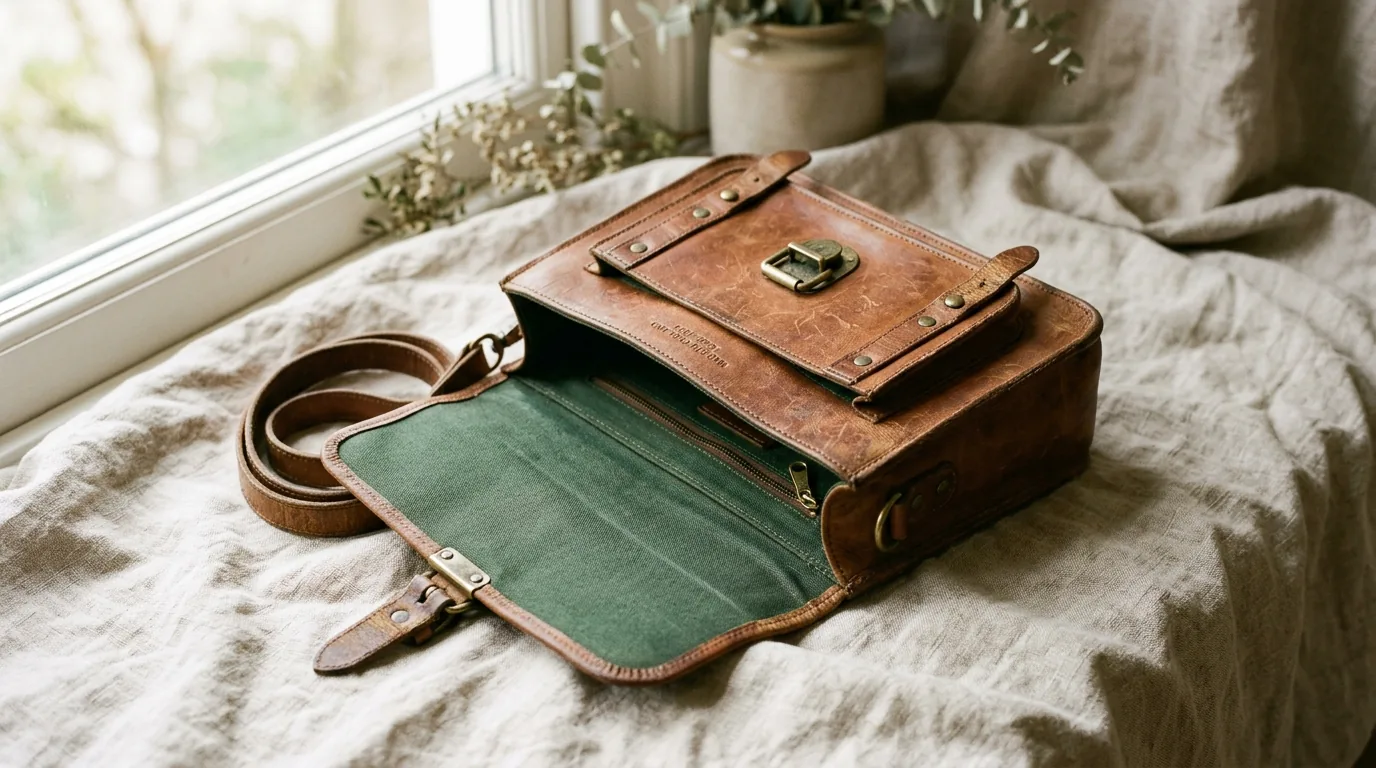
A reseller in Cleveland sent me a leather bag last spring that her grandmother had carried to a 1962 wedding. The lining smelled faintly of old peppermint. The brass had not been touched. Knowing how to date a vintage handbag means reading the small evidence first: a hardware finish, a thread color, a hidden tag, a stamp burned into leather. Those quiet details settle the decade long before any price guide does.
Hardware finishes and closures: the first clue when learning how to date a vintage handbag
Hardware is the loudest age tell on a bag, louder than the label. When learning how to date a vintage handbag, run a fingertip over the brass, weigh the buckle, and listen to the click of the closure. Pre-1950 hardware is solid cast brass with a heavy hand, often unmarked and warm in color.
Through the 1930s and 1940s, frames and clasps were cast brass or sterling silver with deep, even tarnish. Nickel-plated steel takes over in the late 1950s, lighter to the touch and prone to silver wear-through at stress points. The 1960s introduce gilt-brass with bright lacquer finishes, then matte gold-tone arrives in the 1970s with the rise of imported Italian leather goods. Tarnish itself is a tell: even oxidation suggests age, while a too-perfect plate suggests a recent reissue. The Vintage Fashion Guild keeps a useful label and hardware resource tracking these decade-by-decade shifts.
Closures follow their own timeline. Turn locks and kiss locks dominate from the 1920s through the 1950s. Magnetic snaps do not appear until the late 1980s, so a magnetic snap inside a "1970s" bag is an immediate red flag. Zipper teeth are a precise dating tool: brass tooth zippers run pre-1965, nylon coil zippers (often YKK marked) take over from the late 1960s, and plastic molded zippers belong to the 1990s and later.
Lining materials and colors in a vintage handbag
Lining is the bag's quiet honesty when learning how to date a vintage handbag. Open the inner gusset, hold it to natural light, and the weave reads like a decade tag. Through the 1930s, cotton sateen and silk twill lined most leather bags. Rayon takes over in the 1940s, often in warm browns and oxblood reds.
February 1955 is the date every collector memorizes: Coco Chanel introduced the 2.55 quilted bag with a burgundy jersey lining and the rectangular Mademoiselle lock, details the Metropolitan Museum costume collection uses to separate original production from later reissues. The burgundy was chosen because Chanel's convent uniform was burgundy, a biographical thread that turns a lining into a primary source. Reissued 2.55s from 2005 onward switch to the interlocking CC lock and lighter beige linings.
By the 1960s and 1970s, nylon and acetate twill replace silk for cost. Color shifts are diagnostic: rust orange and avocado interiors signal the early 1970s, dusty pink and mauve point to the early 1980s. Hermès uses chèvre or grosgrain through the period, both with a distinctive ribbed texture. The Victoria and Albert Museum textile guides document these period lining transitions and dating indicators.
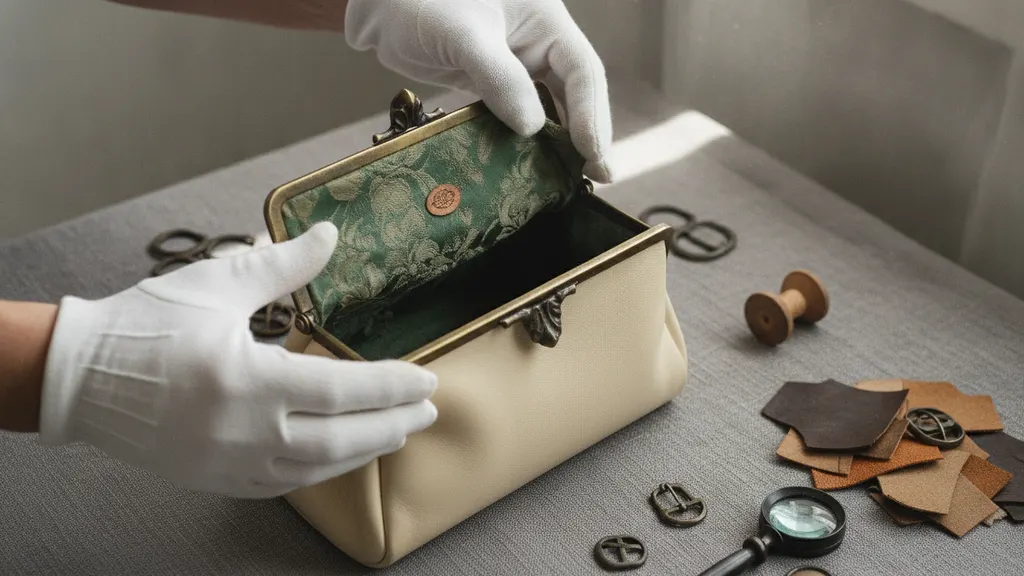
Maker marks, stamps, and serial numbers when learning how to date a vintage handbag
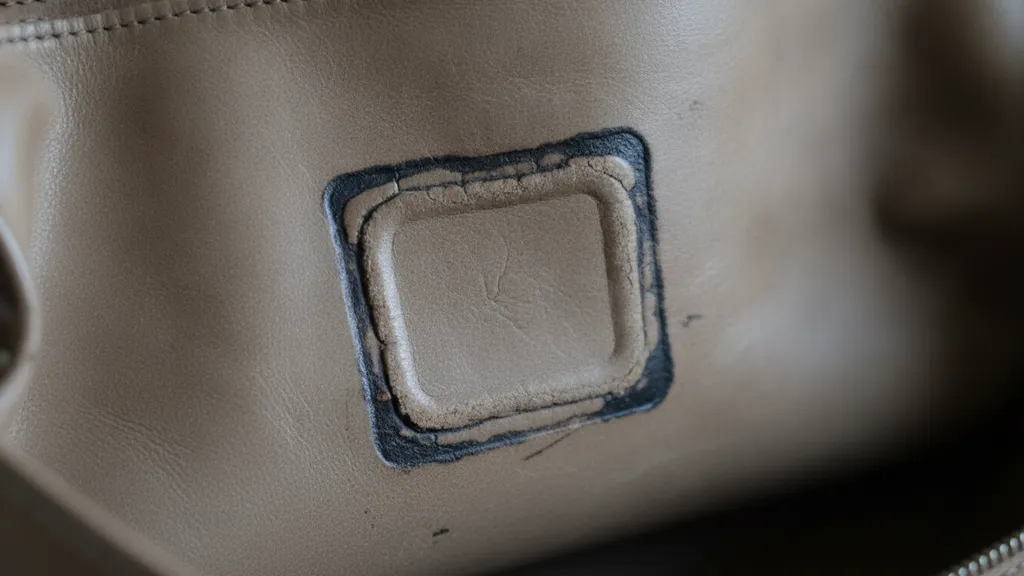
Every authentic pre-1971 Coach bag carries two fixed marks: a "Made in New York City" interior stamp and a unique style number burned directly into the leather. Knowing how to date a vintage handbag means reading those marks against documented production timelines, starting with the Coach baseline before moving to less systematic makers.
Hermès uses an alphabet year code stamped near the interior signature, a system documented by the FIT Museum collections alongside its accessories archive. A circled letter signals factory year between 1945 and 1970; a square letter belongs to 1971 onward. Chanel introduces serial number holograms in 1986, with seven-digit sequences then eight-digit from 2005. Gucci serial tags use a two-line format on the back of the leather tab, with style number on top and supplier code below.
| Brand | Mark style | Era introduced |
|---|---|---|
| Coach | "Made in New York City" stamp plus burned style number | Pre-1971 |
| Hermès | Year alphabet code (circled or squared letter) | 1945 to present |
| Chanel | Serial number hologram | 1986 to present |
| Gucci | Two-line serial on leather tab | 1960s to present |
| Louis Vuitton | Date code (letters plus four-digit week and year) | 1980s to present |
Treat any stamp that wipes off, sits crooked across the grain, or uses modern Helvetica on a "1950s" bag as fraudulent. Heat-burned stamps sink slightly below the leather surface. Foil-stamped marks ride flat above the grain. A 10x jeweler's loupe is the cheapest authentication tool a reseller can own.
Stitching patterns and thread color in vintage construction
Cotton thread dominates until 1969; polyester replaces it for the 1970s and after. That swap is the last reliable dating signal when learning how to date a vintage handbag. Cotton ages with a slight fuzzy halo at each stitch; polyester stays crisp and color-matched. Raking light shows the difference in seconds.
Stitch count is decade-coded. Pre-1960 luxury bags often run 8 to 10 stitches per inch in the saddle-stitch tradition, hand-pulled and slightly uneven. Machine stitching from the late 1960s onward runs 10 to 12 stitches per inch with mechanical regularity. Hermès still hand-saddle-stitches its leather goods today, with the irregular two-needle pull visible under magnification, a detail Christie's catalogues highlight in their handbags and accessories department notes.
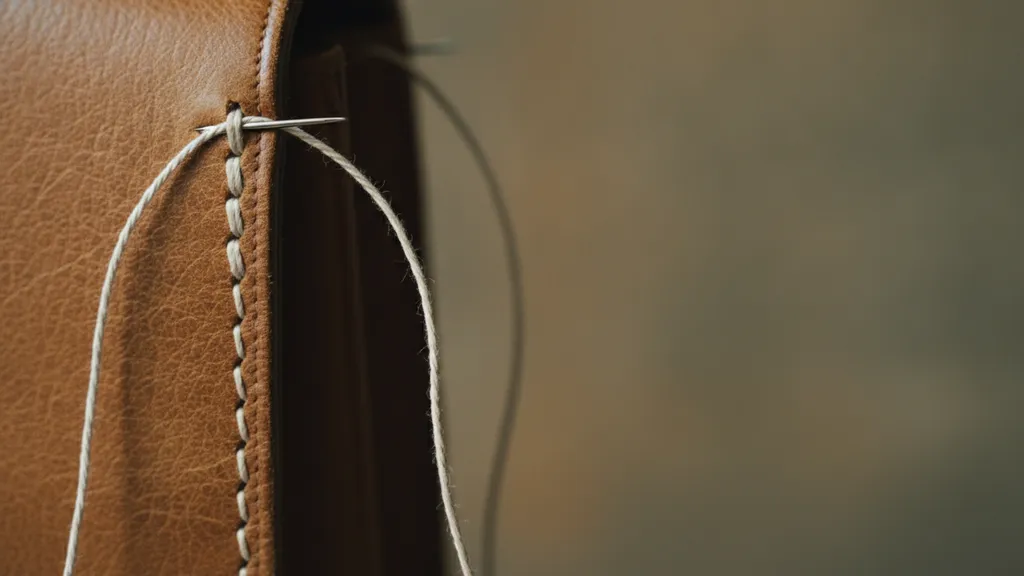
Thread color is its own signal. Pre-1970 thread was dyed in small batches and tends to read slightly off-tone from the leather. After 1970, color-matched polyester sits invisibly against the body, which is part of why authentic vintage bags often look "less polished" than reproductions. Off-color stitching is usually a good sign, not a bad one. Compare a similar dating logic for denim in our guide to dating vintage Levi's 501s.
Resale value: what holds when you know how to date a vintage handbag
A 2024 Sotheby's auction in Hong Kong closed a Hermès Himalaya Birkin at USD $379,000. That figure is the ceiling reference when you know how to date a vintage handbag and want to price it. Hermès leads rare leather goods at auction by a wide margin; documented production records, identifiable variants, and original packaging drive that premium.
Chanel sits in the second tier, with original 1955 2.55 bags and 1980s-era classic flaps in highest demand. Coach pre-1971 New York production has its own quiet market among American collectors, particularly Bonnie Cashin-designed bags. Louis Vuitton steamer trunks and early Speedy bags from the 1960s and 1970s draw consistent interest. Outside the top tier, Bottega Veneta intrecciato weave from the 1970s and Judith Leiber minaudières from the 1980s have built durable secondary markets. The Sotheby's handbags and accessories department publishes regular sale results, and Vogue tracks the broader investment trend in its accessories coverage.
Dating logic carries across vintage categories. The same label, hardware, and stitch reading applies to vintage trench coat authentication, 1960s mod fashion identification, and authenticating a 1990s slip dress.
Frequently asked questions
What is the easiest way to tell a real vintage Coach bag from a reproduction?
Knowing how to date a vintage handbag from the Coach catalog starts with the interior stamp. Authentic pre-1971 Coach bags were produced in New York City and bear a "Made in New York City" interior stamp alongside a unique style number burned or embossed directly into the leather, according to the Vintage Fashion Guild label reference. The leather itself is glove-tanned cowhide, heavy in the hand and warm in tone. Reproductions tend to use foil-printed Helvetica stamps and lighter leather. A 10x loupe shows burn marks sinking below the leather grain on an authentic stamp, never sitting flat above it.
When you are learning how to date a vintage handbag without any maker label, what cues should you check first?
With no maker label, decade dating relies on three layered clues. First, the hardware: heavy cast brass points pre-1950, nickel plate to the 1950s through early 1960s, gilt brass to mid-1960s, matte gold to the 1970s. Second, the lining fabric and color: silk and rayon through the 1950s, nylon and acetate twill in the 1960s and 1970s, often in rust orange, avocado, or dusty pink that decade-codes the era. Third, the stitching: cotton thread with 8 to 10 stitches per inch before 1970, polyester thread tighter and color-matched after. The Victoria and Albert textile collection documents these timelines.
Why does the lining color matter so much on a vintage Chanel 2.55?
The 2.55 introduced in February 1955 came with a burgundy jersey lining and a rectangular Mademoiselle lock, both deliberate biographical choices from Coco Chanel and both details documented in the Metropolitan Museum costume collection. The burgundy referenced her convent uniform. The Mademoiselle lock signaled her unmarried status. Both details changed in the 2005 reissue, which switched to the interlocking CC turn lock and lighter, often pale beige, lining. A burgundy jersey interior plus the rectangular lock confirms original production. Any other combination is a later reissue or a reproduction.
Are vintage handbags actually a good investment in 2026?
Vintage handbags have moved from collector category to tracked investable asset over the past decade. A 2024 Sotheby's auction in Hong Kong achieved USD $379,000 for a Hermès Himalaya Birkin, cementing rare vintage leather handbags as a recognized investment class. The market is concentrated: the Sotheby's handbags department shows Hermès Birkin and Kelly bags account for the majority of high-value lots, with Chanel 2.55s and early Louis Vuitton trunks rounding out the top tier. Outside the rarities, average vintage bags appreciate modestly. Condition, original packaging, and provenance documentation drive premium pricing far more than brand alone.
What is the difference between a date code and a serial number on a vintage handbag?
Date codes and serial numbers do different jobs. Hermès uses a date code: a single alphabet letter near the interior signature, circled for 1945 to 1970 production and squared for 1971 onward, marking factory year. Chanel uses a serial number: a sequential identification number on a hologram sticker introduced in 1986, with seven digits then eight digits from 2005. Louis Vuitton uses both, a two-letter factory code plus a four-digit week and year code. The FIT Museum accessories archive includes reference examples of each system, useful for side-by-side comparison. Bags produced before code systems were established carry no interior mark; for Hermès, the absence of an alphabet letter typically places production before 1945, which is itself a clue when learning how to date a vintage handbag. Always cross-reference any code against a published reference chart before purchasing, as repositioned stamps and reglued hardware tabs are among the most common authentication concerns in the high-value segment.
How do I clean a vintage handbag lining without damaging it?
Spot cleaning is the only safe home treatment for vintage handbag linings. A dry chamois removes loose particulate. A barely-damp white microfiber cloth lifts surface dirt without wetting the structural leather behind the lining. Never submerge a vintage bag or use enzymatic cleaners; both will set stains and weaken old thread. Acetate and rayon linings from the 1940s and 1950s are the most fragile of all; even small amounts of moisture can cause them to split along the folds. Test any cleaner on a hidden corner first, checking for dye transfer before treating the full interior. For heavy soiling, the Victoria and Albert Museum textile care guidance recommends consulting a textile conservator. Storing the bag stuffed with acid-free tissue inside a cotton dust bag, away from direct light, preserves both lining color and leather flexibility for decades.