June 2026
The Vintage Leather Jacket Guide: From Moto to Bomber Styles
The vintage leather jacket guide for moto, bomber, racer, and flight cuts. Authentication tells, era markers, and the brands serious collectors chase today.
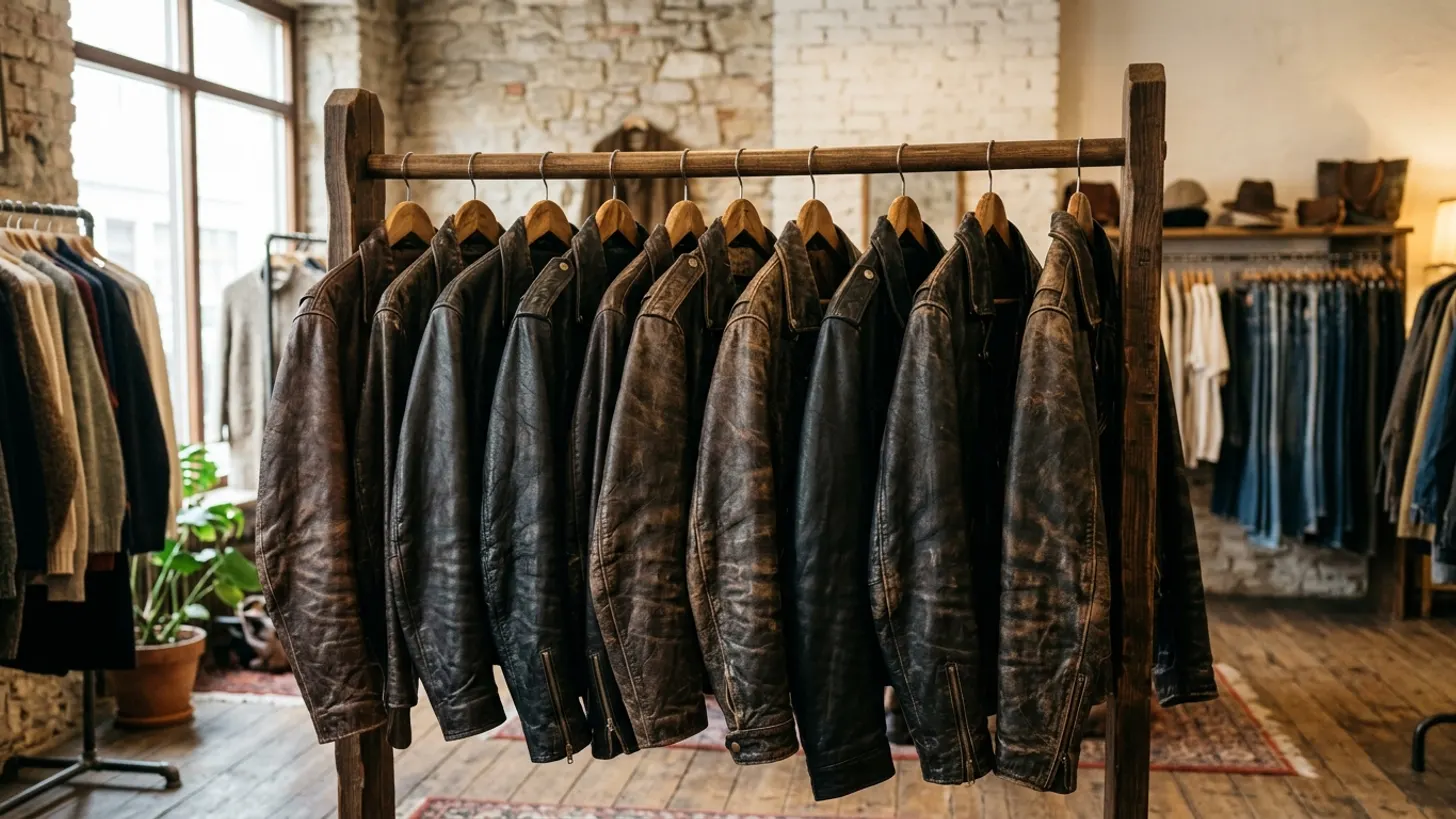
The vintage leather jacket guide that follows is the one I wanted when I was twenty-three, holding a 1960s Schott Perfecto at a Sacramento estate sale. A dealer there, Carol Trent, who had sourced outerwear since the 1970s, walked me through the Talon zipper tell that afternoon. That conversation became the foundation of Sol Siren. Real vintage leather is read by hand, not by hashtag. This walks through moto versus bomber versus racer cuts, era tells from hardware and lining, the houses worth chasing, and how to keep what you find for another fifty years.
The vintage leather jacket guide to moto, bomber, racer, and biker cuts
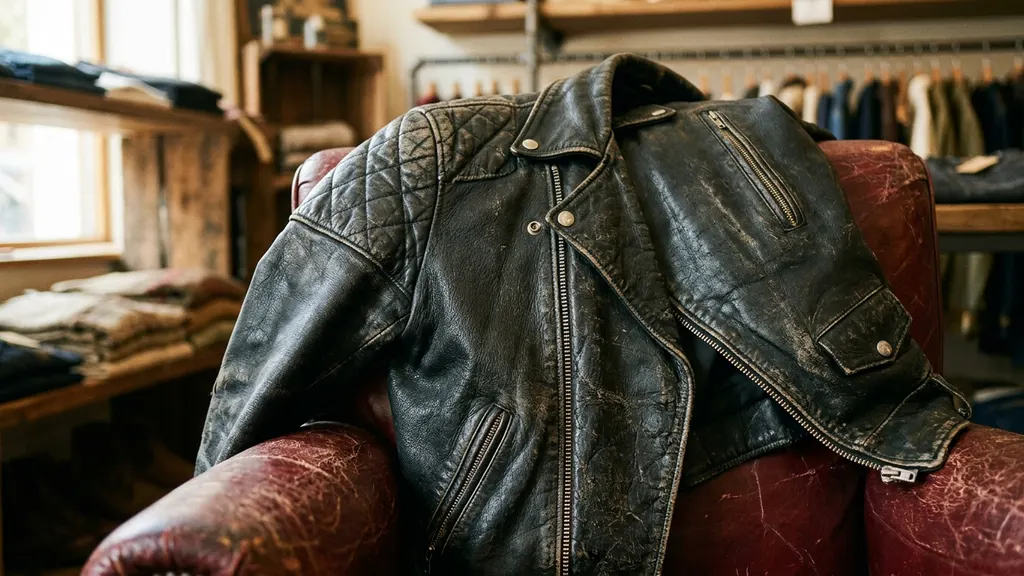
A moto cut is asymmetric, with a wide off-center zipper and notched lapels. A bomber has a ribbed waist and cuffs over a clean front zip. A racer is fitted and minimal-collared. A biker leans heavy and modular. Each silhouette belongs to a different decade and a different way of using the garment, which is where any good vintage leather jacket guide really starts.
The moto, also called the Perfecto after Schott NYC's 1928 model, was built for Long Branch riders who wanted to stay warm on Harleys. Wide lapels meant a rider could button the collar against wind without losing visibility, and the asymmetric zip lay flat against the bike's tank. Marlon Brando in The Wild One (1953) put this cut on every American teenager who saw the film, and demand has never quite cooled since, a cultural shift documented across American apparel history.
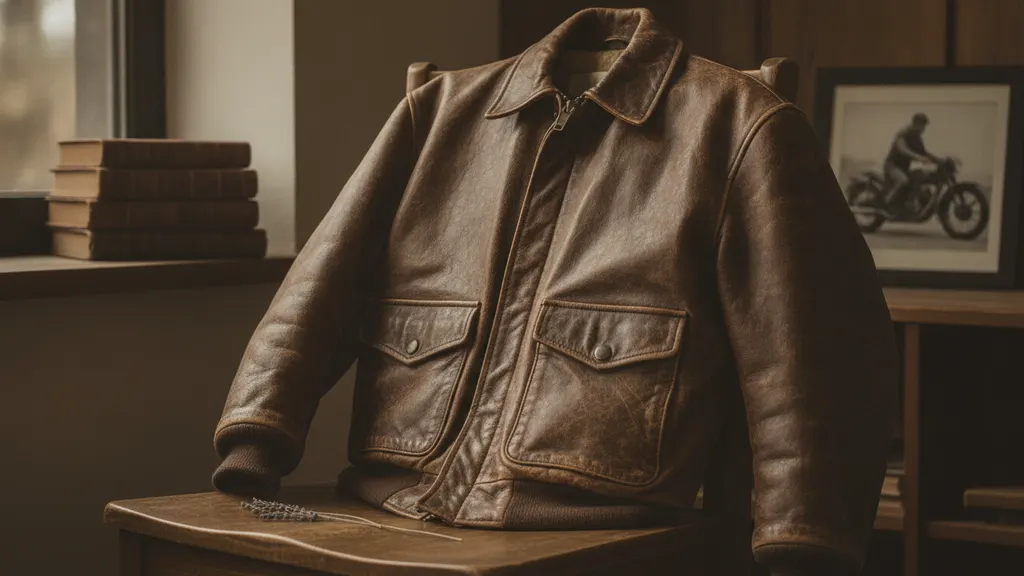
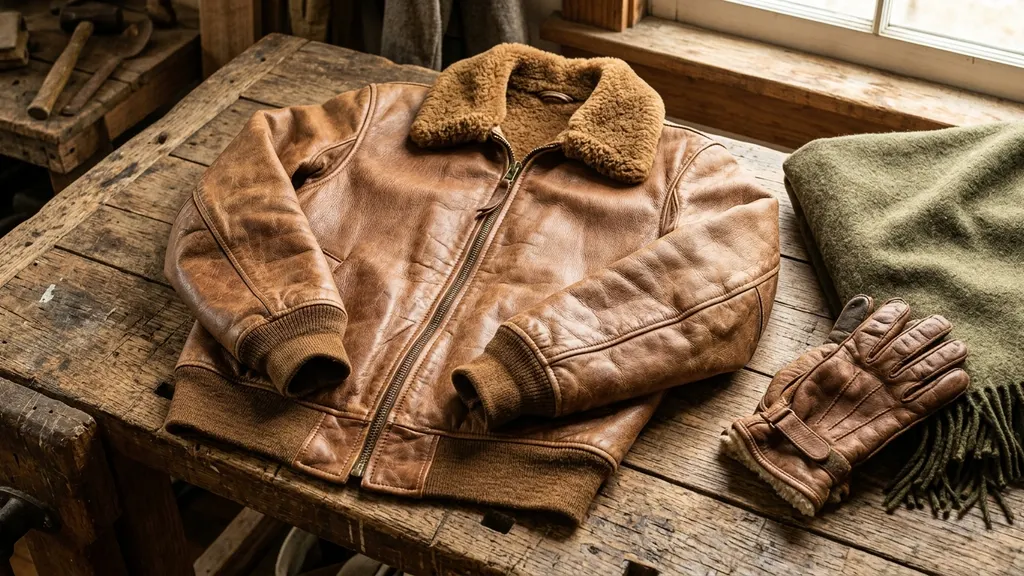
The bomber traces to the A-1 and A-2 flight jackets the US Army Air Corps adopted as standard issue in 1931. Production stopped in 1943 when the Army switched to the B-10 and B-15 cloth shells, which is why surviving A-2s with original contract labels are now held in the Metropolitan Museum's Costume Institute. Ribbed knit cuffs and waist seal heat; the simple front zip stays clear of cockpit equipment.
The racer (or cafe) is a 1950s and 1960s British and Italian silhouette: minimal stand collar, no lapel, fitted through the body, ending right at the hip. Lewis Leathers' Bronx and Aviakit are the canonical examples, and the cut also shows up on early Bates and Buco USA pieces. It's the silhouette you reach for when a moto's lapels feel theatrical.
The biker is the heaviest of the four: thicker hides, padded panels, and modular zipper vents. Vanson and Langlitz built this style for road riders who needed real abrasion protection, not movie-prop drama. If you find a vintage Langlitz Columbia with the original interior tag, you are holding three to five hundred hours of one builder's bench time.
| Cut | Silhouette | Origin era | Key brands | Hardware tell | Price band (pre-1980 originals) |
|---|---|---|---|---|---|
| Moto (Perfecto) | Asymmetric off-center zip, wide notched lapels, fitted waist | 1928, United States | Schott NYC, Buco | Talon brass zipper, ILGWU union label | $1,500-$3,500 |
| Bomber (A-2) | Center zip, knit cuffs and waistband, boxy body | 1931, US Army Air Corps | Rough Wear, Avirex, Monarch | Talon or Conmar zip, contract label in storm flap | $900-$2,400 |
| Racer (Cafe) | Minimal stand collar, no lapel, hip-length fitted body | 1950s-60s, UK and Italy | Lewis Leathers, Bates, Aviakit | Single small collar zip, snap epaulettes | $400-$1,800 |
| Biker | Heavy hide, padded shoulder and elbow panels, modular zip vents | 1960s-70s, United States | Langlitz, Vanson, Bates | Multiple Talon or YKK zippers, D-ring adjustment tabs | $500-$2,500 |
Real, reproduced, or relabeled: tells you can read with your hands
A vintage leather jacket guide is only as good as your hands. Visual inspection, not lab work, separates a 1965 Schott from a 2015 reproduction. Four senses do the work: stitch quality, leather grain, smell, and hardware patina. None of these requires a microscope.
Stitch lines on pre-1980 American outerwear run lockstitch at 7-9 stitches per inch on Singer 111W or Pfaff 145 industrial machines. Modern reproductions usually run faster (10-12 SPI) for speed and use bonded nylon thread that catches light differently than the cotton-wrapped polyester or pure cotton of the original era. Look for slight irregularity that says human hands, not perfect machine straightness. Our step-by-step vintage leather jacket authentication walkthrough covers the stitch tells in photographic detail.
The grain on vegetable-tanned hides from the 1950s and 1960s is uneven, often with a slight pebbled texture and a warm amber undertone. Chrome-tanned modern leather is smoother, flatter, and reads cooler and grayer. Run your thumb across the chest: real vintage gives a tactile drag that smooth modern leather does not. The Vintage Fashion Guild's leather identification primer is the reference I trained on.
Smell is the cheapest test. Vegetable tan smells faintly of bark and oil, like an old library. Chrome tan smells of chemistry. Reproductions often smell of solvent or shoe polish from finishing sprays. Hardware patina on real vintage is uneven and grain-following; on aged reproductions, it sits uniformly on the surface.
Houses, eras, and prices: the vintage leather jacket guide for collectors
When collectors ask which vintage leather jacket guide names matter, the answer is shorter than the internet suggests. Five American houses and three European ones account for roughly 80 percent of the resale market. Knowing them by hand and label saves you from paying Schott prices for mall-grade stock.
Schott NYC began in 1913 on Manhattan's Lower East Side. The Perfecto, introduced in 1928 and originally sold for $5.50 at a New Jersey gas station, is the most copied silhouette in twentieth-century outerwear. Original 1950s and 1960s 613SH and 618 models trade in the $1,500-$3,000 range at auction today. Buco, out of Detroit, ran 1933-1985 and made the heaviest American horsehide pieces; collectors chase the J-100 and J-82.
Bates of Hollywood built custom jackets for the 1960s racing scene and signed each piece by builder on the interior tag. Langlitz Portland, founded 1947, still makes one-at-a-time bench jackets; vintage Columbias from before 1985 are the grail of American biker collecting.
European tells: Lewis Leathers (London, leather division 1962) made the Bronx and Lightning. Aero Leather Clothing (Scotland) produces licensed military reissues in horsehide. Avirex began in 1975 making A-2 reproductions for the US Air Force, and the early pieces are now themselves collectible. The how-to-date-a-vintage-fur-coat walkthrough applies the same era-anchoring method to outerwear hides.
Hardware, lining, and tanning details: a vintage leather jacket guide to age tells
A vintage leather jacket guide that ignores hardware is worth nothing. The zipper, the lining stamp, and the tanning method together date a jacket within a five-year window with no guesswork. Talon zippers, ILGWU union labels, and vegetable-tanned grain are the three signals that say older than 1980.
Talon held a near-monopoly on American zipper production from 1930 to 1968. A vintage moto with a Talon brass zipper and Made in USA tape almost always predates 1968. Conmar (1932-1971) is the second most common American maker; YKK-USA shows up after 1974 on US-assembled jackets. Talon zippers have a distinctive stop bar shape and pin teeth that almost no reproduction bothers to match, one of the most reliable signals in any vintage leather jacket guide.
The lining stamp tells you who sewed the jacket. ILGWU (International Ladies' Garment Workers' Union, 1900-1995) and Amalgamated Clothing Workers tags appear on union-shop production. ILGWU printed dated tags from 1959 onward, with a typographic redesign in 1974 you can spot at a glance. Reference scans for both tag generations are held in the Smithsonian's American labor history collection and through vintage textile research archives.
Tanning matters as much as anything. Pre-1970 American outerwear is almost all vegetable-tanned, which is what gives 60-year-old jackets their characteristic amber depth. Chrome tanning took over in the 1980s for speed and cost, and a chrome-tanned jacket will read flat and cool against a vegetable-tanned reference. Roll the leather between thumb and forefinger; vegetable tan gives you body memory, chrome does not.
Conditioning and storage: keeping a vintage leather jacket for fifty more years
A jacket that survived from 1962 deserves better than a wire hanger in a dry closet. Condition every six to twelve months with a neutral leather balm, hang on a padded wooden form, and keep the room between 60 and 70 degrees Fahrenheit at 40 to 55 percent humidity. Anything else marketed as a vintage leather jacket guide step for storage is decoration.
Use a neutral cream like Bickmore Bick 4 or Pecard Leather Dressing. Avoid mink oil on vegetable-tanned hides; it darkens unevenly and accelerates oxidation. Apply a thin coat with a clean cotton rag, let it absorb overnight, buff with a horsehair brush in the morning. Once a year is enough for jackets in regular rotation, every six months for jackets in storage.
Hang on a wide wooden hanger; wire deforms the shoulder line within months. Store in a breathable cotton garment bag, never plastic, in a closet that does not back onto an exterior wall. If you live somewhere humid, run a small dehumidifier or use silica packs. The Victoria and Albert Museum's leather care guidance follows the same protocol for its historical outerwear holdings.
If you smell mildew, treat immediately. A 50/50 distilled water and white vinegar wipe-down followed by air-drying out of direct sunlight handles surface mold. Anything deeper goes to a specialist; do not soak vintage leather. For archival storage of pieces I am not currently wearing, I follow the longer protocol in our how-to-store-vintage-outerwear walkthrough.
Vintage leather jacket guide: frequently asked questions
What is the difference between a moto and a bomber leather jacket?
A moto jacket has an asymmetric off-center zipper, wide notched lapels, and a fitted waist designed for someone leaning forward on a motorcycle. A bomber has a straight center zipper, knit cuffs and waistband, and a boxier cut derived from military flight jackets. The moto traces to Schott's 1928 Perfecto; the bomber traces to the 1931 A-1 and A-2 flight specifications adopted by the US Army Air Corps, as documented in the Metropolitan Museum's Costume Institute. Both styles run in vintage rotation today, but the moto reads as civilian outerwear while the bomber reads as military surplus, which is the first split this vintage leather jacket guide draws. For comparable 1960s examples in clean condition, the moto commands a $300-$500 resale premium over the bomber.
How do you tell a real vintage leather jacket from a reproduction?
Four hand-checks: stitch count, leather grain, smell, and hardware patina. Pre-1980 American jackets run 7-9 stitches per inch on lockstitch machines; reproductions usually run faster and more uniform. Vegetable-tanned vintage leather feels uneven and warm-toned, while chrome-tanned modern leather reads smoother and cooler. Vintage smells faintly of bark and oil; reproductions smell of solvent or polish. Hardware patina on real vintage is uneven and follows the grain, while aged reproductions sit on the surface. Run all four checks in under three minutes: you rarely need more than two to confirm a piece is genuine or not. The Vintage Fashion Guild's textile and leather primer is the reference most vintage specialists train on, including me when I started Sol Siren.
Which vintage leather jacket brands hold value best at auction?
Schott NYC Perfectos from the 1950s and 1960s anchor any serious vintage leather jacket guide for value: they routinely clear $1,500 to $3,500. Buco horsehide pieces from before 1970, Bates of Hollywood custom builds, and Langlitz Portland Columbias from before 1985 sit in the same tier. European collectors chase Lewis Leathers Bronx and Lightning models from the 1960s and 1970s, plus early Aero Leather Clothing horsehide reissues. Vintage resale research from Business of Fashion shows that provenance and original hardware drive the top end; a relabeled or rezipped jacket loses 40 to 60 percent of value regardless of how clean the leather looks. Original zippers and labels are worth more than any cleaning or restoration you could apply.
How can I date a vintage leather jacket without a manufacturer label?
Hardware is the most reliable signal when working through this vintage leather jacket guide question. Talon brass zippers with Made in USA tape almost always predate 1968. Conmar zippers fall between 1932 and 1971. YKK-USA appears after 1974. Lining clues: rayon and acetate dominate 1940s through 1960s pieces, quilted polyester appears after 1970, mouton fur collars on bombers usually mean late 1940s through early 1950s. Stitching at 7-9 SPI on lockstitch machines is pre-1980. Combine three of these signals and you can date a jacket within a five-year window, and our vintage clothing size conversion guide helps cross-check era from label sizing alone. One caution: relabeled pieces are common on the secondary market, so always cross-reference at least two independent tells before committing to a price.
Is vegetable-tanned leather better than chrome-tanned for vintage jackets?
For vintage jackets, vegetable tanning is what most pre-1980 American outerwear used and what gives 60-year-old pieces their characteristic warm amber color and supple body memory. Chrome tanning took over in the 1980s because it is faster (one day versus six weeks) and cheaper, but it produces a flatter, cooler leather that ages by drying out rather than developing patina. Neither is inherently better. Vegetable tan is what you want for collectible vintage and slow-fashion buying. Chrome tan is what you find on modern leather goods. The industry-wide shift from vegetable to chrome tanning is documented in American industrial history. Tell them apart by smell and finger drag: vegetable-tanned leather absorbs a light balm coat in hours, while chrome-tanned hides hold the product on the surface considerably longer.
How often should I condition a vintage leather jacket?
Once a year for jackets in active rotation, every six months for jackets in long-term storage. Use a neutral cream conditioner: Bickmore Bick 4, Pecard Leather Dressing, or Lexol on heavier hides. Avoid mink oil on vegetable-tanned vintage; it darkens the leather unevenly and accelerates oxidation of older fibers. Apply a thin coat with a clean cotton rag, let it absorb overnight, buff in the morning with a horsehair brush. Store on a wide wooden hanger inside a breathable cotton garment bag, never plastic. Keep conditioner off metal hardware; wipe any overspray before it dries to prevent surface tarnish on original brass or nickel fittings. The Victoria and Albert Museum's clothing care guidance is the reference protocol I follow for my own collection.