October 2026
How to date vintage military jackets: M-65, MA-1, and field coats
A curator's guide to how to date vintage military jackets, from M-65 and MA-1 labels to contract numbers, hardware, and the tells that give modern copies away.
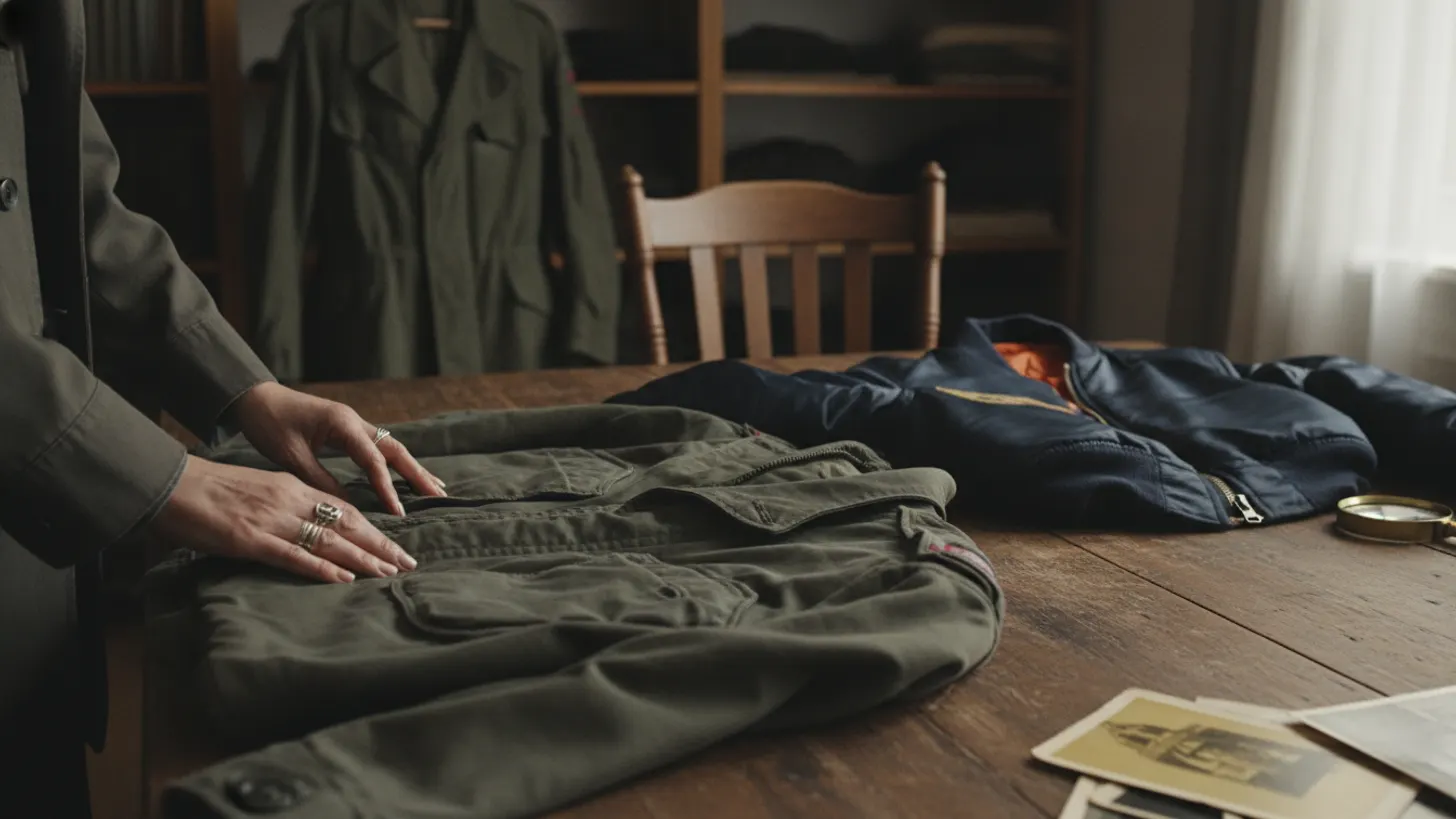
In a Des Moines estate garage last February, a seller handed me an olive field coat and said his father wore it in 1968. The label said otherwise: a DLA contract prefix that did not exist until 1977. That gap is the whole craft of how to date vintage military jackets. The jacket gives up its year in label text, pocket geometry, and zipper teeth, long before anyone's memory does.
M-65, MA-1, or field coat: the first sort in how to date vintage military jackets
Three families, spanning pattern years from 1943 to the 1980s, cover almost everything sold as surplus outerwear. Field coats are cotton-shell land-army jackets built in dated pattern generations. The M-65 is the 1965 generation of that line. The MA-1 is nylon flight gear, knit at collar, cuff, and waist, and built for cockpits rather than trenches.
Smithsonian Magazine identifies the M-65 field jacket as a U.S. military design adopted in 1965, and the same publication describes the MA-1 as a flight jacket developed for mid-century military aviation. Those two facts do a lot of sorting. A four-pocket cotton jacket with a zippered collar pocket is a field coat; a nylon bomber with ribbed trim is flight gear; anything with a fur-trimmed hood and a heavy nylon shell is closer to a B-15 or N-3B relative than to an MA-1. Sorting the family first is the opening move, because each line keeps its own calendar of changes.
Civilian wardrobes have been borrowing from this stock since the 1940s. The Metropolitan Museum of Art documents how military clothing and surplus shaped postwar civilian fashion, which explains why so many jackets in the wild sit somewhere between issue and imitation.
| Family | Shell | Era markers |
|---|---|---|
| M-1943 and M-1951 field | Cotton sateen or poplin | Pattern year sits in the designation; Quartermaster-era labels |
| M-65 field | Cotton-nylon sateen | Adopted 1965; zippered collar hood pocket; hook-and-loop cuffs |
| MA-1 flight | Nylon with knit trim | Mid-century aviation design; reversible high-visibility lining |
How to date vintage military jackets by label and contract number
The label is the primary document. Read the contract number prefix first, then the specification line, then the stock number format, then the presence or absence of a care tag. Four reads, in that order, and most jackets give up their decade before you touch the zipper.
Quartermaster Corps contracts carry the garment through the 1940s and 1950s. The Defense Supply Agency took over purchasing and its DSA prefix runs from 1962 to 1977, when the Defense Logistics Agency replaced it and DLA prefixes begin. That single substitution is the most reliable hinge in how to date vintage military jackets, and it is why the Des Moines coat could not have been on anyone's back in 1968.
Below the contract line sits the spec, usually written MIL-J- followed by digits and a revision letter. Revisions move forward in time, so a later letter on the same spec means a later build. Federal Stock Numbers give way to the longer National Stock Number format in the mid-1970s, and U.S. care labeling arrives in the same stretch, which means a field coat with sewn-in washing instructions is almost never a 1950s garment. The Vintage Fashion Guild label resource is the open-access reference I check against, and the same label-first method carries straight over to how to date vintage denim.
In short: M-1943 was adopted in 1943, M-1951 in 1951, and M-65 in 1965, with each pattern's year built directly into its name.
How to date vintage military jackets by hardware and construction
Hardware is the cross-check. Zipper makers, snap stamps, cuff closures, and pocket geometry each have a working life, and when they disagree with the label, one of them has been replaced. Three details that agree beat one strong detail every time.
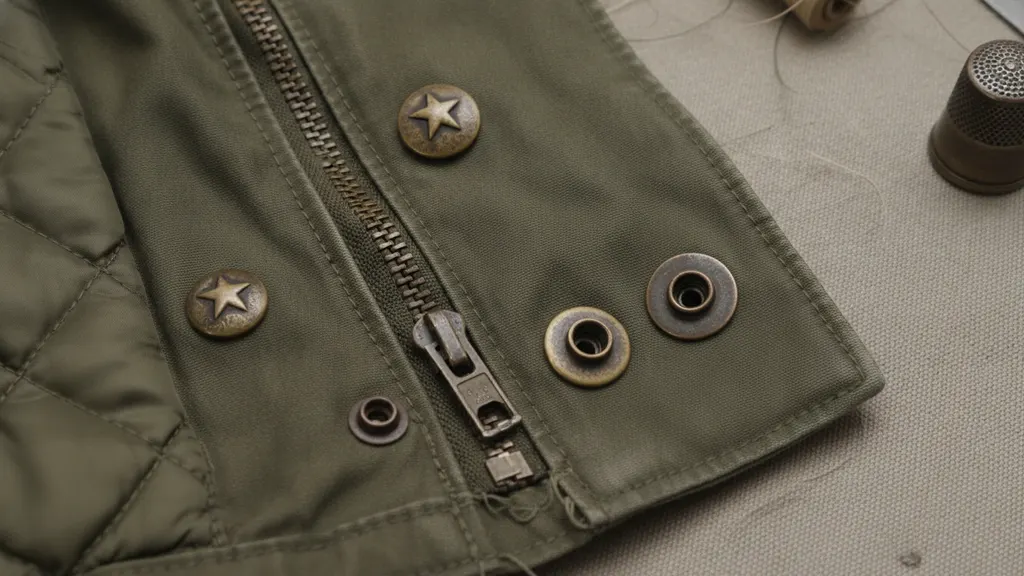
American zippers tell most of the story. Talon, Conmar, Crown, and Scovill dominate mid-century issue work, in brass and then aluminum, before nylon coil becomes standard. A YKK pull on a jacket whose label reads DSA is a repair, not a date. Snaps carry maker stamps on the underside. On field coats, the M-1951 fastens its cuffs with a button tab while the M-65 uses hook-and-loop, and the M-65 hides a roll-up hood in a zippered collar pocket that earlier patterns do not have.
Stitching matters too. Issue construction favors flat, heavy thread in a matched olive, with bar tacks at pocket corners and pocket flaps cut square. Loose backtacking, contrast topstitching, or a lining seam running to a serged edge reads modern. I work through how to date vintage military jackets with the garment inside out under a lamp, because the inside is where the factory stopped pretending.
Issue or copy: how to date vintage military jackets against a reproduction
Reproductions are not fakes by intent, and they have been in steady production since the 1970s, decades after the last Quartermaster-stamped coat left a factory. Most are fashion jackets borrowing a silhouette, and they announce themselves in weight, label, and trim. The question is never whether a jacket looks military. It is whether cloth, paperwork, and hardware all agree on one year.
Weight first. Issue cotton-nylon sateen has a dry, dense hand and holds a crease; fashion shells feel light and slick. Then the label: an importer name, a fiber-content percentage, and a country of manufacture with no contract number is a civilian garment, full stop. Trim is third, and knit collars give bombers away, since issue rib is short and dense while reproduction rib is soft and springy. Sourcing Journal's coverage of textile sourcing explains why modern mills rarely make the old sateen economically, and the study collections at The Museum at FIT are where I go to see originals under glass.
Surplus-as-fashion is old news rather than a recent fad, which is part of why copies exist in such volume. The honest version of how to date vintage military jackets accepts that a well-made reproduction can be a very good jacket. It simply is not a document, and it should never be priced as one.
In short: M-1951 fastens with a button-tab cuff and four outer pockets, M-65 adds a hook-and-loop cuff while keeping that four-pocket count, and MA-1 trades patch pockets for two slash pockets and a knit collar band instead of a fold-down collar.
Condition clues for how to date vintage military jackets
Condition decides whether a dated jacket is wearable or only collectible. On cotton field coats, watch pocket corners, cuff edges, and the shoulder yoke. On nylon flight jackets, watch the knit trim and the zipper tape, because those give out long before the shell does.
Cotton sateen splits along abrasion lines: pocket mouths, elbow creases, the back of the collar. Those are repairable. Sun fade on one shoulder is not reversible, and it tells you the jacket hung in a window for years. Nylon shells can separate at coated seams, and a shell that crackles when you flex it is on borrowed time. Knit cuffs stretch into ruffles and can be rewoven or replaced, which follows the same logic covered in how to repair vintage knitwear.
Moth damage lives in wool liners rather than shells, so pull the liner and hold it to the light. Smell counts as evidence: mildew usually means basement storage, and that often comes with foxing on the label, which costs you the date. Condition and dating interact: dating gets harder once a zipper has been swapped or a label scrubbed pale by a hot wash. Cleaning belongs at the end of the process, not the start, which is why I send buyers to how to clean vintage clothing first. Condition, not rarity, sets the ceiling on what a dated jacket is worth.
Styling and storing a jacket once you have dated it
A dated jacket wants to be worn like any good coat, not handled as a costume, and surplus silhouettes have cycled back into mainstream fashion roughly every decade since the 1960s. Keep the proportions honest: field coats sit best over a crewneck and a straight trouser, and bombers want a shorter hem beneath them so the knit waist reads intentional rather than bunched.
Olive agrees with more than people expect, including cream, oxblood, and raw denim. I keep one M-65 in regular rotation and let the fade accumulate, because the wear pattern becomes part of what the jacket records. That accumulated wear is also what separates a well-dated jacket from a reproduction wearing the same silhouette. For mixing eras without looking staged, see how to style vintage clothing.
Storage closes the loop. Breathable cotton garment bags, a wide hanger carrying the shoulders, cedar nearby but never touching the cloth, and no sealed plastic bins. Nylon in particular needs air. The full method sits in how to store vintage outerwear, and following it is what lets the next owner date the jacket just as easily twenty years from now.
Frequently asked questions
How do I tell what year my M-65 field jacket was made?
Start inside, at the contract label. The agency prefix on the contract number brackets the decade: Quartermaster contracts run through the 1950s, DSA contracts from 1962, and DLA contracts from 1977 onward. Then read the spec line, the stock number format, and whether a sewn-in care label is present, since U.S. care labeling arrived in the early 1970s. Cross-check against hardware: zipper maker, cuff closure, and the zippered collar pocket that holds the roll-up hood. The Vintage Fashion Guild label resource is the reference I keep open while working through how to date vintage military jackets.
Is a nylon MA-1 with an orange lining always military issue?
No. The reversible high-visibility lining is the most copied feature in flight-jacket reproduction, and it has been a civilian styling cue since the 1970s. Smithsonian Magazine describes the MA-1 as a flight jacket developed for mid-century military aviation, which means an issue example should also carry a contract label, a spec designation, and period-correct knit trim. If the lining is bright but the only tag inside is a fiber-content label with a modern importer name, you are holding a fashion bomber. Judge label and hardware first, and treat the lining as decoration rather than evidence.
What does the DSA number inside my jacket mean?
DSA stands for Defense Supply Agency, the purchasing body whose name appears on contract labels from 1962 until it became the Defense Logistics Agency in 1977. A DSA contract number therefore places the garment inside that fifteen-year window, which for field coats usually means an M-1951 or an early to middle M-65. The digits that follow encode fiscal year and contract sequence, not the wearer's unit. The Metropolitan Museum of Art's documentation of military dress gives useful background on why issue labeling was standardized so tightly. Pair prefix with spec line and that window becomes the backbone of how to date vintage military jackets.
Are vintage military jackets worth more than reproductions?
Usually, though the gap depends on pattern, condition, and completeness rather than age alone. Issue examples with a legible contract label, an original zipper, and an intact liner draw the strongest interest, while a worn reproduction is worth roughly what any used jacket is worth. Christie's, which sells documented fashion and textiles, has long treated provenance as the thing that moves a garment's value, and the same logic scales down to surplus. I describe by what the label proves and what the condition shows. Anything I cannot support with a label or a construction read gets listed as unattributed.
Can I wash a vintage field jacket at home?
Cotton sateen field coats tolerate careful hand washing in cool water with a pH-neutral detergent, then flat drying away from direct sun. Nylon flight jackets are different: the knit trim felts and the coated shell can bloom if agitated, so spot cleaning is the safer default. Never machine dry either one, and never press over a contract label, because heat lifts printed ink and you lose the dating evidence. Keep the habit simple: wash less, air more, and let the contract label stay dry and legible for the next owner who needs to date the jacket.
Does the size on a military label match my modern size?
Rarely. Issue sizing uses chest-and-length pairs such as Small Regular or Medium Long, measured for layering over a liner and a shirt, so a Medium Regular field coat often fits a modern large. Flight jacket sizing reads closer to the body because the knit waist pulls in. Measure flat across the chest, double it, and compare against a jacket you already wear. The V&A dress and textiles collection makes the same point about historic sizing: a label records a system, not a body. That vocabulary also feeds into how to date vintage military jackets.