July 2026
How to style vintage clothing: a practical guide to mixing eras
How to style vintage clothing with modern basics: the single-statement rule, vintage sizing gaps, and era pairings that wear easy without costume-y reads.
The question that lands in my inbox most weeks is some version of: I just bought a 1970s shearling, how do I wear it without looking like I am in a movie? My honest answer to how to style vintage clothing in 2026 is rarely about the coat itself. It is about everything you put next to it. The rule that works for me, and for the editors I read, is restraint.
How to style vintage clothing with the single-statement rule
The most reliable framework for how to style vintage clothing is the one-anchor approach: pick a single vintage hero, then build the rest of the outfit from modern, neutral basics. Stylist Trinny Woodall has long advised the same approach in Vogue features on personal style, and editors at Harper's Bazaar echo the same logic across their styling columns.
The reason it works is visual hierarchy. One loud period piece against a quiet contemporary base reads as deliberate. Two or more competing era pieces in the same outfit, by contrast, read as costume. A 1960s Penny Lane coat over flat-front modern denim and a plain white tee tells a clear story. The same coat over high-rise corduroy flares and a printed peasant blouse tells a confusing one.
I learned this by making the opposite mistake. I once paired a 1950s circle skirt with a 1980s power blazer at the Manhattan Vintage Show in 2019, and every person who saw me asked who I was dressed as.
If you are new to building outfits this way, set yourself a quick test: name out loud the single vintage item before you leave the house. If you cannot pick one in three seconds, the outfit is doing too much. Trim it back. ThredUp's 2023 Annual Resale Report found that 56% of US consumers had shopped secondhand apparel in the prior 12 months, and the survey respondents flagged styling uncertainty as one of the top barriers to buying more. The single-item rule is the most direct answer to that uncertainty.
How to style vintage clothing in outerwear without the costume read
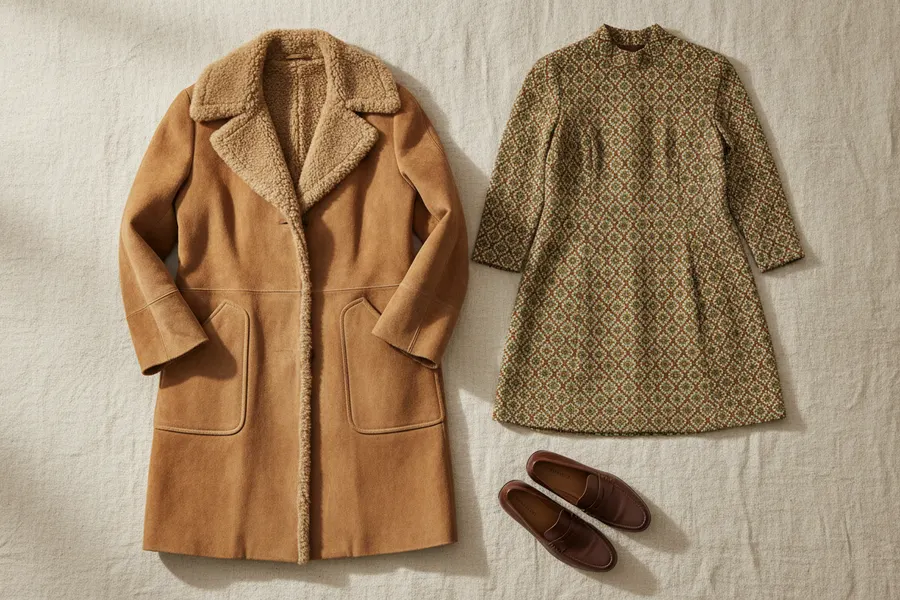
The formula for how to style vintage clothing in outerwear is precise: vintage coat, modern tee or fine knit, modern denim or trousers, modern leather boots or trainers. That combination keeps three recognisably current anchors around the loud vintage piece, so the eye reads the coat as a deliberate statement rather than a full period re-creation.
Outerwear is where this rule gets tested hardest. A vintage fur, shearling, or 1970s suede coat is loud by definition, and the temptation when you put it on is to dress up the layer underneath to match that drama. That is the move that turns the look into a costume. The Met Costume Institute's installation practice uses the same counterintuitive approach: one period element framed by neutral context so the viewer can read it clearly.
If the coat itself is fragile or you want it to last through more than a single season, treat care as part of the look. Our guide to cleaning vintage wool coats covers the basics of safe at-home maintenance and when to defer to a specialist cleaner.
Modern accessories and footwear that pair with vintage
The fastest way to modernise a vintage outfit is at the feet and at the bag. ThredUp's 2023 Annual Resale Report named styling uncertainty as the leading barrier to secondhand buying in the US, and footwear is where that gap closes fastest: a plain leather loafer, a clean white trainer, or a low-shaft Chelsea boot will pull a 1970s coat into 2026. When you are working out how to style vintage clothing alongside contemporary accessories, both items sit at the visual extremes of the silhouette and register instantly as either current or period.
Bags follow the same logic. A current-season tote, a slim cross-body, or a structured top-handle from a contemporary maker keeps the outfit grounded. Avoid pairing a vintage piece with a vintage bag from the same decade unless you are deliberately doing a full-era look. Who What Wear's styling editors make this point regularly: split the era references between the garment and the accessories.
Jewellery is the small lever. A single piece of modern fine jewellery, a slim chain or a 14K gold-filled pendant, will read as current without competing with the coat. Stacked period jewellery alongside a period coat is the easiest way to tip into costume territory.
Vintage sizing: why the label lies and how to measure correctly
Sizing is the practical wall most new vintage buyers hit. Vintage US women's labels run roughly 2 to 4 sizes smaller than current US vanity sizing, with the gap widening through the 1980s and 1990s. A vintage labeled 12 commonly fits a modern 6 or 8 body. If you take the label at face value, you will buy the wrong piece.
The practical workflow for how to style vintage clothing across this gap is to ignore labels and ask the seller for measurements. Bust, waist, hip, shoulder, sleeve. Compare those against a garment that already fits you, taken from your own closet, laid flat.
| Vintage decade | Typical label gap vs modern | Tailoring outlook |
|---|---|---|
| 1960s | ~2 sizes smaller | Often adjustable; generous seams |
| 1970s | ~2 to 3 sizes smaller | Workable; check zipper length |
| 1980s | ~3 sizes smaller | Wider shoulders, roomier on torso |
| 1990s | ~3 to 4 sizes smaller | Slimmer cuts; less seam allowance |
If you want to verify era before you commit to a size assumption, our breakdowns on dating vintage Levi's 501s and on authenticating vintage trench coats show the label and stitching tells worth checking.
Era combinations that pair well and the ones that clash
Decade pairing is the deeper layer of how to style vintage clothing well, and it follows one rule: adjacent eras blend; eras three decades apart clash. A 1960s mod minidress works under a 1970s suede coat because the silhouettes share a line. A 1990s slip dress works with an 1980s blazer for the same reason. The shapes are within conversational distance of each other.
The pairings that tend to fail are 1950s with 1980s, or 1940s with 1990s. The silhouettes are too far apart, and the eye reads the outfit as historical reenactment rather than personal style. The V&A museum's costume archive and the FIT museum collections show clearly how silhouettes evolved decade to decade; flipping through their digitised records before buying is a free styling education.
If you want to learn the visual vocabulary of each decade, our 1960s mod fashion guide and our authentic 1990s slip dress identification piece are good starting points.
Frequently asked questions
Does the single-vintage-item rule actually work?
Yes, for most outfits, most days. The rule exists because it stops you from layering competing period references that fight for attention. One statement vintage piece anchored by modern basics is the approach stylist Trinny Woodall has named in multiple published interviews, and The Cut's styling coverage echoes the same logic across editorial pieces. The exceptions are themed events, full-period editorial shoots, or if you are confident enough in your visual eye to break the rule on purpose. For everyday wear, the rule keeps the outfit readable as 2026 rather than reenactment.
How do I figure out vintage sizing without trying things on?
Ignore the label and ask the seller for flat measurements: bust, waist, hip, shoulder, and sleeve. Compare those to a current garment in your closet that already fits, measured the same way. Vintage US women's sizing runs roughly 2 to 4 sizes smaller, so trust the tape, not the tag. Reputable vintage sellers list measurements as standard. The Vintage Fashion Guild publishes era-by-era sizing context that is worth reading before any major buy. If a seller refuses to share measurements, that itself is a useful signal about the listing.
How to style vintage clothing for the office without looking dated?
Pick one vintage element that is restrained in shape: a 1970s silk blouse, a tailored 1960s blazer, a 1990s minimal slip skirt. Pair it with modern trousers or denim, modern leather shoes, and a current bag. The point of how to style vintage clothing in a work setting is that the vintage piece reads as quality and intention, not nostalgia. In a conservative office, a 1970s silk blouse in a muted solid reads as quiet sophistication; a 1960s graphic-print shift in the same setting reads as costume. Skip anything with very period-coded shoulders, ruffles, or prints unless your workplace is openly creative. Restraint reads as polish.
Can I mix two vintage pieces in one outfit?
Sometimes, if the eras are adjacent and the silhouettes share a line. A 1970s coat over a 1960s minidress is usually fine because both belong to the same visual conversation. Pairing a 1950s circle skirt with a 1990s slip top is much harder to pull off because the shapes argue. If you do double up, keep accessories firmly modern: current shoes, current bag, current jewellery. The contemporary anchors stop the outfit reading as fancy dress, even when the garments are both period.
What is the single biggest mistake new vintage buyers make?
Buying the era they love most without checking measurements or condition. A coat that does not fit cannot be styled, and a coat with weakened seams or compromised lining will not last past one season of real wear. Read listings carefully. Ask for measurements. Ask for honest condition notes. Run a search before you fall in love with a piece, especially if you are buying outerwear or knitwear that will get hard daily use. Most regrets come from skipping these basic checks, not from style choices.
How to style vintage clothing in summer when fur and shearling are off the table?
Lean on lighter vintage categories: 1970s cotton sundresses, 1990s slip dresses, 1960s shift dresses, and vintage cotton or linen blouses with modern denim. The single-item rule still applies. Modern flat sandals, a current straw or canvas tote, and minimal modern jewellery will keep the outfit grounded. Lightweight vintage layers can also work as outerwear: a 1970s cotton kimono over a plain modern tank and shorts is one of my own go-to looks in July. Heat does not cancel the principles; it just shifts the materials.