November 2026
Vintage 1970s peasant blouses: fabrics, embroidery, provenance
Vintage 1970s peasant blouses, decoded: fabrics, hand versus machine embroidery, neckline tells, and the provenance clues that reveal real artisan work.
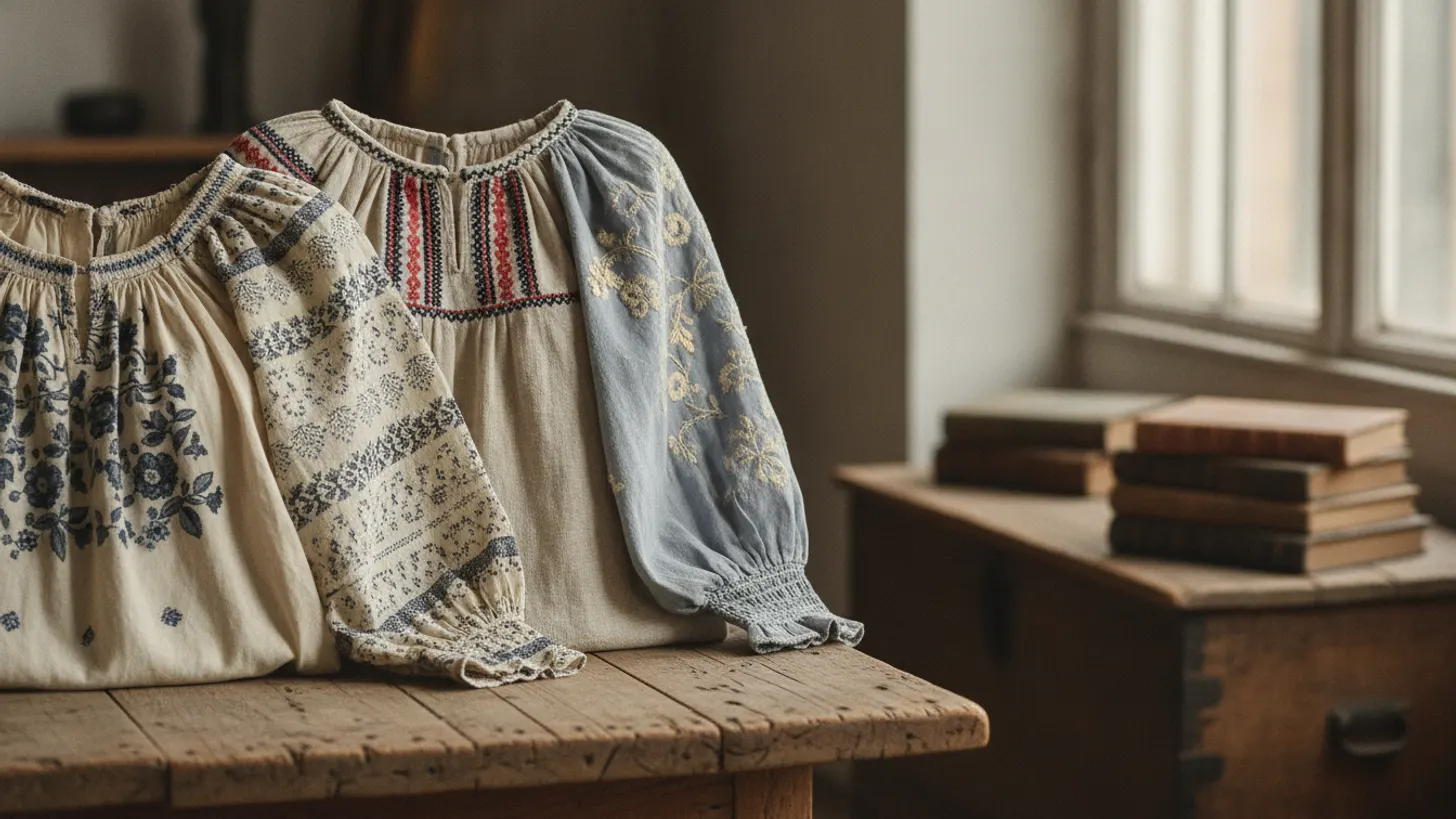
Turn the blouse inside out. That one move answers most of what buyers want to know about vintage 1970s peasant blouses: whether the embroidery was worked by hand, whether the cotton belongs to the era, whether the gathers were set by a home sewer or a factory. The Victoria and Albert Museum traces how folk dress shaped twentieth century fashion, and the garments themselves still carry the evidence on the reverse.
What design details define vintage 1970s peasant blouses?
Four details recur. The neckline is gathered onto a drawstring or elastic casing rather than set with a collar. The sleeves are cut full and gathered at the shoulder seam. The body carries little waist shaping. Decoration sits where the eye lands first, at the neck opening, across the yoke, or around the cuff.
That shape was borrowed, not invented. Victoria and Albert Museum research on folk dress and craft traditions in twentieth century fashion records how European and South Asian village clothing moved into mainstream wardrobes, and the blouse is the plainest case of it. Most vintage 1970s peasant blouses use one of three sleeve shapes: a bishop sleeve gathered into a narrow elasticated cuff, a bell sleeve left open and wide, or an angel sleeve falling straight from the shoulder with no cuff at all. Ties at the neckline, crochet insertion at the yoke, and short slits at the side hem all read as period. The same years produced vintage 1970s disco dresses, and the two hung on neighboring rails, one sewn for movement under lights, the other for daylight and dust.
How to tell hand embroidery from machine work on vintage 1970s peasant blouses
Turn the garment inside out and study the reverse of a motif. Hand work leaves knots, threads carried between shapes, and stitch lengths that drift by a millimeter or two. Machine work leaves a clean bobbin line, repeats that match exactly, and sometimes a residue of backing paper or stabilizer.
The technique itself is old and global. The Metropolitan Museum of Art Heilbrunn Timeline of Art History identifies embroidery as a decorative technique practiced across cultures and historical periods, which is why a 1974 blouse can carry a stitch vocabulary far older than the sewing machine. On vintage 1970s peasant blouses, chain stitch, satin stitch, and cross stitch are the usual three. Hold the fabric up to a window: hand satin stitch shows floss whose sheen shifts as the stitch direction changes, while machine satin stitch holds one flat tone end to end. Factory embroidery machines of the same decade decorated workwear too, and the vintage western shirts guide covers how those chain stitch yokes were produced at volume.
Which fabrics and neckline treatments are typical of vintage 1970s peasant blouses?
Expect four fabric families: crinkled cotton gauze, fine cotton voile, rayon crepe, and polyester or polyester blend crepe. Each one handles gathering differently, and the way a neckline holds its fullness after fifty years is often a better dating clue than the print on the cloth.
Fiber content narrows the window further. The Museum at FIT describes polyester as a synthetic fiber that became widely used in fashion during the twentieth century, and on these blouses it shows up most in the back half of the decade: a slick hand, a crepe that springs back, a gathered neckline still crisp decades on. Cotton and rayon age in the opposite direction. The Vintage Fashion Guild fabric resource remains the reference for separating them by feel, drape, and burn behavior. Neckline treatment on vintage 1970s peasant blouses falls into three types: a casing with a drawstring, a casing with flat elastic, and a shirred panel of several elastic rows. Shirring that has gone slack can be restored; a drawstring casing almost never fails.
| Fabric | How it handles gathering | Era signal |
|---|---|---|
| Crinkled cotton gauze | Soft, collapsing fullness | Across the decade, often Indian import |
| Cotton voile | Fine gathers, slight crispness | Early to mid decade |
| Rayon crepe | Heavy drape, limp when damp | Early decade or revival stock |
| Polyester crepe | Springy, holds its shape | Mid to late decade |
| Handloom cotton | Uneven weave, firm gathers | Workshop or small batch sewing |
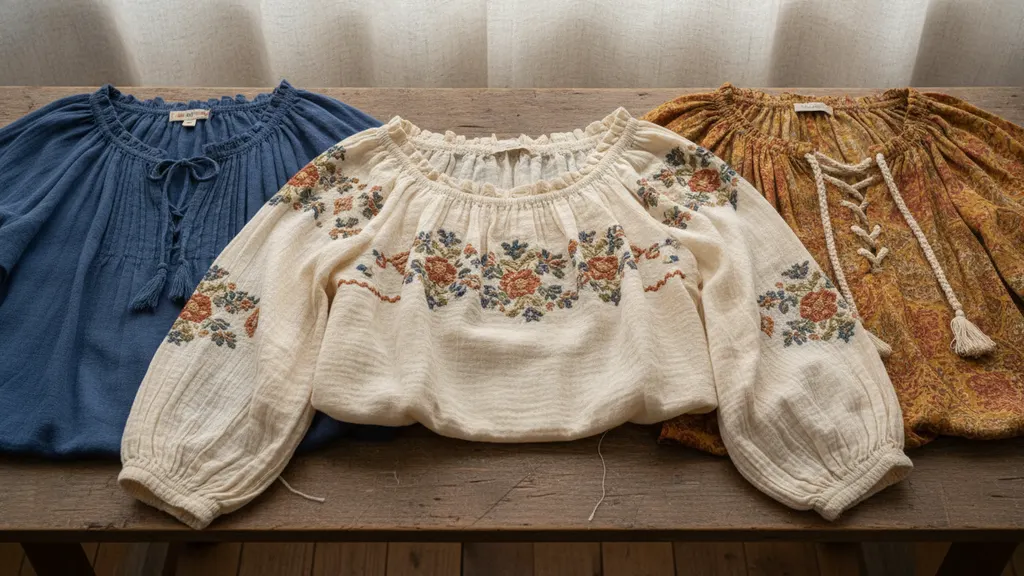
Related reading: How to identify vintage fabrics: rayon, acetate, nylon, polyester.
Provenance clues that separate artisan vintage 1970s peasant blouses from mass-market styles
Reading the label stack on vintage 1970s peasant blouses means checking five things together: maker name, fiber content, country of origin, care wording, and any registered number. A woven maker label plus a registered number plus printed care symbols means a regulated retail product. No label at all usually means home or small workshop sewing, which is where the best hand work hides.
Sorting the two takes practice. The Vintage Fashion Guild label resource catalogs maker labels by period, and because care labeling spread across American garments during the 1970s, a blouse printed with fiber content but no washing instruction often sits early in the decade. Imports tell their own story: hand block printed cotton, slightly irregular selvedge, and a neckline finished with a narrow bias strip point toward workshop production, while Smithsonian Magazine reporting on folk craft and global textile trade gives the context for how that work reached American shops. Artisan vintage 1970s peasant blouses tend to show small inconsistencies that a factory would have rejected. Buying remotely, ask for photographs of the label, the inside neckline, and the embroidery reverse; the rest of the request list sits in how to shop vintage fashion online.
How should delicate embroidery and gathered seams on vintage 1970s peasant blouses be inspected?
Three failure points decide whether a blouse is wearable or only storable: the neckline elastic, the underarm fabric, and the gathering stitches that hold the fullness in place. Each takes seconds to check, and each one is cheaper to find before money changes hands than after.
- Stretch the neckline gently. Elastic that crackles or stays stretched has perished and needs replacing through the casing.
- Hold the underarm to the light. Deodorant damage thins rayon and cotton into a haze of broken fibers that no cleaning reverses.
- Run a finger along the gathering line. Loose or snapped stitches let fullness slide to one side and set a hem crooked.
- Scratch gently at the back of a motif. Floss that powders or sheds color has been sun bleached.
Most vintage 1970s peasant blouses that fail fail at the elastic rather than the embroidery, because rubber ages faster than cotton floss. That repair is small and worth making. Hand gathered seams and a sleeve head eased in rather than machine gathered usually signal a home or workshop maker, which is the same evidence that lifts provenance. Honest condition notes should name every one of these points, not only the flattering ones.
How vintage 1970s peasant blouses earn a place in a modern wardrobe
Vintage 1970s peasant blouses work in a modern wardrobe because the shape is loose where current cuts are tight, and the decoration does the styling for you. One embroidered blouse over straight denim needs nothing else. Yves Saint Laurent's Fall 1976 Opulence collection put peasant blouses and folk embroidery on the runway, and Vogue has tracked the silhouette's returns since.
There is a second argument for buying them. Good On You research on secondhand clothing and garment longevity makes the case that the lowest impact garment is one already made, and a fifty year old blouse that still gathers correctly has proven its construction. Pair one with high waisted trousers, a wide belt, or a sheer slip beneath if the gauze is open; how to style vintage clothing works through mixing eras without tipping into theme dressing. Buy for the stitching and the cloth, and the decade sorts itself out.
Frequently asked questions
How can I tell if a peasant blouse is really from the 1970s?
Look at construction before decoration. Single needle side seams, a neckline casing with flat elastic or a drawstring, and a label listing fiber content without printed care symbols all point to the early part of the decade. Overlocked seams in bright polyester thread, fused interfacing, and full care symbol panels push the garment later, or past 1980 entirely. The Vintage Fashion Guild label resource lets you date many maker labels directly from their typography and wording. No single clue is proof. Three clues that agree is as close as visual dating gets, and an honest seller will say exactly that in the listing.
Is hand embroidery always worth more than machine embroidery?
No. Condition, maker, and the quality of the design matter more than method. A dense hand worked Hungarian yoke in sound condition usually outranks a generic machine motif, but a well designed machine embroidered blouse from a known label can beat clumsy hand stitching on thin cloth. The Metropolitan Museum of Art Heilbrunn Timeline of Art History treats embroidery as a decorative technique practiced across cultures and historical periods, not a single quality tier. Judge stitch density, how well the color has held, and whether the motif suits the cut of the garment it sits on.
What fabric are 1970s peasant blouses usually made from?
Cotton gauze, cotton voile, rayon crepe, and polyester blends cover most of them. Earlier blouses lean toward cotton and rayon, later ones toward synthetics. The Museum at FIT describes polyester as a synthetic fiber that became widely used in fashion during the twentieth century, which is why a slick, springy crepe usually reads as mid to late decade. Cotton gauze creases and softens with age. Rayon goes limp when damp and can split at stress points. If a listing does not state fiber content, ask, and expect the answer to be a reading rather than a test result.
Can I wash a vintage embroidered blouse at home?
Often yes, carefully. Cold water, a pH neutral detergent, no wringing, and drying flat away from direct sun protects both the ground fabric and the embroidery floss. Test for color bleed first by blotting one embroidered area with a damp white cloth; if color lifts, stop and hand the garment to a specialist cleaner. Elastic casings should never go near a dryer, since heat finishes off perished rubber. The method in how to clean vintage clothing covers water temperature and drying, and Good On You guidance on garment care and longevity argues for washing less often.
What size is a vintage peasant blouse compared with modern sizing?
Treat the label size as decoration and the measurements as fact. These blouses were cut full through the body, so one marked size 10 in 1974 can fit a wide modern range once the gathers are accounted for. Measure a blouse you already wear while it lies flat, then compare bust, shoulder to hem, and sleeve length against the seller numbers. Elasticated necklines stretch, but perished elastic does not recover. The Vintage Fashion Guild community resources on vintage sizing explain why decade labels and current size charts rarely line up.
Where were most 1970s peasant blouses made?
Three streams produced nearly all of them. European folk workshops in Hungary, Romania, Greece, and Austria supplied hand worked pieces. South Asian export production, India above all, supplied gauze and handloom cotton at volume. Domestic American manufacturers copied both. Country of origin on the label is the fastest way to sort them. The Victoria and Albert Museum documents the influence of folk dress and craft traditions on twentieth century fashion, which explains why a blouse sewn in the United States can still carry a motif lifted from a Transylvanian pattern book. With no label, read the embroidery vocabulary and the sleeve head.