October 2026
Vintage western shirts guide: snaps, yokes, embroidery, brands
A vintage western shirts guide to snaps, yokes, embroidery, labels, and brands, with era tells, condition checks, and styling notes from a working curator.
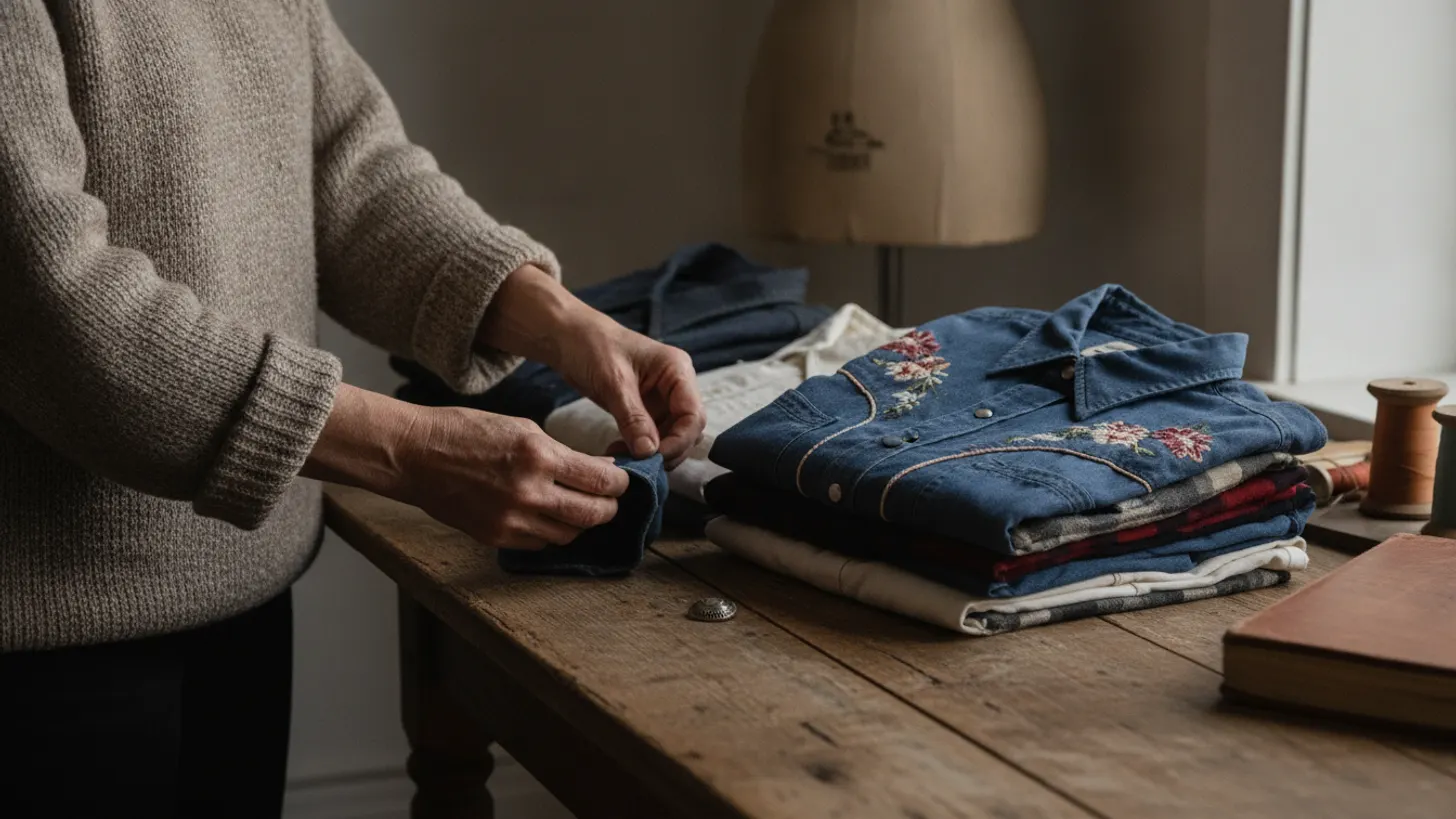
Nudie Cohn opened his North Hollywood shop in 1947 and spent the next four decades stitching rhinestones onto country music. Smithsonian Magazine names him the designer behind that look. Most shirts you will actually find are not Nudies, though, and that is what this vintage western shirts guide is for: reading snaps, yokes, embroidery, and labels well enough to date a shirt on a rack in bad light.
What this vintage western shirts guide checks first on construction
Four things, in order: the front closure, the yoke shape, the pocket treatment, and the label. A western shirt is defined by a snap placket, a pointed or scalloped yoke front and back, and pockets that echo the yoke line. Everything else is decoration on that frame.
The placket is where this vintage western shirts guide starts, because it is the fastest read in a crowded rack. Prewar western shirts button. Snap fasteners arrive commercially in the mid 1940s, and by the 1950s a snap front is the default on ranch and rodeo shirts. H Bar C added snap fronts to its own line by 1948, close behind Rockmount, which is why a shirt with button cuffs and a snap placket usually means a transition piece from the last years of the 1940s. Ring snaps, where a metal ring surrounds a pearlized or enamel center, read earlier than the flat all-metal snaps that dominate 1980s production. Count them, too: a 1950s shirt often runs five or six on the front placket, with two on each cuff and one on the sleeve gauntlet.
How this vintage western shirts guide reads snaps, yokes, cuffs, and embroidery
Snaps date the closure, yokes date the silhouette, cuffs date the labor cost, and embroidery dates the taste. Read them together rather than singly. A shirt with ring snaps, a sawtooth yoke, chainstitched roses, and a union label is telling you one consistent story about the 1950s.
I learned that lesson the expensive way. Three years ago I dated a shirt as 1950s Rockmount on ring snaps and a sawtooth yoke alone, listed it, and sold it within a day. The buyer, a collector who specializes in union labels, wrote back to point out that the label stitching was a later replacement and the snaps had been swapped onto a 1970s shell. I refunded the sale, ate the return shipping, and have not dated a shirt on one tell since.
Cuffs are the detail most people skip. A deep cuff with two or three snaps plus a snapped gauntlet placket signals a shirt built when labor was cheap and specification mattered. Later mass production shortened the cuff and dropped the gauntlet snap entirely. Fabric moves on a parallel track: rayon and wool gabardine through the 1940s and 1950s, cotton broadcloth and sanforized twill alongside them, then polyester blends through the late 1960s and 1970s. The Vintage Fashion Guild fabric resource is the reference I keep open when a hand feels ambiguous.
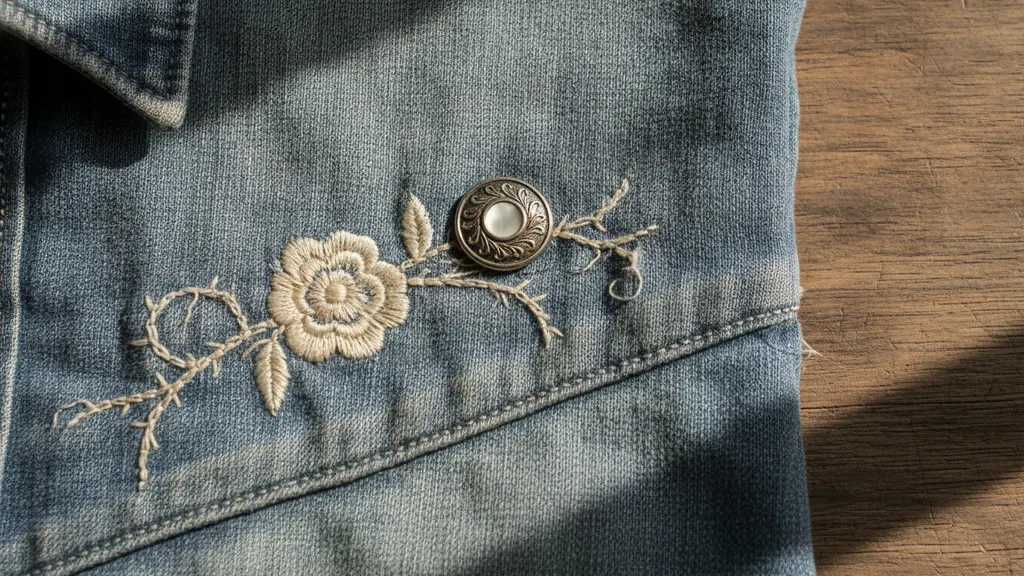
Embroidery is the loudest clue and the least reliable on its own. Chainstitched floral and horseshoe panels were applied by specialist shops for decades. The rhinestone end of that spectrum belongs to one tailor above all: Smithsonian Magazine's reporting on Nudie Cohn credits him with the covered-in-stones stage clothing worn by country performers from the late 1940s onward.
Read that chart as overlap, not as a set of walls. A vintage western shirts guide is most useful exactly where the bands cross, because a shirt sitting in two bands at once is usually honest, and a shirt sitting in none of them is usually a reproduction.
Which brands and labels this vintage western shirts guide collects
Rockmount Ranch Wear, H Bar C California Ranchwear, Nudie's Rodeo Tailors, Levi's, Wrangler, Panhandle Slim, Karman, and Miller are the names that surface most. Rockmount is the label most associated with putting the snap-front western shirt into commercial production, from 1946 in Denver.
Brand value and collecting value separate quickly. A chainstitched Nudie sits in auction territory, while a 1970s Karman with a pretty yoke sits in wearing territory, and both are worth owning for different reasons. Vogue's coverage of western wear entering mainstream fashion tracks how the silhouette kept resurfacing, which is why a solid 1970s shirt holds its price better than its construction alone would suggest. The costume exhibitions at The Museum at FIT are a useful corrective: museum framing values construction and provenance over label hype, and that is the standard worth holding any shirt to before you pay for it.
| Label | Era to look for | What gives it away |
|---|---|---|
| Rockmount Ranch Wear | 1946 onward | Denver address, early snap-front production, sawtooth flaps |
| H Bar C California Ranchwear | 1950s to 1970s | Heavier gabardine, deep cuffs, pronounced yoke piping |
| Nudie's Rodeo Tailors | Late 1940s to 1970s | Chainstitch and rhinestone work, North Hollywood label |
| Levi's western shirts | 1950s to 1960s | Early logo labels, plain yokes, sanforized cotton |
| Karman, Panhandle Slim, Miller | 1960s to 1980s | Polyester blends, flatter snaps, printed care tags |
Labels are themselves datable objects. Woven labels with scripted logos, RN numbers, union tags, and later care-instruction tags each sit in different windows. The Vintage Fashion Guild label resource catalogues many of them, and the presence of a care tag is a clue in itself, since garment care labelling became standard in the United States in the early 1970s.
How this vintage western shirts guide evaluates condition, fit, and alterations
Check four contact points first: underarms, collar points, snap caps, and the inside of the back yoke. This vintage western shirts guide weighs fabric failure heavier than missing hardware, since a cracked snap cap costs under five dollars to replace while shattered rayon cannot be repaired at all. Then look for taken-in side seams, which can shift the chest measurement by an inch or more and change the whole line of the shirt.
Fit is the quiet problem. Midcentury western shirts were cut long in the body and narrow through the chest, with sleeve lengths set by the actual inch rather than by S, M, or L. Measure flat and compare against a shirt you already wear; my vintage clothing size conversion guide covers the arithmetic. For cleaning, go slow. The V&A's textile conservation guidance is cautious for good reason, and so is my own walkthrough of how to clean vintage clothing. Any care advice that tells you to machine wash a rayon gabardine shell is advice to ignore.
How a vintage western shirts guide styles a shirt for now
Treat it as a shirt, not a costume. Limit yourself to one western element per outfit, chosen from a short list of four: the shirt, the hat, the bolo, or the boots. Tuck a plain gabardine snap shirt into wide trousers, or wear a chainstitched one open over a tee, and skip the other three pieces on the same day.
The pieces that work hardest are the quiet ones: solid colors, modest yokes, no stones. Those read as a good shirt first and a vintage one second. The Cut's reporting on western dressing makes the same point from the runway side, that the silhouette survives because it is wearable rather than referential. My notes on how to style vintage clothing go further into mixing decades, but the rule underneath all of them is the same: styling only works once the shirt actually fits your shoulders.
Frequently asked questions
How can I tell if a western shirt is actually vintage?
Start at the closure and work inward. Ring snaps with pearlized centers, two or three snaps per cuff, and a snapped gauntlet on the sleeve placket all point older, because that hardware costs money and reproductions usually skip it. Then check the side seams for single-needle construction and the label for a union tag or a missing care tag. Any vintage western shirts guide worth following tells you to stack three or four tells before deciding, never one. The dating resources published by the Vintage Fashion Guild are the fastest way to confirm a label you do not recognize.
What do pearl snaps say about how old a shirt is?
Snaps narrow the window rather than fixing a date. Commercial snap-front western shirts begin in the mid 1940s, so a snap front rules out anything prewar. Within that, ring snaps surrounding a pearlized or enamel center read as 1940s through 1960s, while flat, fully metal snaps of smaller diameter lean 1970s and later. Snap caps also crack and get replaced, so treat a mismatched set as a repair rather than a lie. The American decorative dress traditions that produced this hardware are documented across the costume holdings of The Metropolitan Museum of Art.
Which vintage western shirt brands are worth collecting?
Rockmount Ranch Wear, H Bar C California Ranchwear, Nudie's Rodeo Tailors, early Levi's western shirts, and Wrangler's Blue Bell era pieces are the names collectors chase first. Below them, Karman, Panhandle Slim, and Miller made handsome 1960s and 1970s shirts that still sell for wearing money. A vintage western shirts guide should separate the two groups honestly: the first is auction and archive material, the second is what you actually wear on a Tuesday. Coverage of recurring western revivals in Harper's Bazaar explains why even the second group holds its value.
How do I date a western shirt that has no label?
Use fabric, hardware, and seam construction together. A rayon or wool gabardine hand with a slightly chalky drape suggests the 1940s or 1950s, crisp sanforized cotton suggests the 1950s and 1960s, and a polyester blend with springy recovery suggests the late 1960s onward. Add the cuff snap count, the gauntlet snap, and whether the side seams are single-needle. Finally, look at stitching density and thread type, which shifted as production moved offshore, a change traced in manufacturing coverage from Sourcing Journal. Three agreeing clues beat any single one.
Do vintage western shirts run small?
Usually yes through the chest and shoulders, and usually long in the body. Midcentury western shirts were cut for a tucked silhouette, with sleeves specified in inches rather than by letter sizes, so a labeled neck measurement can wear far narrower than a modern shirt of the same number. Measure a shirt you already own flat across the chest and compare, rather than trusting the tag. Shrinkage from decades of home laundering compounds the problem on cotton. Reporting on vintage sizing and resale in the New York Times makes the same point: tags from this era describe a different body.
Can I wash a vintage western shirt at home?
Sometimes, depending on fiber. Cotton and cotton blends usually take a cold hand wash and a flat dry. Rayon gabardine and wool gabardine do not, since they shrink, bleed, and can shatter at the underarm, so those go to a cleaner who knows vintage. Snaps should be kept away from heat, and the shirt should never go into a dryer. The most conservative advice in any vintage western shirts guide is also the correct one: wash less often, air more. Guidance from Good On You on washing garments less frequently applies directly to shirts this old.