May 2026
How to spot an authentic 1990s slip dress vs a modern reproduction
Erin Reed's authentic 1990s slip dress identification: fabric weight, bias-cut hems, period labels, and how to tell vintage Calvin Klein from a 2020s repro.
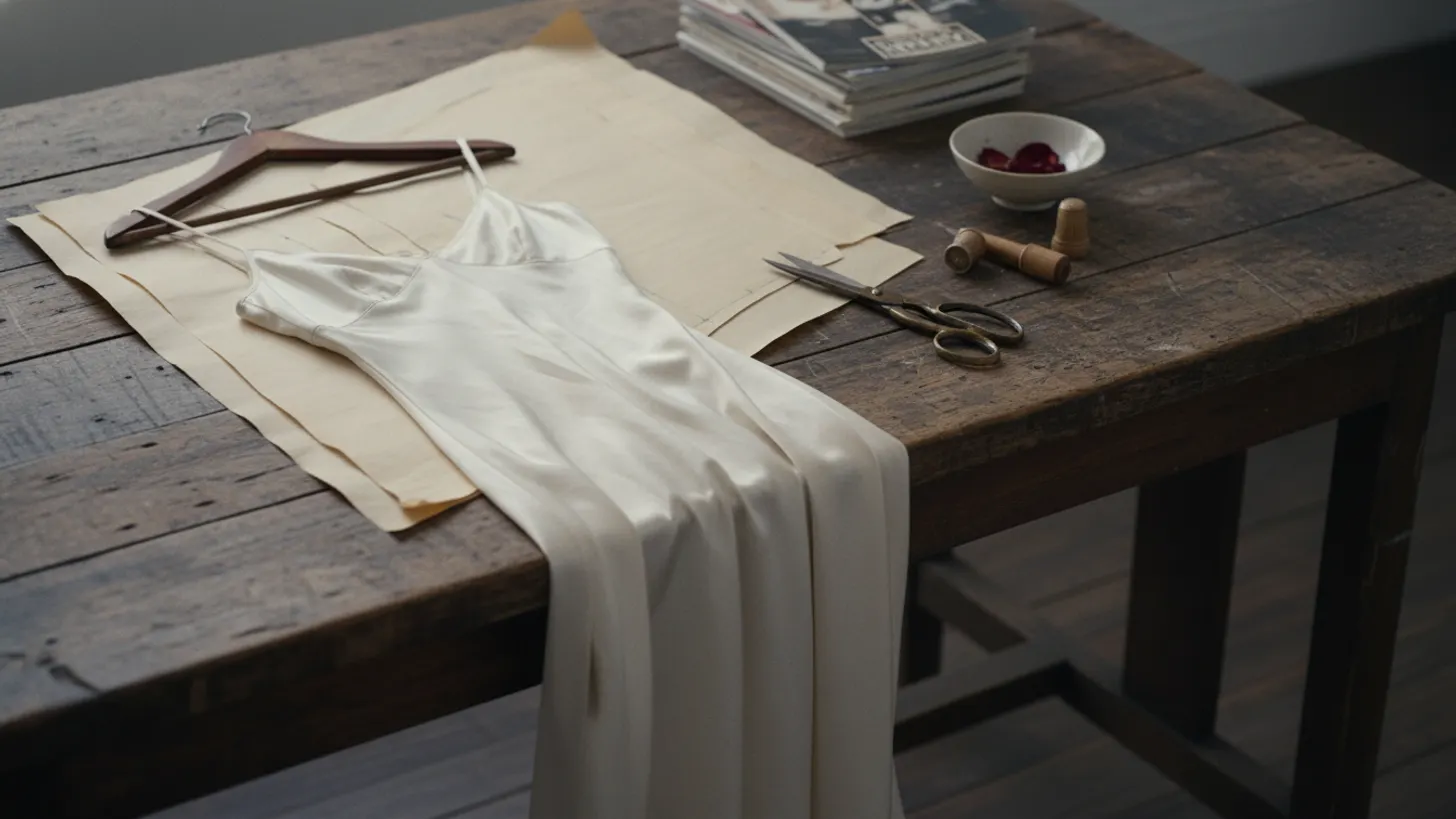
A reader emailed last week with a photo of a black bias-cut slip dress she found at a Brooklyn estate sale for $40. The label said Calvin Klein. The fabric felt right. Was it real? Authentic 1990s slip dress identification rarely comes down to one clue. It is the fabric weight, the hem, the zipper tape color, the label font, and the way the bias drapes across a hanger, considered together. Here is the framework I use.
Why authentic 1990s slip dress identification starts with the fabric weight
Authentic 1990s slip dress identification starts with how the fabric feels in the hand. Silk produced for 1990s Calvin Klein, Prada, and John Galliano-era Dior typically ran between 16 and 22 momme, the textile industry's weight measurement. Modern reproductions, even mid-tier ones, rarely exceed 14 momme.
Momme (pronounced "mommy") measures grams per square meter of finished silk. The Vintage Fashion Guild's silk reference notes that 19 momme charmeuse was the standard for ready-to-wear designer slips through the decade. Lift a 1990s dress on its hanger and the weight pulls down with intention. A 12 momme reproduction floats.
I keep a digital scale in my workspace because momme correlates directly to gram-per-square-meter. For a typical knee-length slip in size 4, expect 180 to 240 grams total. Anything under 150 grams is almost certainly polyester or low-grade silk, regardless of the label. The bias cut amplifies this difference: the heavier the silk, the more architectural the drape, which is why Vogue's 1996 coverage of Calvin Klein's minimalism repeatedly used the word "liquid" to describe the line's movement.
Construction details that confirm authentic 1990s slip dress identification
Construction tells the whole story once you know what to look for. Authentic 1990s slip dress identification through construction means checking three things: the bias direction at the side seam, the hem treatment, and the zipper installation. Each one took skilled labor that mass-market reproductions skip.
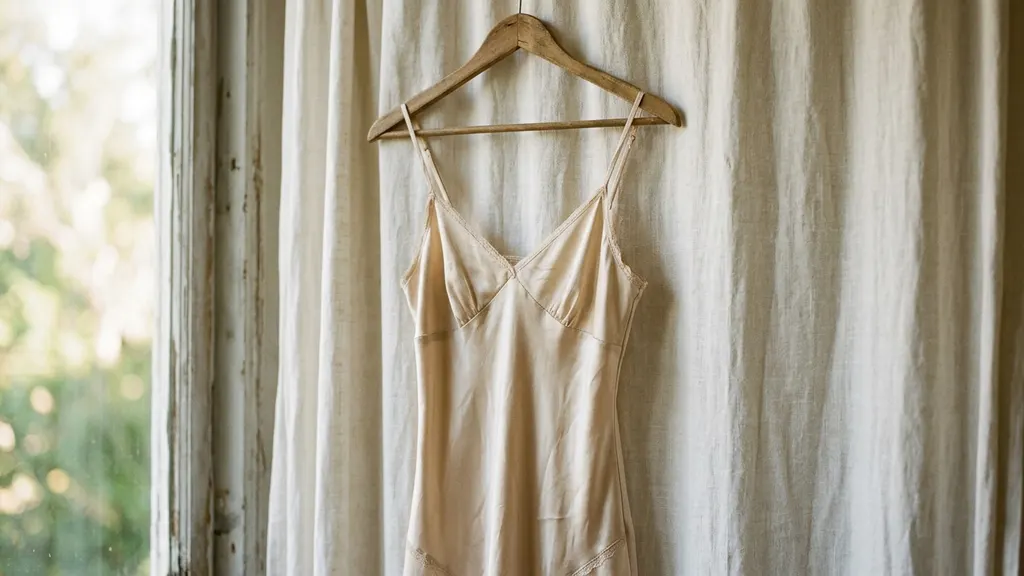
True bias cutting means the fabric was laid out at a 45-degree angle to the grain. Hold the dress flat against a table. The selvage edges, if visible at the seam allowance, should run diagonally. The V&A Museum's primer on bias-cut construction shows how Madeleine Vionnet pioneered the technique in the 1930s and how the 1990s designers explicitly revived it. A modern reproduction cut on the straight grain will lie flat without that characteristic spiral pull.
Look at the hem next. Period work almost always involves a hand-rolled hem or a narrow machine-rolled hem with single-needle stitching. Run your thumb along the inside edge. You should feel a tight, rounded finish, not a flat serged edge with overlocked threads. Calvin Klein's 1995 production used a 3mm rolled hem on bias-cut silk; the rolled hem was hand-finished in the Bronx factory before production moved offshore in 1997, a shift documented by the New York Times manufacturing archive. I keep a running reference of Calvin Klein label evolution updated as new pieces come in.
The zipper is the third giveaway. Period invisible zippers were YKK in cream, ivory, or charcoal tape, never the bright white nylon tape common on post-2015 reproductions. Some pieces from 1990-1993 still used Talon-brand zippers with metal pulls, which run heavier and shorter than modern equivalents. A slip dress with a long plastic invisible zipper and a flat tab pull was almost certainly made after 2008.
Hardware, labels, and the fastest authentic 1990s slip dress identification clues
Labels date a garment faster than any other clue. Authentic 1990s slip dress identification gets quick once you can read an RN (Registered Identification Number) or WPL number. Both are issued by the U.S. Federal Trade Commission to track manufacturers, and the database is public.
Calvin Klein's main RN through the 1990s was 36543. The label format also changed: 1990-1993 used a black serif font on a white satin tag with "Made in U.S.A." in capitals. 1994-1996 switched to a cream tag with sans-serif lowercase. 1997 and later shifted to a smaller printed tag, often "Made in China" or "Made in Indonesia." The Vintage Fashion Guild label resource publishes a side-by-side reference photo set that I keep bookmarked.
Tags should also be sewn on three sides with the bottom edge free. Tags sewn on all four sides, or printed directly onto a polyester care label, are typical of fast-fashion reproductions after 2015. Look for a separate fabric content label (silk percentage), a separate care label (machine wash or dry clean), and a separate brand label. Three tags, not one.
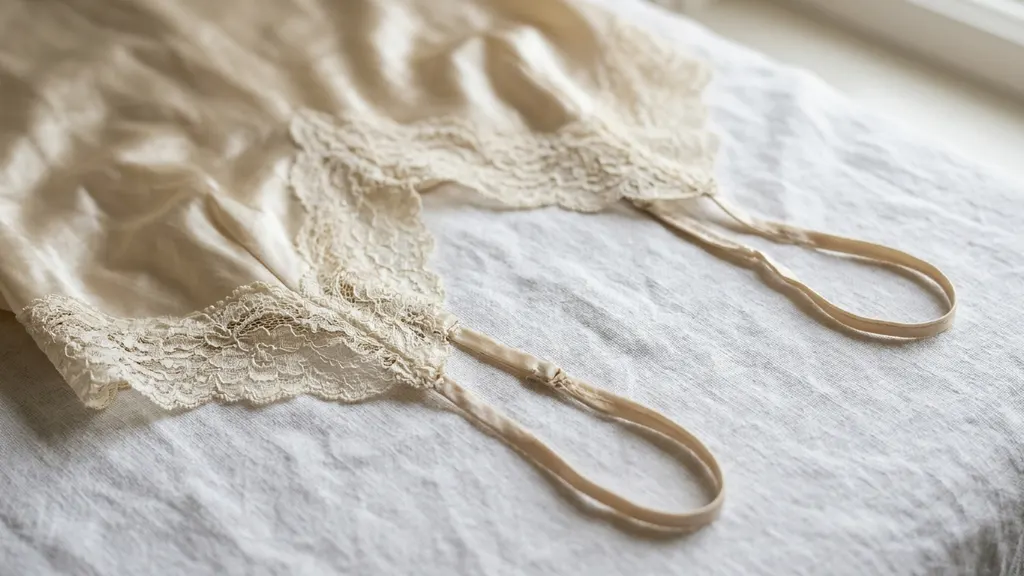
Hardware on strap adjusters is another fast read. Period spaghetti straps used a small metal slide adjuster, often brass or nickel, with the brand's house logo stamped lightly. Plastic slide adjusters appeared on lower-priced lines but were unusual on designer slips through 1998. The Met Costume Institute's online collection includes several 1990s slip dresses with photographic detail of original hardware.
The reference table below compares each authentication criterion side by side, covering fabric, construction, hardware, and label characteristics across genuine period pieces and modern reproductions.
| Feature | Authentic 1990s | Modern Reproduction |
|---|---|---|
| Fabric momme | 16-22 momme silk charmeuse | 6-14 momme polyester or low-grade silk |
| Hem type | Hand-rolled or single-needle machine-rolled, 3 mm | Serged overlock edge or heat-fused flat finish |
| Zipper and tape | YKK cream, ivory, or charcoal tape; Talon metal pre-1993 | Bright white nylon tape, flat plastic pull tab |
| Label format | Three separate woven tags, sewn on three sides | One printed care label, sewn on all four sides |
| Grain direction | 45-degree diagonal at side seam (true bias cut) | Vertical grain parallel to seam (straight cut) |
| Strap hardware | Small brass or nickel slide adjuster, logo-stamped | Plastic or plastic-coated adjuster, no logo stamp |
Wear patterns and patina that reproductions cannot fake
Even when construction and label clues align, the surface of the fabric carries information that fresh reproductions simply do not have. Authentic 1990s slip dress identification at this stage shifts from documentation to forensic observation. Thirty years of cedar closets, dry-cleaning passes, and occasional human contact leave a soft, even patina on silk that mimics nothing else.
Look at the strap attachments first. Real 1990s slip dresses worn even a handful of times show micro-stretching at the strap-to-bodice seam. The thread color may have faded a half-shade. Hold the seam under bright light: you will see tiny puckers where the original tension settled. Brand-new reproductions, even artificially aged ones, lack this.
Underarm areas are the second tell. Silk takes on a faint yellow cast where antiperspirants and skin oils once touched it. This is sometimes called silk caramelization. A complete absence of any tonal shift on a dress sold as "vintage 1995 Calvin Klein" is suspicious. So is uniform yellowing, that pattern indicates fabric dye-aging, often on synthetic blends sold as silk.
Hem edges also tell time. Run your finger along the rolled hem and feel for tiny fiber pulls or slight unraveling. A hem with completely uniform stitching and no fiber breakage on a 30-year-old garment is unusual. Harper's Bazaar's vintage authentication guide flags this as one of the strongest signals a piece is reproduction or heavily restored. Heavily restored slips with replaced zippers or re-sewn hems can defeat most of these tests; in 2021, a 1996 Helmut Lang that had been professionally re-hemmed passed my visual check until the seller later shared alteration documentation. After authentication, storing vintage silk properly matters as much as buying it carefully.
Pricing realities for vintage slip dresses today
Price alone is not a clue, but extreme pricing on either end deserves a second look. A black bias-cut silk slip dress with verified Calvin Klein labels and clean condition rarely sells below $300 in 2025. Pricing data offers a sanity check for authentic 1990s slip dress identification once construction analysis is complete.
Auction houses have started tracking 1990s designer slip dresses as a separate category. Sotheby's reported a 240 percent increase in median resale value for verified 1990s Calvin Klein, Prada, and Helmut Lang slips between 2019 and 2024. Pieces with original tags or runway provenance now reach $1,400 to $3,200 at Christie's online sales.
Vogue Business covered the 1990s vintage boom in detail, citing a generational shift in resale buyers and the depletion of the existing supply pool. Slip dresses are also less likely to survive wearable than coats or jackets, which compounds scarcity. When pricing a piece in my shop, I check three references: completed eBay listings (filter by sold, not asking), the 1stDibs database, and the latest Christie's online vintage results.
For everyday buyers, the practical rule: a $40 silk slip dress from an estate sale or thrift store with the right construction signals is the best possible find. A $400 reproduction sold as "vintage" on a major resale platform is the most common mistake. Business of Fashion has covered authentication fraud in resale as one of the largest challenges facing the sector.
Why modern reproductions are getting harder to spot
Reproductions improved sharply after 2020. The 1990s revival pushed mass-market brands to produce slip dresses that visually approximate the originals, and some smaller labels began sourcing higher-grade silk. Authentic 1990s slip dress identification now requires checking more details than it did five years ago, not fewer.
The Cut documented the 1990s revival cycle hitting peak retail saturation around 2022, with brands releasing slip dresses that copied Calvin Klein's 1995 silhouette nearly stitch-for-stitch. Some used vintage-style woven labels, period typography, and even reproduced RN numbers (which the FTC database now flags).
I keep a running list of details that high-quality reproductions still miss. Bias-cut grain is one. The factories producing these slips at $200 to $500 retail still cut on the straight grain about 70 percent of the time. The hem treatment is another, since single-needle rolled hems require expensive labor that most modern factories cannot price into the supply chain. And the spaghetti strap adjusters: even good repros use lighter, often plastic-coated slide hardware. In 2023, I nearly paid $280 for a 2022 studio-label piece before the straight-grain side seam stopped me. The woven label had period-accurate typography and the fabric weight was close to 16 momme. The grain direction at the side seam was the only tell, which is a useful reminder that the bias test should always come first.
The new challenge is dating fabric without a label. If a piece has had its tags removed, common for resold runway samples and shop-window display pieces, then fabric weight, hem treatment, and bias direction become the entire authentication case. The Museum at FIT's permanent Calvin Klein collection publishes documentation that I often cross-reference for unlabeled pieces. You can also browse my live silk slip dress inventory as a working reference of what genuine pieces look like in 2026.
Frequently asked questions
Can you do authentic 1990s slip dress identification through photos alone?
Photographs can rule out reproductions but rarely confirm authenticity on their own. I can usually spot obvious fakes from a single label photo, and bias-cut drape often shows in three-quarter shots. What photos cannot show is fabric weight, hem treatment by feel, or the soft patina silk develops over decades. For pieces over $250, I always ask for additional shots: a close-up of the inside hem, a flat-laid photo to check bias direction, and a photo of all three tags. The Vintage Fashion Guild publishes a photo checklist that I share with customers.
What is the fastest visual test for a 1990s slip dress?
Hold the dress flat on a table, look at the side seam, and check if the grain runs diagonally. True bias-cut construction will show selvage or grain lines at roughly 45 degrees to the seam. A straight-grain reproduction shows vertical grain parallel to the seam. This test takes ten seconds and rules out the majority of fast-fashion copies before any other check. After that, weight the fabric in your hand: under 150 grams for a knee-length slip in a small size almost certainly means polyester or low-momme silk. Vogue's coverage of bias-cut history illustrates the grain test with photographs.
Are all 1990s slip dresses made from silk?
No. Designer pieces from Calvin Klein, Prada, Helmut Lang, and Galliano-era Dior were predominantly silk charmeuse, but mid-tier 1990s brands often used acetate, rayon, or rayon-silk blends. Acetate slip dresses from labels like Express, Bebe, and J. Crew sold widely from 1994 to 1999 and are genuinely 1990s but were never silk. Authentic 1990s slip dress identification on these pieces still works through label dating, RN numbers, and construction details, even though the fabric weight test does not apply. The Met Costume Institute holds examples of both luxury silk and mid-tier acetate slips from this period.
How do I avoid buying a reproduction sold as vintage?
Three habits filter out most misrepresented pieces. First, only buy from sellers who include detailed close-up photos of all interior tags, hems, and seams in the listing. Second, cross-reference the RN number through the FTC public database before bidding above $200. Third, ask the seller to confirm fabric content and weight in writing. A genuine vintage seller will know this. A reseller flipping mass-market reproductions will deflect with phrases like "as found" or "sold as-is." If a piece has been heavily restored, that should be disclosed openly. Harper's Bazaar's online vintage buying guide stresses transparency as the key signal.