October 2026
Vintage slips and lingerie guide: silk, lace, labels, and fit
A vintage slips and lingerie guide to reading silk, rayon, and nylon, dating labels and seams, judging fit and condition, and storing pieces safely at home.
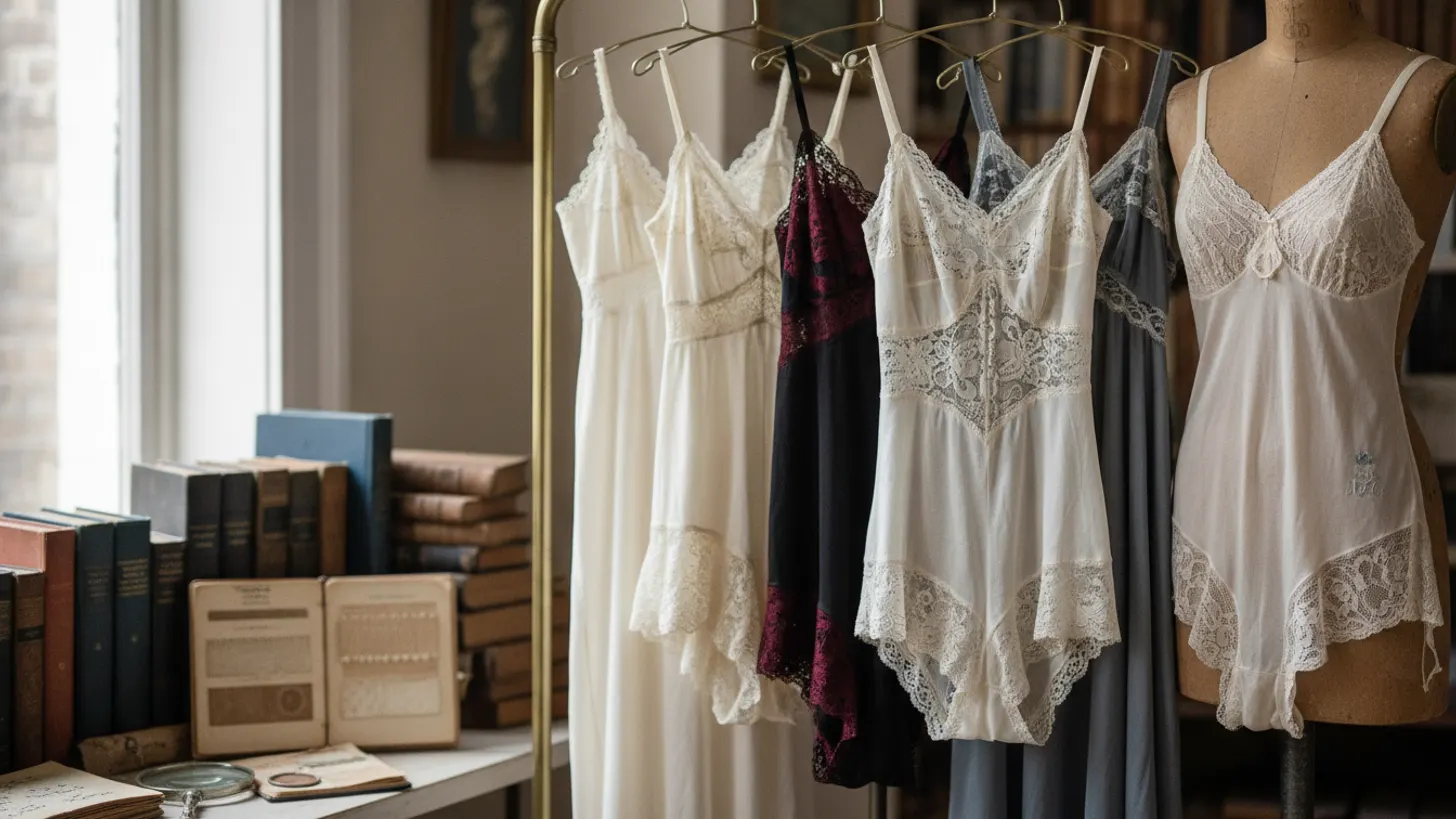
In 1914, Mary Phelps Jacob filed a New York patent for an early modern brassiere, a design the V&A still records as a turning point in how underwear was built. Everything a vintage slips and lingerie guide has to teach sits downstream of that moment: fiber, cut, label, and seam all changed quickly afterward. Read those four in order and a strange old slip stops being a mystery.
What a vintage slips and lingerie guide looks for in a collectible piece
Four things decide whether an old slip is worth buying: fiber, cut, label, and condition. A bias-cut silk slip with a legible maker's label and sound side seams is collectible. A 1970s nylon half-slip with shredded waist elastic is laundry. Most pieces sit between those two poles, and that gap is where the money is.
Underwear became a designed object worth collecting only once it stopped being purely structural. The V&A's underwear collection records Mary Phelps Jacob's 1914 patent for an early modern brassiere, the point at which a garment meant to be hidden started carrying a designer's name and a date. From there, lingerie picks up the same markers that make any garment datable: a label, a seam type, a fastening, a fiber that did not exist ten years earlier.
Collectible and wearable are not the same thing, and a vintage slips and lingerie guide has to hold both ideas at once. Exhibition programs at the Museum at FIT treat lingerie as dress history, which means the pieces that matter most to a museum are often too fragile to wear. What you want for an evening out is a sound garment in a flattering cut. What you want for a collection might be a damaged 1930s piece with an unusual label. Decide which you are shopping for before you open your wallet. If 1990s minimalism is the target, the tells are narrower and well documented in our notes on spotting an authentic 1990s slip dress.
How does a vintage slips and lingerie guide tell silk, rayon, nylon, and acetate apart?
Hand, drape, and sheen separate the four fibers you will meet most. Silk is cool at first touch and then warms, with a dry, uneven luster. Rayon drapes heavily and creases. Nylon feels slick and springs back from a crush. Acetate has a glassy shine and holds sharp folds.
The Metropolitan Museum of Art's costume and textile notes identify rayon as a regenerated cellulose fiber that became important in twentieth-century dress, which matters because cellulose takes on water, swells, and loses strength when wet. That single fact changes how you wash a piece and how you read a stain, and it is the most useful thing in any vintage slips and lingerie guide. Rayon also yellows faster than silk once it sits against raw wood, acidic cardboard, or old newspaper, so a slip that has gone evenly tea colored across its whole surface was almost always stored badly rather than worn hard. Nylon reached American shoppers in 1940, as Smithsonian Magazine's reporting on nylon's debut describes, so an all-nylon tricot slip has a hard date floor underneath it and cannot be mistaken for anything earlier. Acetate sits between the two on every test: it takes dye as brightly as rayon but holds up to water closer to nylon, which is why 1920s and 1930s acetate trim often survives in better shape than the silk or rayon body it was stitched onto.
Fiber tells this vintage slips and lingerie guide leans on
| Fiber | Hand and drape | Sheen | Date floor |
|---|---|---|---|
| Silk | Cool at first touch, warms fast, light for its drape | Dry, slightly uneven | All eras |
| Rayon | Heavy drape, creases sharply, weak when damp | Soft and even | 1910s onward |
| Nylon | Slick and springy, recovers from a crush | Bright, almost plastic | 1940 onward |
| Acetate | Stiffer fall, folds hold, warm to the touch | Glassy | 1920s onward |
When the label is gone, cross-check against the Vintage Fashion Guild fabric and label resources before committing to an identification. No fiber analysis happens in this shop; these are traditional visual and tactile readings, and they are disclosed that way in every listing. Say what you observed, say what you inferred, and keep the two separate.
Which construction details does a vintage slips and lingerie guide check to date old lingerie?
Seams, fastenings, and lace date a piece faster than a label does. French seams and hand-rolled hems point early. Metal hook-and-eye tape and weighted hems point to mid-century. Nylon zippers, overlocked edges, and stretch lace point later. Bias cutting runs across eras but peaks between the wars.
Bias is the single most useful thing to recognize. Harper's Bazaar's explanation of bias cutting describes how cutting at an angle to the grain allows a slip dress to skim the body and move with the wearer instead of hanging off the shoulders. Hold the garment by one strap: a true bias piece swings and spirals rather than falling flat, while a straight-grain slip cut in the same decade just hangs stiff and square from the shoulder. Seam lines running diagonally across the hip are the other giveaway, since a cutter working on the bias has no choice but to piece the fabric at an angle to make a seam lie flat against the body. The technique peaked between the two world wars, when silk was still affordable and dressmakers had the skill to cut it without waste, then went quiet through the nylon decades before the 1990s brought the bias slip dress back as outerwear in its own right.
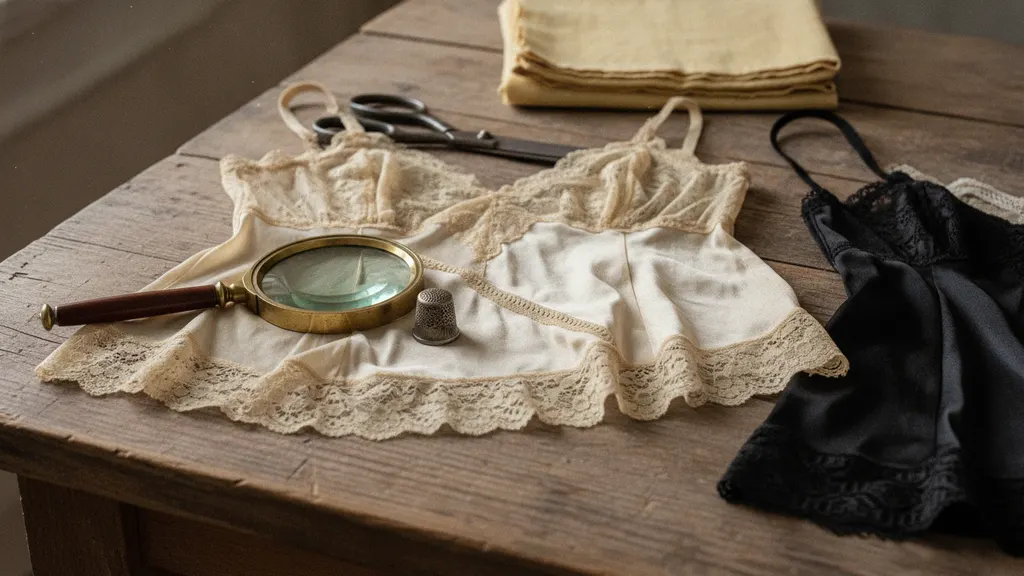
Lace carries date evidence too. Early machine and hand-made laces have irregular picots and a slightly cloudy ground that sits softly against the silk. Post-war nylon lace is bright, even, springy, and sits proud of the fabric it edges. Any vintage slips and lingerie guide that skips lace throws away half the available evidence, since lace was often replaced or added later and a mismatch tells you the garment has a repair history.
Fit, condition, and repairs in a vintage slips and lingerie guide
Measure, do not trust the tag. Vintage sizing answered to different standards and different bodies, so a label reading 34 may suit a modern 6 or a modern 12. Take bust, waist, hip, and shoulder-to-hem flat in inches, then compare those four numbers against a garment already in your closet.
Slips forgive more than fitted dresses do, which makes them a soft landing for a first vintage purchase. A bias cut stretches on the diagonal, so half an inch of difference disappears in wear. What does not forgive is torso length: if shoulder-to-hem is wrong, the bust apex lands in the wrong place and no alteration fixes that cheaply. Our size conversion notes on old labels versus modern fit cover the arithmetic in more detail.
Condition is the other half of the decision, and this is where a vintage slips and lingerie guide earns its keep. Sort every flaw into one of three buckets before you buy: wearable as found, repairable by a seamstress, or display only. Perished waist elastic, an open side seam in sound silk, and a torn lace edge over an intact ground all belong in the repairable bucket. Shattered silk at the underarm does not, because the fiber itself has failed and stitching only moves the tear sideways. I learned that distinction the expensive way in March 2014, when I bought a labeled 1931 Vanity Fair bias slip at a Pasadena estate sale for the lace alone and only found the shattered silk at the left underarm once I had it home under a reading lamp. I still own that slip. It stays in my reference box instead of in inventory, because listing it as wearable would have misrepresented what a quick sale-table inspection missed. Every piece I grade now gets the same window test before a price goes on it.
Styling and storage in this vintage slips and lingerie guide
Wear it as a dress with something structured over the top, or keep it as a layer under sheer knits. Store it flat, folded with acid-free tissue in the creases, out of plastic and out of light. Hang only sound pieces, and only on padded hangers.
The slip as outerwear is not a new idea. Vogue's archive coverage of the slip dress tracks the silhouette from 1930s bias gowns through the 1990s minimal revival and back again, which is why a 1930s piece still reads current under a heavy cardigan or a leather jacket. Keep the proportions honest: a bias slip wants a flat shoe or a low block heel and a stronger shoulder above it.
Storage ends more vintage lingerie than wearing it ever does. Silk and rayon both yellow where they touch raw wood or untreated cardboard, and plastic garment bags hold the moisture that starts mildew. Fold, tissue, box, and look at the piece once a year, the same discipline described in our guide to storing vintage outerwear for decades. That is the whole maintenance side of this vintage slips and lingerie guide: cool water, flat drying, dark storage, annual inspection.
Frequently asked questions
Can I really wear a 1930s silk slip, or will it fall apart?
Often yes, as long as the silk has not shattered. Hold the slip up to a window: healthy silk blocks light evenly, while shattering shows as fine parallel splits at the shoulder and underarm, where sweat and old deodorant did their work. Spread the side seams gently and pull nothing. A sound 1930s bias slip handles dinner and a taxi; it does not handle a crowded dance floor. Condition reporting at auction houses such as Christie's is a good model to copy, since it describes damage plainly and lets the buyer decide. If the silk is sound, wear a liner underneath to keep body oils off it.
How can I tell silk from rayon without fiber testing?
Use hand, drape, and sheen, in that order. Silk feels cool for a moment and then warms against your palm, and its luster is dry and slightly uneven. Rayon stays cool longer, drapes heavier than its weight suggests, creases sharply, and goes limp and weak when damp. Check inside seam allowances, where wear is lowest and the original surface survives. A vintage slips and lingerie guide can only take you this far honestly: these are traditional visual and tactile readings, not analysis. Fiber reporting from outlets such as Sourcing Journal gives useful background on how both fibers behave in production.
What size vintage slip should I buy if I usually wear a medium?
Ignore the number on the label and work from four flat measurements: bust, waist, hip, and shoulder-to-hem. Mid-century sizing ran narrower through the rib cage and longer through the torso than modern sizing does, so a vintage 34 can land anywhere across two or three contemporary sizes. Lay a slip you already wear flat and compare the four numbers. Bias-cut pieces give you roughly half an inch of forgiveness on the diagonal; straight-cut nylon gives you almost none. Marie Claire's vintage shopping coverage makes the same argument for measuring instead of trusting tags.
Is a designer label worth paying extra for on vintage lingerie?
Sometimes, and only when the label agrees with everything else in the garment. A named-house label on a piece whose seams, lace, and fastenings all match the same period earns a premium, because provenance is part of what you are buying, and auction catalogues at Sotheby's price label and provenance together for that reason. A crisp label stitched into an otherwise anonymous nylon slip is a warning sign, since labels get moved. This vintage slips and lingerie guide would rather own an unlabeled 1930s bias slip in sound condition than a labeled one with shattered silk at the underarm.
How should I wash a vintage silk slip at home?
Cool water, a pH-neutral wash made for protein fibers, no agitation, no wringing. Submerge the slip, press gently, rinse twice, then roll it in a towel to blot and dry it flat away from sun and heat. Do not treat rayon the same way without testing a hidden seam allowance first, because cellulose fibers lose strength when wet and can shrink unevenly. Skip bleach and skip the machine entirely. Care guidance from Good On You on washing delicate fibers cool matches what old garments tolerate, and our home cleaning guide for vintage clothing covers spot treatment.
Why does a vintage slip still smell musty after it has been washed?
Because the smell usually sits in the fiber core or in old finishing residue rather than on the surface. Mildew and decades of closet air bind to cellulose, so a single wash moves very little of it. Air the piece in shade for several days, then try a long soak in cool water with a mild deodorizer and repeat the soak instead of escalating the chemistry. Secondhand market reporting in The New York Times notes how much resale value rests on smell and condition. Our notes on removing musty smells safely list the methods in order.