October 2026
How to build a vintage capsule wardrobe that works year-round
Build a vintage capsule wardrobe that works all year: the five slots that carry every season, how to mix decades without costume, and what to check first.

In 1970s London, Susie Faux opened a boutique called Wardrobe and told women to buy fewer clothes that worked harder. Fifty years on, that advice is what makes a vintage capsule wardrobe possible: older garments were cut for alteration and repair, so they hold a rotation better than most new ones. Decide on a palette, a shoulder line, and a hem, and a dozen pieces will dress a whole year.
What makes a vintage capsule wardrobe practical for everyday dressing?
A vintage capsule wardrobe is a small, fixed rotation of secondhand garments, sourced one piece at a time rather than bought as a matching set, usually ten to fourteen pieces, chosen to share one palette, one shoulder line, and one hem length so that almost any two items pair cleanly without a second thought. It stays practical for the same reason Susie Faux's original idea did: a short list of garments that agree with each other needs none of the novelty a season of new retail depends on. When ten or twelve of them share one palette and one shoulder line, nearly every pairing works, so getting dressed stops being a decision made each morning and becomes closer to a habit you no longer have to think through.
The idea is not new. Vogue's reporting on the origins of the capsule wardrobe credits Faux, whose shop sold a short list of garments chosen to work with each other rather than a season of novelty. Vintage suits that discipline better than fast retail does, because the supply is finite. You cannot buy six versions of one 1970s shearling. You find one, you check it, and you build outward.
Old construction helps too. Generous seam allowances, bound edges, and full linings mean a coat can be taken in twice across a decade without looking tired. That is also why a vintage capsule wardrobe rewards care over replacement, and why it is worth reading our notes on storing vintage outerwear between seasons before the rail fills up.
Which vintage basics work across seasons and dress codes?
Five slots carry the year: outerwear, denim, knitwear, a shirt or blouse, and one trouser or skirt in a neutral. Each slot wants a warm-weather answer and a cold-weather answer. That is how twelve garments cover twelve months without repeating the same look twice a week.
Separates have done this work in every period. The V&A's fashion collection shows the jacket-and-trouser grammar recurring from the 1920s onward, and the Metropolitan Museum of Art's costume collection lets you trace a single silhouette across several historical periods. A vintage capsule wardrobe borrows that grammar instead of inventing one.
| Slot | Warm months | Cold months | Dress-code reach |
|---|---|---|---|
| Outerwear | Unlined 1970s trench | Shearling or fur-collar coat | Daily to dinner |
| Denim | Straight leg, light wash | Dark rigid denim | Daily, dressed up with a blazer |
| Knitwear | Fine-gauge cotton or silk knit | Lambswool or cashmere crew | Daily to office |
| Shirt or blouse | Silk or cotton, short sleeve | Oxford cotton, layered | Office to evening |
| Trouser or skirt | Wide linen trouser | Wool trouser or midi skirt | Office to evening |
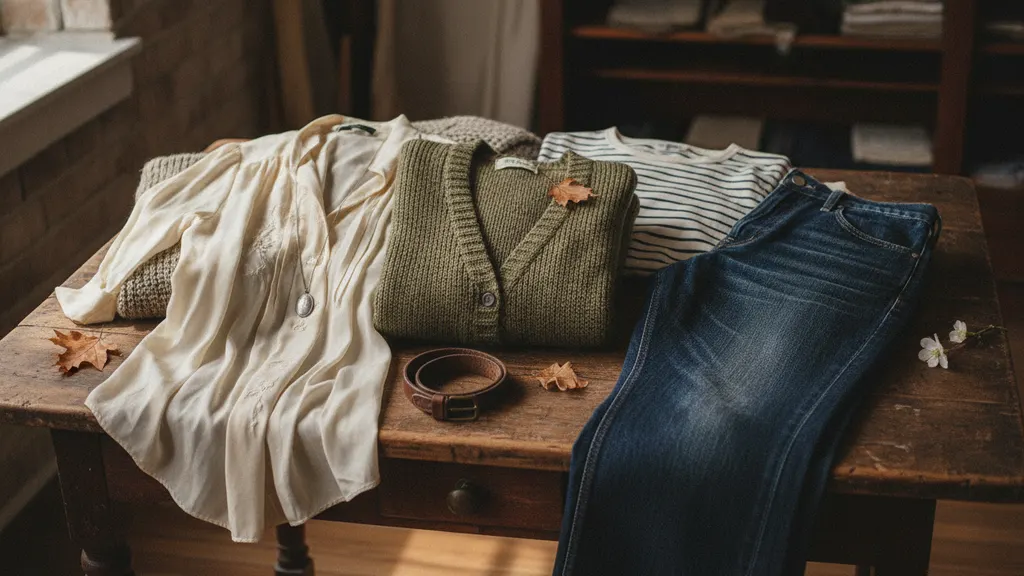
Sizing is the usual snag. Labels moved across decades, so buy to flat measurements and read our vintage size conversion guide before you commit to a number on a tag.
How to balance statement pieces with separates in a vintage capsule wardrobe
One loud piece per outfit, and no more than a fifth of the rail loud in total. Statement garments carry the biography: a Penny Lane coat, a fox collar, a beaded cardigan. Separates carry the week. Buy the separates first, because they decide what a statement can sit beside.
Donna Karan's 1985 collection remains the clearest model for this. Vogue's fashion coverage of Seven Easy Pieces describes seven interchangeable garments built on a bodysuit, dressed up or down without changing the base layer. Seven was not a magic number. The point was that each piece had to pair with every other piece, which is the only test a vintage capsule wardrobe really needs to pass.
The statement slot is where provenance matters most. A vintage Penny Lane coat reads differently from a later copy of one, and the difference usually sits in collar depth, lining, and the way the shearling is seamed.
How can you mix decades without the outfit reading as costume?
Costume happens when an outfit quotes one year completely. Keep a single decade as the loudest voice and let the others stay quiet, matched on color and proportion rather than era. A 1970s coat over 1990s denim with a modern tee reads as personal style, not a reenactment.
Train the eye on proportion before provenance. Museum at FIT, which sits inside a fashion school and stages close-looking exhibitions, is a good place to study how a decade's shoulder relates to its hem. Borrow one of those two measurements from a period, never both. Our longer piece on mixing eras in practice works through specific pairings.
Shoes and bags are the fastest way to break the spell, because they date an outfit harder than a coat does. Keep them plain and current. A vintage capsule wardrobe makes all of this easier, since the palette was settled at the buying stage and nothing on the rail fights anything else.
How do you assess quality, fit, and cost per wear before buying?
Cost per wear is the simplest number in buying anything, vintage or not: take the purchase price and divide it by the number of times you actually wear the piece. A $340 shearling worn twice a week lands under $7 a wear by the end of its first winter and keeps falling every season after that, while a $90 fast-fashion coat that survives two wears before the zipper fails costs $45 a wear and still looks like a bad decision. Check fiber, seams, lining, and closures in that order, then test the measurements against a garment you already own. Price matters less than wear count. Anything you reach for weekly pays for itself quickly, and anything needing three alterations rarely does, however good the label looks.
Fiber first. Vintage Fashion Guild's fabric resource is the reference most dealers work from, and a burn test or a hand feel is still how fibers get identified in the trade. No visual check is a laboratory result, and an honest seller will say which calls are judgment calls. Condition language should be specific: a weak underarm seam, a replaced lining, a missing hook. For buying secondhand well rather than often, Good On You's guidance on secondhand shopping is a sane starting point.
Read the curve rather than the sticker. That same $340 shearling crosses 100 wears by its third winter, for a cost per wear near $3.40, and by year six, somewhere past 300 wears, it is down under $1.15. Dividing any purchase price by wears, the cost of an outing falls steeply across the first 25 wears and then flattens, which is why a plain coat worn twice a week beats a rare one worn twice a year, no matter what either one cost at checkout. The arithmetic is what keeps a vintage capsule wardrobe honest, and it is also the argument for spending the most on the piece you will wear in public most often, usually a jacket. Our vintage leather jacket guide covers what to look for in that slot.
Keeping a vintage capsule wardrobe in rotation all year
Rotation beats accumulation. Store the off-season half properly, keep two repairs pending at most, and audit the rail twice a year by asking which pieces went unworn through an entire season. Those are the slots to sell on or swap, not to apologise for.
Layering does the heavy lifting in the shoulder seasons. A fine knit under a trench covers most of spring, and the same knit under a shearling covers most of January. Keep the layers thin enough to fit inside a sleeve cut for a 1970s body, which was often narrower than a modern one. Fur and shearling need air and hangers with depth, not bags.
A vintage capsule wardrobe is finished when nothing on it needs explaining. Each piece has a reason, a weight, and a wear count, and the loud pieces stay outnumbered. That is a rail you can dress from in the dark.
Frequently asked questions
How many pieces should a vintage capsule wardrobe have?
There is no fixed number, and a seller who gives you one is usually selling the number. Ten to fourteen garments covers a four-season climate if each one fills a slot instead of a mood: outerwear, denim, knitwear, a shirt, and a trouser or skirt, with a warm answer and a cold answer for each. Who What Wear's styling coverage treats the count as a function of climate and dress code rather than a rule, which is the right instinct. Start from the eight pieces you already reach for, note what the week keeps asking for, and buy against that gap.
Can I wear vintage every day without looking like I am in costume?
Yes, if you stop at one era per outfit. The tell is total period accuracy: 1940s hair with 1940s shoes and a 1940s dress reads as a reenactment, while a single 1940s coat over plain modern trousers reads as taste. Harper's Bazaar's fashion desk keeps returning to the same fix, which is to anchor an old garment with contemporary basics and current shoes. Proportion matters more than age. Match the volume of the top to the volume of the bottom, keep the accessories quiet, and let the oldest thing in the outfit be the only loud one.
What vintage piece should I buy first if I am starting from nothing?
Outerwear, every time. A coat is the piece people see first, it covers whatever is underneath, and vintage outerwear survives better than vintage knitwear or vintage shoes because it was built with heavy interlinings and replaceable linings. The Cut's shopping coverage makes the same argument from another direction: the garment with the longest wear window deserves the largest share of the budget. Pick a cut that works open and closed, in a neutral that sits beside your denim, then fill the quieter slots around it over the following year.
How do I know whether a vintage coat will actually fit me?
Measure a garment you already like while it lies flat, then compare those numbers against the seller's flat measurements rather than any label. Vintage sizing drifted decade by decade, so a 1970s 12 and a 2026 12 are not the same garment. The Vintage Fashion Guild's label resource helps you place the era, which tells you which sizing convention you are reading. For coats, check shoulder width first, because it is the one measurement a tailor cannot fix cheaply. Sleeve length, hem, and waist all move. Shoulders do not.
Is vintage clothing actually better made than new clothing?
Sometimes, and it depends on what you are holding. Pre-1980s garments were often made with fuller seam allowances, bound or taped seams, and linings meant to be replaced, all of which make repair possible decades later. The Business of Fashion has documented how production economics shifted toward speed and lower material cost, which is the honest explanation for much of the difference. I passed on a 1970s shearling two years ago because the leather had gone dry and cracked under the collar, where a heat vent had been blowing on it for decades; it looked fine on a hanger and would have fallen apart within a season. Judge the garment in your hands by its seams, closures, and fiber rather than by its birth year.
How do I keep a vintage capsule wardrobe working through summer?
Summer is where most capsules fail, so plan for it while you buy. Swap weight, not silhouette: the same straight trouser in linen, the same shirt in cotton voile, the same coat shape in an unlined gabardine. Marie Claire's fashion desk makes the point that hot-weather dressing lives or dies on fiber choice, and old stock gives you access to fibers that are now expensive, including heavy silk and real linen. Store the winter half properly between seasons and the rail stays at twelve pieces instead of creeping toward forty.