November 2026
Vintage beaded evening bags: how to date, assess, and style them
A field guide to dating vintage beaded evening bags by bead material, frame, and lining, assessing condition honestly, and styling them safely for real wear.
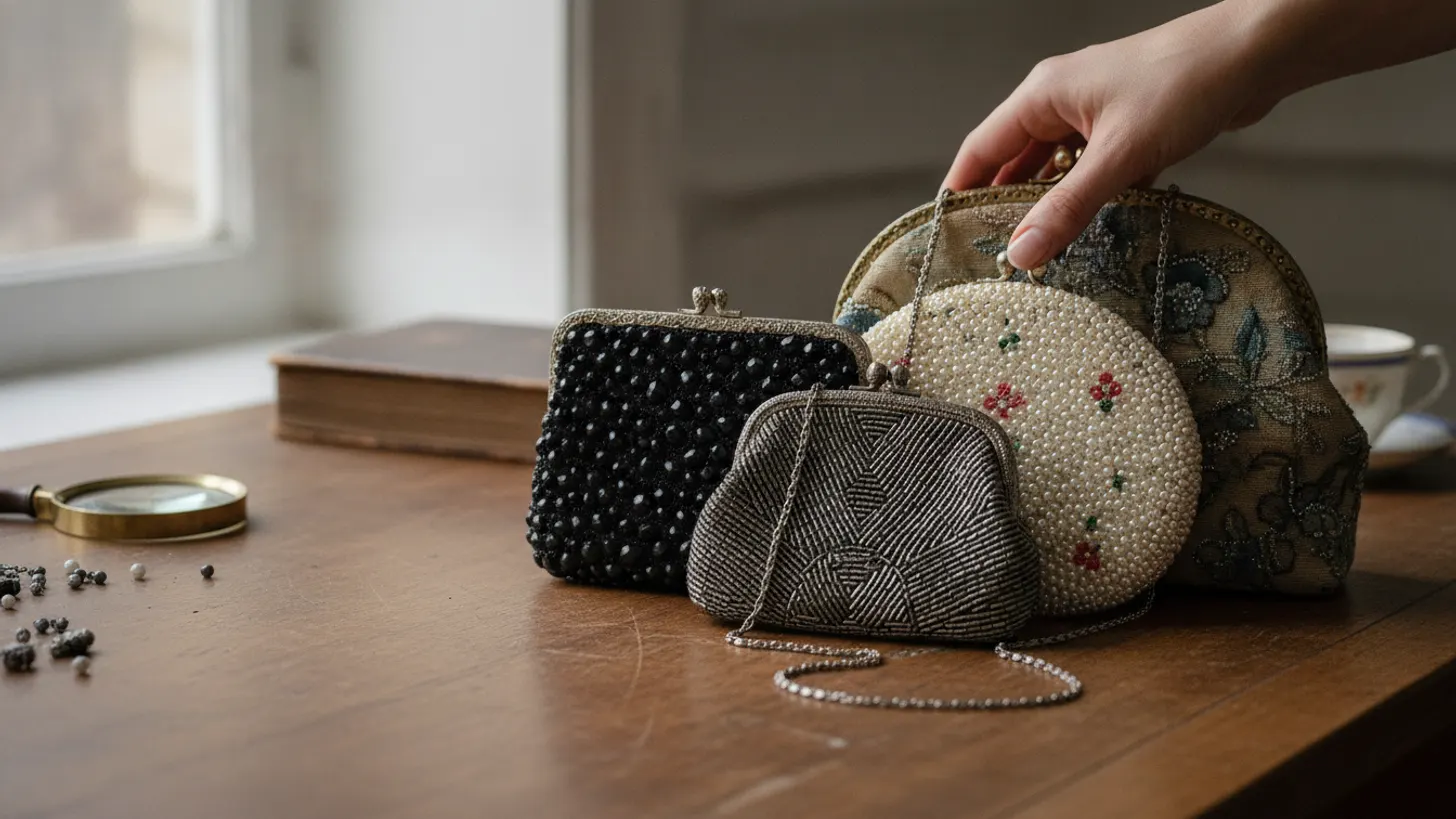
A 1920s American drawstring bag, silk worked with crystals, sits in the Metropolitan Museum of Art collection, and it answers the first question buyers ask about vintage beaded evening bags: what am I actually looking at. Beads date the fashion. The frame, the lining, and the sewing thread date the object. Read them in that order, slowly, and condition stops being a coin toss.
Which vintage beaded evening bags collectors actually chase
Four families of vintage beaded evening bags hold their value: cut-steel and small-glass bags from the 1820s to the 1860s, Edwardian knitted figurals, 1920s drawstring and frame bags in silk and crystal, and 1950s hand-beaded clutches. The Metropolitan Museum of Art documents examples across all four, which gives buyers a comparison set instead of a hunch.
The Metropolitan Museum of Art collection records catalogue knitted beadwork bags as fashionable accessories from the 1830s through the 1860s, which corrects the assumption I hear most often: that the form arrived with the flapper. It did not. By the time a 1920s American evening drawstring bag of silk and crystals entered those holdings, the technique was already roughly a century old, and that long runway is why early examples read as needlework rather than as handbags.
Figural and scenic panels, worked bead by bead into landscapes, buildings, or floral repeats, carry the most labor and the most risk. A plain-ground bag with a sound frame is the safer first purchase. Sale records from Christie's handbag and accessory sales and the Sotheby's fashion and accessories department are the fastest way to see which shapes hold demand, while the accessories holdings at the Museum at FIT help with silhouette dating when you cannot get to New York. For the hardware groundwork this piece assumes, my guide to dating a vintage handbag by hardware and lining covers it.
Provenance matters more than most sellers admit. Museum records place beaded bags in Philadelphia, the Catskills, Italy, Austria, Germany, and Holland, and those six origins behave differently. Austrian and German glass runs finer and more uniform. Italian work tends toward larger bead sizes with bolder color blocking. American knitted bags from Philadelphia and the Catskills often pair modest beadwork with heavier cotton or linen ground thread. Paperwork for these pieces is rare, so the object has to testify for itself against those baselines.
How beads, frames, and linings date vintage beaded evening bags
Work from the inside out. Bead material narrows the decade, the frame narrows it further, and the lining and sewing thread confirm or break the story. A bag can wear 1860s beads on a 1920s frame, so the earliest dateable element tells you only what the maker had on hand that week.
Cut steel, common in early nineteenth-century work, is heavy, faintly magnetic, and oxidizes to a dull grey rather than flaking. Small uniform glass seed beads in regular rows suggest Continental production. The Vintage Fashion Guild fabric and label resources are what I return to for ground-cloth identification, and the same reasoning I apply to garments in identifying rayon, acetate, nylon, and polyester applies to a bag lining. Celluloid and early plastics in a frame put you after 1900. A zipper in a beaded bag almost always means 1935 or later, and a nylon zip means a replacement or a late piece.
| Era | Bead and ground tell | Frame and closure tell | Lining tell |
|---|---|---|---|
| 1830s to 1860s | Knitted or crocheted ground, tiny glass or cut steel worked in rows | Drawstring or small stamped metal frame, no snap | Silk or fine cotton, sometimes unlined at the base |
| 1890s to 1910s | Scenic and figural panels, finer Continental seed beads | Pierced or chased frames, chain handles, celluloid appears | Silk moire, occasional small interior pocket |
| 1920s | Silk drawstring bodies with crystals, long bead fringe | Enameled or marcasite-set frames, snap closures | Lightweight silk, maker stamp on the frame |
| 1930s to 1950s | Hand-beaded satin or faille clutches, sequins beside beads | Zippers from the mid 1930s, kiss-lock frames | Rayon or early acetate, printed labels |
Dating vintage beaded evening bags from one feature alone is how buyers overpay. Take the frame, the closure, the ground cloth, the thread, and the bead type together, then date the object by its latest element. The chart below plots the two eras the museum records fix most firmly, which gives you anchor points instead of guesses.
Original construction versus later repair in vintage beaded evening bags
Turn the bag inside out under a strong lamp. Original sewing thread ages evenly with the ground cloth and sits slightly dulled. Replacement thread looks brighter, often whiter, and usually runs a different stitch length. Frame hinges, screw heads, and tack holes record every repair the bag has had.
Three tells separate honest restoration from disguise. Doubled holes along the frame tack line mean the bag has been re-mounted at least once. A crisp acetate lining inside an 1860s knitted body is a later replacement, which is fine when disclosed and a problem when it hides a split seam. Modern polyester thread under a loupe looks smooth and glassy next to the matte twist of old silk or cotton. Restoration is not a flaw. Undisclosed restoration is. A bag that reaches a hundred years has usually been repaired at least once, and good listings say so plainly. Beadwork on 1920s pieces follows the construction logic I set out in identifying vintage 1920s dresses by beading, bias, and labels.
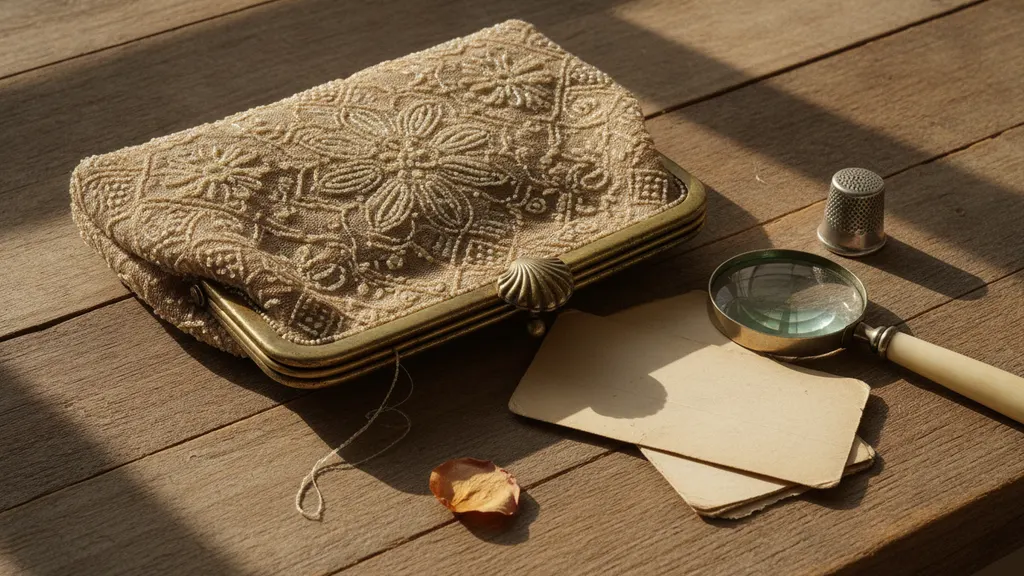
Assessing missing beads and condition in vintage beaded evening bags
Condition on a beaded bag is structural, not cosmetic. A missing bead is a cut thread, and a cut thread spreads with every opening. Before you buy, ask for a daylight photograph of the worked panel, a shot of the interior corners, and a direct answer about smell.
Four problems decide whether a bag is wearable or shelf-only. Loose or missing beads in a continuous run signal a broken thread path that will keep opening, while scattered single losses in a dense ground are usually stable. Lining shatter, where old silk splits into brittle strips along the fold lines, cannot be reversed, only replaced. Odor from smoke or mildew sits in the lining and the ground cloth, and airing helps where washing destroys. Metal mesh bags sag and split at the hinge line, and a split in the mesh body is specialist work. The Victoria and Albert Museum textile care guidance is the most useful free reference on handling aged silk, and my notes on cleaning vintage clothing at home explain why solvents and beaded grounds do not mix.
Price the repair before you price the bag. I disclose condition in every listing because the alternative is a buyer discovering shatter halfway through a wedding reception. When you assess vintage beaded evening bags, assume one repair is already in the price and ask who is going to do the second one.
How to style and store vintage beaded evening bags safely
Carry it short and carry it light. Weight is the enemy of hundred-year-old thread, so the contents cap out at a phone, a key, a card, and a lipstick. Store the bag flat with the beads facing up, in acid-free tissue, never hanging from its handle or chain.
Styling is simpler than people expect: let the bag be the only worked surface in the outfit. Plain wool, matte silk, or a sharp black trouser gives the beadwork somewhere to sit. Vogue evening and accessories coverage reads the same way, and Harper's Bazaar accessories reporting is good for tracking which eras are in rotation. A 1920s drawstring works against a modern slip; a scenic Edwardian panel wants quiet around it. My guide to mixing eras without looking costumed covers the proportion rules in detail.
For storage, think cool, dark, flat, and dry. Keep metal frames away from leather dyes and cedar oils, skip the plastic bin that traps humidity, and look at the back of the worked panel once a year to catch a loosening thread while it is still one bead. Vintage beaded evening bags survive storage better than they survive use, so decide which one you bought the bag for, and then be honest with yourself about it.
Frequently asked questions
How can I tell if a beaded evening bag is antique or just old?
Date the parts, not the whole. A knitted or crocheted ground with a drawstring and no snap points early, since the Metropolitan Museum of Art catalogues knitted beadwork bags as fashionable accessories from the 1830s through the 1860s. A stamped or enameled frame with a snap, a chain handle, and a silk body worked with crystals points to the 1920s. Celluloid in the frame means after 1900, and a zipper means the mid 1930s at the earliest. Most vintage beaded evening bags mix elements, so take the latest dateable component as the honest floor for the age of the object.
Is it safe to carry a vintage beaded evening bag to a wedding?
Yes, with limits. Weight is what breaks a beaded bag, because every ounce inside pulls on thread that may be a century old. Carry a phone, a key, a card, and a lipstick, nothing heavier, and keep the bag in your hand or on your forearm rather than hanging from a shoulder for six hours. Check the frame hinge and the handle attachment the week before, not at the door. Occasion coverage from Who What Wear tracks how evening bags are worn now, and the short answer is that vintage beaded evening bags read best against plain tailoring.
Can missing beads be repaired, and is it worth paying for?
Scattered single losses in a dense ground can usually be filled by a textile specialist with period-appropriate beads, and the repair is close to invisible. A continuous run of loss is different, because the thread path has broken and the panel will keep opening until it is restitched from the back. Restringing a knitted body is slow hand work priced by the hour, so ask for a written estimate before you buy rather than after. Conservation resources from the Victoria and Albert Museum collections explain why an aged silk ground needs support before any new beadwork goes into it.
How do I tell cut steel beads from glass beads?
Weight and light. Cut steel sits heavy in the hand, holds a faceted sparkle that reads grey rather than colored, and dulls to a soft oxidized tone instead of clouding or flaking. Glass beads are lighter, warmer in color, and chip at the edges when damaged. A weak magnet will show interest in steel and ignore glass, though you should test at a seam rather than across a worked panel. Reporting from Smithsonian Magazine on historic glass and metal beadmaking is a good primer on why the two materials age so differently.
What can I do about a musty smell in a beaded bag?
Air it, do not wash it. Open the frame and leave the bag flat in a dry, shaded room with moving air for several days, with acid-free tissue loosely inside to draw moisture out. Never submerge a beaded bag, never steam it, and keep solvents away from the ground cloth, because wet thread swells and releases beads. Smoke and mildew often live in the lining, so a disclosed lining replacement by a specialist can solve what airing cannot. The Vintage Fashion Guild fabric resource helps you work out what the lining and ground actually are first.
How should I store a beaded bag so it does not lose beads?
Flat, beads facing up, in a cool dark drawer, padded with acid-free tissue so the body holds its shape without stress on the frame. Never hang a beaded bag by its handle or chain, because gravity works on old stitching every hour it hangs. Keep it away from leather dyes, cedar oils, and plastic boxes that trap humidity, and check the thread once a year by looking at the back of the worked panel. Wardrobe care reporting from The Cut makes the same point about flat storage for anything heavily embellished.