October 2026
What is a vintage rockabilly dress? 1950s silhouettes and tells
A vintage rockabilly dress has a nipped waist, full skirt, and 1950s tells in its labels, zippers, and seams. Here is how to spot the real thing before buying.
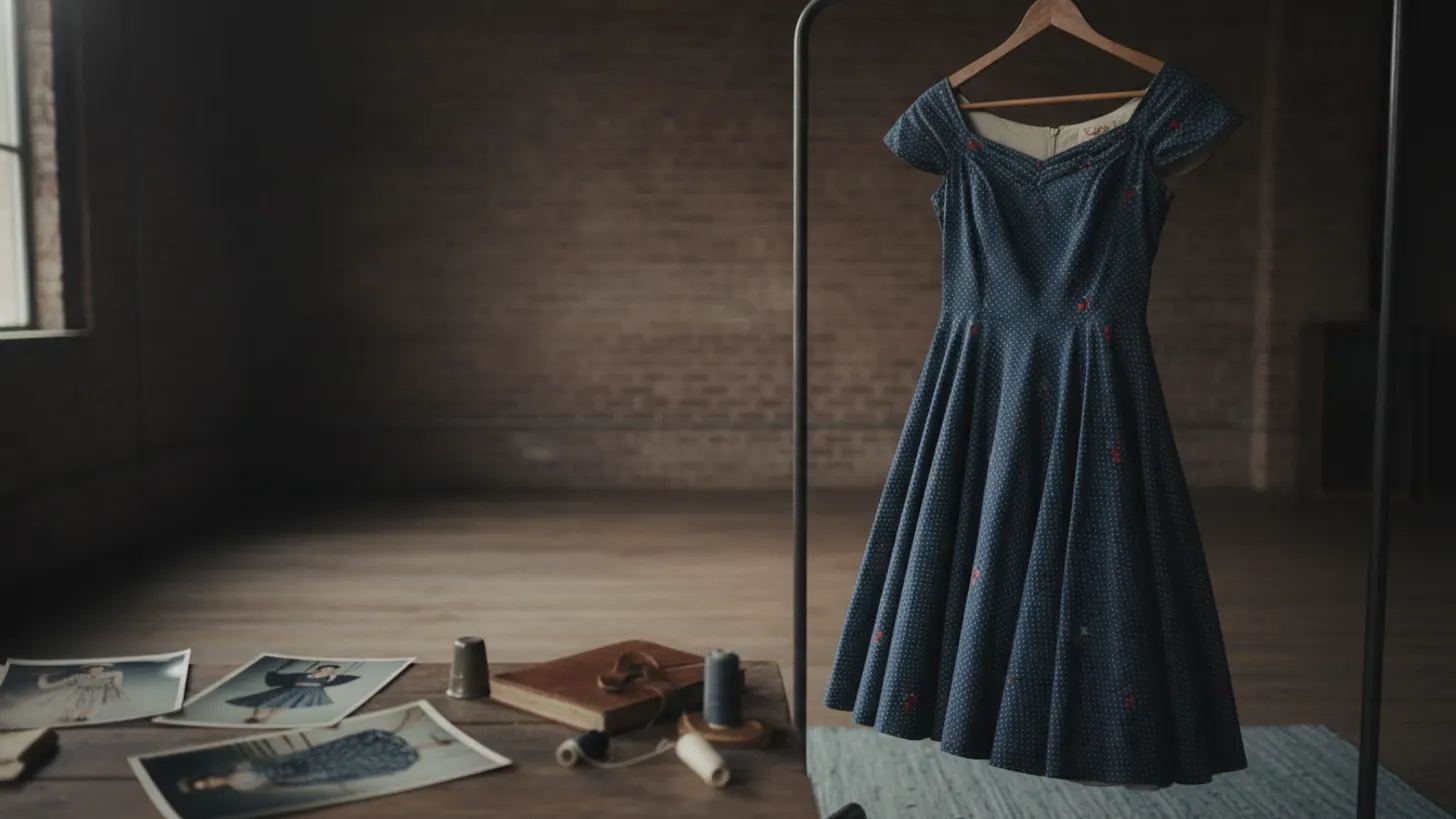
Last spring in a Tulsa estate garage, I pulled a cotton sundress off a rod and felt the weight of a metal zipper under my thumb, the same check my first mentor in the trade, estate liquidator Margaret Doyle, drilled into me a decade ago. That is usually the first honest answer about whether something is a vintage rockabilly dress. The look is a postwar silhouette with a nipped waist and a skirt built for movement, and the proof sits in the seams, not the styling.
What a true 1950s vintage rockabilly dress actually looks like
A true 1950s piece, cut sometime between 1951 and 1958, reads as a day or party dress first and a subculture signal second. Expect a fitted bodice that ends at the natural waist, a full skirt with a sweep of 90 to 120 inches or a sharply cut pencil skirt, and hand finishing that modern factories skip.
The shape is Paris before it is Memphis. The Metropolitan Museum of Art's costume collection records date Christian Dior's New Look debut to 1947, and that arrangement of soft shoulder, cinched waist, and fabric-heavy skirt became the template for nearly everything cut in the decade that followed. A vintage rockabilly dress is what happened when that couture proportion reached American ready-to-wear, cotton mills, and teenage dance floors.
The music came second and changed the meaning. Smithsonian Magazine has documented how American youth culture and recorded music reshaped mid-century dress, turning a conservative silhouette into something worn for speed. Hems sit at mid-calf or just below the knee. Prints get loud. Bodices get halter necks and sweetheart seams. The garment stays polite in cut and stops being polite in attitude.
Two practical consequences follow. First, almost nothing was sold as rockabilly at the time; the word is a later retail category applied to sundresses, day dresses, and party dresses. Second, the defining features are structural, so you can verify them with your hands instead of trusting a listing title.
Which silhouettes, fabrics, and prints define the style
Three silhouettes carry the style: the circle or sun skirt over a stiff petticoat, the gathered dirndl skirt on a fitted bodice, and the wiggle dress cut narrow through the hip. Fabric is usually a 4 to 6 ounce cotton, cotton pique, rayon, taffeta, or barkcloth, and the print does the talking.
V&A collection records for 1950s womenswear show how consistently the period paired a fitted waist with yardage below it, and how novelty prints moved from children's wear into adult day dresses. Fruit, playing cards, poodles, musical notation, atomic starbursts, border prints that run around the hem: these were produced as mass-market cotton, which is why surviving examples still turn up in wearable condition. Most of what sells today as a vintage rockabilly dress is, at root, one of those printed cottons.
Fabric weight is the tell most people miss. Period cotton has a dry, slightly crisp hand in that same 4 to 6 ounce range, and holds a crease. Rayon from the era drapes heavier than modern viscose and takes water badly, which is why a wet hem can shrink a visible half inch if you are not careful.
| Silhouette | Cut and era tell | Who it suits |
|---|---|---|
| Circle or sun skirt | Full skirt cut from a single sweep, narrow waistband, often a self-belt; built for a petticoat | Dancing, warm weather, smaller waist to hip difference |
| Gathered dirndl | Straight yardage gathered into a fitted waist seam; less bulk than a circle | Everyday wear, fuller hip, flatter waistline |
| Wiggle or pencil | Narrow through hip and knee, back kick pleat or vent, shaped bust darts | Hourglass proportions, evening, less forgiving fit |
| Halter sundress | Bare shoulders, ties or buttons at the neck, shelf bust shaping, metal side zip | Summer, strong shoulders, needs a specific bra |
How labels and construction separate a vintage rockabilly dress from a reproduction
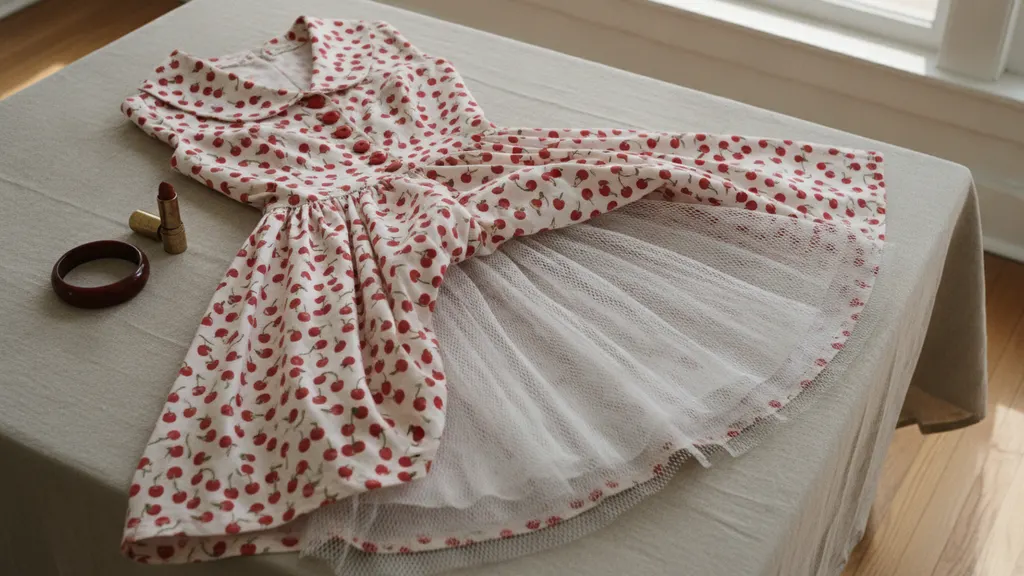
Construction is where the question gets settled. Original mid-century dresses carry a small, repeatable set of signals: a metal zipper in the left side seam, used in roughly 9 of 10 American dresses before 1960, pinked or bound seam allowances, a hand-finished hem, and a label whose typography can be dated. Reproductions announce themselves in the finishing before the fabric.
Zippers first. A metal zipper set into the left side seam was the standard closure for American dresses through the fifties, with metal teeth and a stamped slider body. Center-back nylon zippers belong to the sixties and later. Hooks and eyes above the zipper, sometimes a single covered snap, are normal and often original.
Then labels. The Vintage Fashion Guild label resource holds dated examples you can compare against the tag in front of you, including union labels whose design changed over time. A single number on a woven tag, with no care instructions and no fiber content, is consistent with production before care labeling became standard practice in the mid-1960s. A quick hand-feel or burn test settles it when a seller calls something silk and the cloth says otherwise. My identifications are visual and tactile, made across hundreds of garments, not laboratory analysis, and I say so in every listing.
Seam finishing is the quietest evidence. Pinked edges cut with zigzag shears, bound seams, or raw allowances all read as period. Overlocking on every interior edge reads as modern, and so does fusible interfacing in the collar or bodice, which replaced the hand-basted hair canvas and stiffened cotton of earlier construction. The same reasoning I use for dating vintage denim by stitching and labels transfers directly to a vintage rockabilly dress.
What measurements and alterations matter when buying a vintage rockabilly dress
Measurements decide the purchase, not the tag. Ask for flat bust, flat waist, hip, shoulder to waist, and total length before you commit, since a 1950s 14 commonly fits like a modern 8, a 4 to 6 inch gap at the bust. The waist is the number that cannot be negotiated: a fitted period waist seam carries no spare fabric.
Take your own measurements over the underwear you plan to wear, then compare against the garment flat and allow a little ease at the waist rather than buying to the exact number. Vintage sizing is not a translation you can do from the tag alone; the vintage clothing size conversion guide walks through why a mid-century 14 can measure smaller than a modern 8.
What alters well: hems, side seams taken in, straps shortened, a bodice darted. What does not: letting out a narrow seam allowance, moving a waist seam, or swapping a metal zipper without losing the original closure line. Before you pay for alterations on a vintage rockabilly dress, check the underarms for perspiration damage and the hem fold for brittleness, because weakened fibers will not survive a needle twice.
How to style a vintage rockabilly dress for everyday wear
Treat it as a separate, not a costume. Drop the stiff petticoat, which alone can add 6 to 10 inches of skirt volume, pair the dress with flats and a plain cardigan, and the silhouette reads current rather than themed. Add a leather belt and ankle boots and it needs no period hair at all.
Styling is where the piece earns daily wear. Runway revivals of fifties silhouettes have resurfaced at least once each decade since the 1980s, and the formula holds every time: period proportion, modern shoes, nothing else literal. Pick one era signal and let the rest of the outfit stay current.
Jewelry does more work than the shoes. A single mid-century brooch or a pair of screw-back earrings dates the look without tipping it into costume; my guide to identifying vintage costume jewelry covers materials and findings. For broader mixing rules across decades, the practical guide to styling vintage clothing is the one I send most often. Worn this way, a vintage rockabilly dress becomes a repeatable outfit rather than a one-night piece.
Frequently asked questions
Is a rockabilly dress the same thing as a 1950s swing dress?
Mostly yes, with a difference in intent. Swing describes the skirt: a circle or near-circle cut that moves when you turn. Rockabilly is a later styling label, popularized well after the fact, that borrows those same postwar shapes and pairs them with loud prints, halter and sweetheart bodices, and dance-floor associations. An original garment from the period would have been sold as a sundress, a day dress, or a party dress; mail-order catalogues from 1952 to 1957 use those three terms almost exclusively and never the word rockabilly. If a seller uses the two words interchangeably, read the construction notes instead of the title.
How can I tell if a 50s dress is vintage or a reproduction?
Start with the closure. Through the fifties, a metal zipper set into the left side seam was standard, and a center-back nylon zipper usually signals later manufacture, generally after about 1963. Then look at the seam allowances: original dresses were pinked, bound, or left raw, while overlocked edges on every seam point to an industrial serger. Union labels, single-size tags, and fabric content stated in generic terms are further signals. The Vintage Fashion Guild label resource lets you match a printed label against dated examples, which is the fastest way to settle an argument with a listing photo.
What size should I buy if the dress has no measurements listed?
Do not buy it. Ask instead. Mid-century labels were cut on different grading rules, so a tag reading 14 can measure closer to a modern 8, often a 4 to 6 inch difference at the bust, and a tag reading 10 can be far narrower than you expect. The numbers worth requesting are flat bust, flat waist, hip, shoulder to waist length, and total length, each taken with the dress lying closed and flat. Sellers who measure properly will send those figures without hesitation, and sellers who refuse are telling you something useful.
Can a vintage rockabilly dress be altered to fit?
Some of it, yes. A full skirt can be shortened, and a bodice can usually be taken in at the side seams and the center back, typically up to about one inch total before the panel lines stop sitting correctly. Letting a vintage rockabilly dress out is the hard direction, because original seam allowances are often narrow and the old fold line stays visible in cotton and taffeta. Waist seams are the least forgiving point of all, so buy on the waist and adjust elsewhere.
How do I wash a 1950s cotton dress without ruining it?
Hand wash cotton and cotton blends in cool water with a pH-neutral detergent, support the weight when you lift it out, and dry flat rather than on a hanger, since a wet bodice can stretch a half size at the shoulders in under an hour if left hanging. Rayon, taffeta, and anything with a stiffened or glazed finish should go to a cleaner who handles period textiles, since water can shrink and dull those fabrics permanently. Test any treatment on an inside seam allowance first. My full method is in this guide to cleaning vintage clothing at home.
Is an original 1950s dress worth more than a reproduction?
It depends what you want from it. Reproductions give you modern sizing, stretch, and machine washing, typically for $40 to $90, and there is nothing wrong with that. An original gives you a single garment with a readable construction history, fabric that is no longer milled, and a resale floor that reproductions do not hold; a documented original by a known maker can clear $300 or more at specialty auction. Auction records at Christie's show how sharply condition and maker drive value in period fashion. For daily wear in a demanding week, buy the reproduction. For something you will keep, alter carefully, and pass on, buy the original and read its seams first.