October 2026
Vintage designer sunglasses guide: frames, labels, and UV safety
A vintage designer sunglasses guide to dating frames by shape and material, reading hinges and labels, and checking whether old lenses still block enough UV.
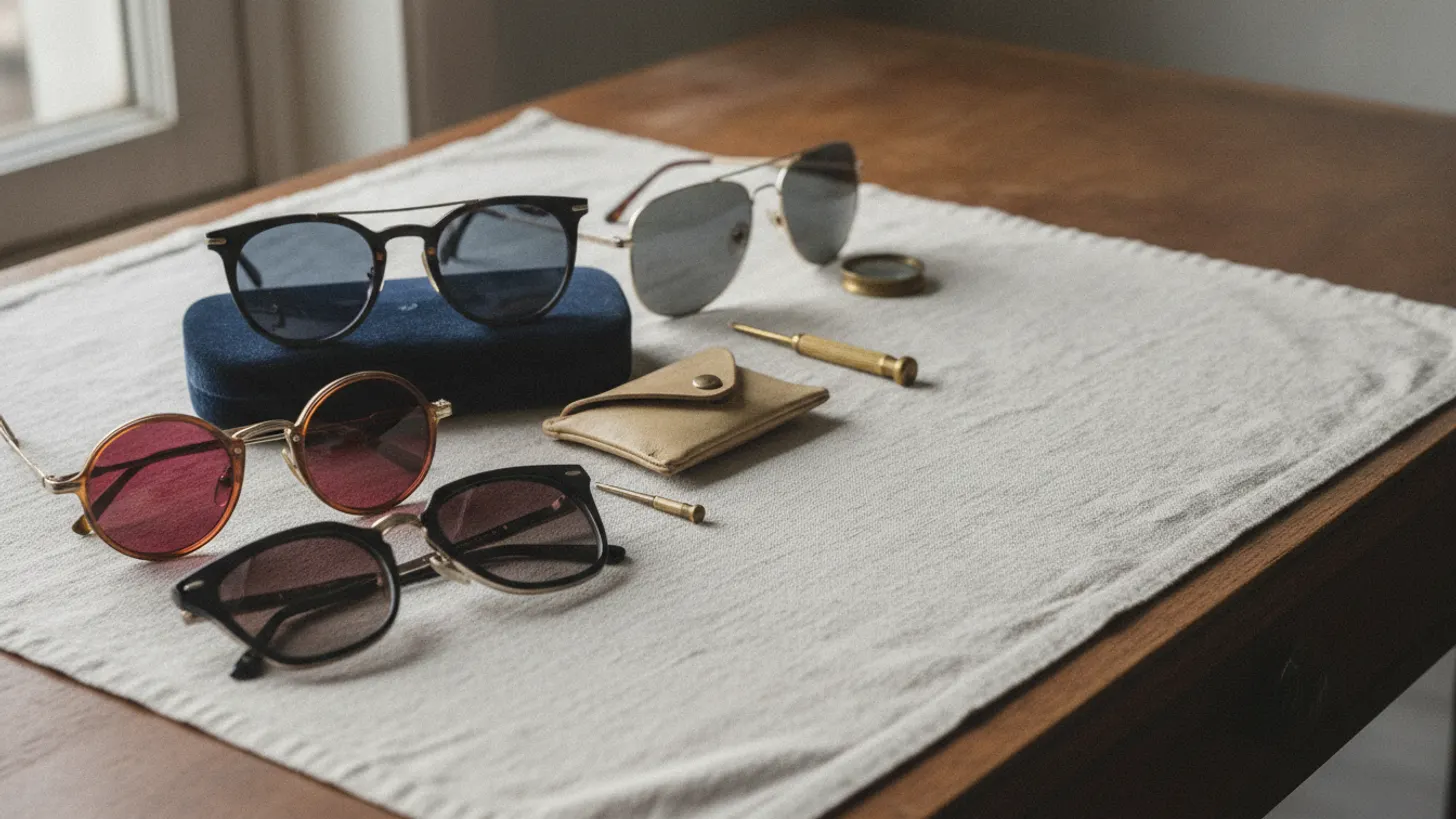
Vogue dates the original Ray-Ban Aviator launch to 1937, which puts the oldest frames still moving through resale close to ninety years old. Age is the appeal and also the problem. A vintage designer sunglasses guide has to hold two ideas at once: how to read a frame as an artifact with a biography, and how to judge whether its lenses still do the one job lenses exist to do. Both answers live in the same pair.
What frame shapes and materials this vintage designer sunglasses guide reads first
Shape dates a pair faster than any label. Round panto and small ovals read 1920s through 1940s. Cat-eye uplift reads 1950s. Oversized discs, squared aviators, and wrap shields read 1960s and 1970s. Shrunken ovals read 1990s. Material then confirms the guess or kills it.
Cellulose nitrate came first and still feels different in the hand: light, polished to a depth molded plastics never reach, ambering at the rims. It shrinks, so a 1930s frame sits tighter than its stamped measurements promise, and it burns, so it never goes near heat. Acetate took over through the 1940s and 1950s, laminated in layers you can see at a cut temple end. Optyl resin arrived around 1968, light for its bulk and shape-retentive. Metal frames date themselves by stamps such as 1/10 12K GF, the same hardware-first habit used in dating a vintage handbag by hardware and maker marks.
Two lineages run in parallel and should not be valued alike. Smithsonian Magazine reporting on protective eyewear and mass production traces the technical line, while the Victoria and Albert Museum eyewear collection documents the line in which sunglasses became a fashion object with a signature on it. This vintage designer sunglasses guide separates them early, because one is judged on optics and the other on design.
| Material | Peak era | Tell in the hand | Handling |
|---|---|---|---|
| Cellulose nitrate | 1920s-1940s | Deep polish, amber edges, faint camphor note | Flammable; keep away from heat |
| Cellulose acetate | 1940s-1970s | Layered stripes at cut edges | Warms and adjusts safely |
| Optyl resin | 1968-1990s | Light for its bulk, springs back | Shape returns in warm water |
| Gold-filled metal | 1930s-1960s | Fraction stamp such as 1/10 12K GF | Polish gently; thin at the pads |
How this vintage designer sunglasses guide authenticates logos, hinges, and case details
Authentication is a stack of small agreements. Temple stamp, hinge construction, lens etching, screw heads, and case should all point at one decade and one factory. One element out of step is usually a repair. Three out of step is a marriage, a reproduction, or a story the seller never checked.
Start inside the left temple. Most pre-1980s frames carry a maker name, a model or color code, and eye and bridge measurements in millimeters, and the format of that string shifted by decade. Country marks matter as much: a house that moved production between France and Italy in a known year dates its own frames. The Vintage Fashion Guild label reference is the standard free comparison set, and the method matches identifying vintage costume jewelry materials and eras.
Hinges resist faking better than logos do. Riveted pins with visible heads dominate early acetate. Five- and seven-barrel hinges mark better postwar construction, and a spring hinge on a frame claiming 1952 is a problem. Lens etching is the quiet witness: Bausch and Lomb marked Ray-Ban lenses for decades, and an unetched lens in an etched-era frame means replacement, which is common and not disqualifying when the seller says so. A vintage designer sunglasses guide is only as good as its reference images, so compare a questionable pair against documented auction results and dealer archives before trusting a seller's dating.

Which decades and designers this vintage designer sunglasses guide calls collectible
Collectibility follows documentation more than age. A 1970s frame with a named designer, a traceable model number, and its original case outruns an anonymous 1940s pair most of the time. Three groups rank first in this vintage designer sunglasses guide: postwar Italian engineering, late-1960s plastics, and 1980s statement frames.
Persol's 649, built in 1957 for Turin tram drivers, is the usual entry into Italian collecting, and the folding 714 that followed is the model most often copied. Ray-Ban's Wayfarer, launched in 1952, sits at the other end: common enough to be affordable, varied enough that early Bausch and Lomb examples are scarce. Vogue archive coverage of the Ray-Ban Aviator, launched in 1937, keeps the oversized British shapes of our 1960s mod fashion guide in circulation.
The 1980s move fastest now. Cazal's 600 and 900 series, adopted by New York hip-hop early in the decade, trade as cultural objects more than as eyewear, a shift style reporters have followed for years. Alain Mikli and Emmanuelle Khanh hold the French side, and museum costume collections increasingly place eyewear alongside couture rather than treating it as an accessory footnote.
The dates below settle most attribution arguments before they start.
Can vintage sunglasses still block UV? What this vintage designer sunglasses guide tests
Sometimes yes, often no, and darkness is not the signal. Ultraviolet filtering comes from lens chemistry or a coating, never from tint depth. A very dark lens with no filter opens the pupil and lets more ultraviolet reach the retina than wearing nothing at all.
Ultraviolet splits into three bands by wavelength: UVC from 100 to 280 nanometers, UVB from 280 to 315, UVA from 315 to 400. The atmosphere absorbs nearly all UVC. A lens rated UV400 stops everything below 400 nanometers, covering both bands that reach the ground. Glass lenses from the 1930s to the 1960s often block a useful share of UVB because glass absorbs short wavelengths; uncoated mid-century plastic frequently does not.
The bands below show what a lens has to stop and where the UV400 line falls.
There is a free test for any pair. Most optical counters keep a UV transmittance meter and will read a frame in under a minute. For anything you plan to wear in strong sun, that reading is the deciding fact this vintage designer sunglasses guide goes by, with one fallback: have an optician cut new UV400 lenses for the original frame and keep the originals in the case. Harper's Bazaar reporting on vintage eyewear and lens replacement covers how ordinary that practice has become.
One honest limit. Nothing here is sent for laboratory analysis; identification at Sol Siren is visual and tactile, with provenance written into each listing. A pair that fails a meter is not worthless, it is indoor.
Fitting, repair, and storage after the purchase
A frame that fits badly never gets worn, and a frame that never gets worn tends to be stored badly. Fit first, repair second, store third. The measurements are stamped on the temple of most frames and map onto modern sizing with no conversion needed.
Read the three numbers: lens width, bridge, temple length, in millimeters. Anything within two millimeters of a modern pair you already wear will sit right. Pre-1960s frames run narrow at the bridge. Acetate can be warmed and adjusted by an optician; nitrate cannot, which is why an unidentified frame stays unheated under this vintage designer sunglasses guide. Screws and nose pads are consumables, while metal hinge repair needs a jeweler with a laser welder, since solder discolors gold fill, the same stabilize-and-document logic as repairing vintage knitwear.
Storage does most of the damage people blame on age. Heat warps acetate and ruins early nitrate; a glovebox in summer will finish a frame. Keep pairs in rigid cases, folded as the hinges intend, in a dark drawer at steady room temperature, with nitrate kept apart because its off-gassing tarnishes nearby metal. The reasoning behind storing vintage outerwear for decades applies directly: heat and humidity degrade leather, nitrate, and lens coatings on the same timeline, regardless of what the object was built to do.
Frequently asked questions
How can I tell what decade my sunglasses are from?
Work from the outside in. Shape gives you a twenty-year window, material narrows it, and the temple stamp usually closes it. Round panto reads prewar, cat-eye reads 1950s, oversized plastic reads 1960s and 1970s, shrunken ovals read 1990s. Then check hinges: riveted pins are early, multi-barrel hinges are postwar, spring hinges are late. Compare the logo and country mark against a reference set such as the Vintage Fashion Guild label archive. This vintage designer sunglasses guide follows that order every time, because each step narrows what the next one has to explain.
Do old sunglasses still protect your eyes from UV?
Sometimes, and you cannot tell by looking. Filtering comes from the lens material or a coating, not from tint depth, so a near-black 1970s lens with no filter is worse than bare eyes because it widens your pupil. Glass from the 1930s to the 1960s often blocks a useful share of UVB; uncoated plastic from the same years frequently does not. Ask an optical counter for a UV transmittance reading, which takes about a minute. Smithsonian Magazine reporting on protective eyewear explains why the filtering question predates the fashion one by decades.
Are vintage designer sunglasses actually worth anything?
Some are, and the dividing line is documentation. A named house, a readable model code, an original case, and undamaged lenses together move a pair into collector territory, while anonymous frames mostly stay decorative. A vintage designer sunglasses guide weighs condition before rarity, because crazed lenses and cracked acetate cannot be reversed. Specialist results from the Sotheby's design and fashion department show what documented examples reach at auction, which is a steadier reference than open-marketplace asking prices, since asking prices record hope rather than outcome.
Can an optician put new lenses in vintage frames?
Usually yes, and it is the standard fix for a frame you intend to wear. An optician traces the original lens shape, cuts UV400 replacements, and returns the old lenses to you. Acetate and Optyl take new lenses easily, while brittle nitrate and deeply curved profiles are the hard cases, and some wrap shapes cannot be matched at all. Ask before you buy if wearing matters to you. This vintage designer sunglasses guide treats a relens as restoration rather than loss, a view The Cut coverage of vintage eyewear revivals echoes among people who wear their frames daily.
What is the difference between vintage and deadstock sunglasses?
Deadstock means unsold old inventory that never reached a customer: original tags, original case, often original lens stickers still in place. Vintage simply means old and previously owned. Deadstock asks more because condition and completeness are given rather than argued, but the lenses are the same age and carry the same filtering limits as any worn pair. Treat a deadstock claim the way you treat any provenance claim, by checking the paperwork against the frame. Metropolitan Museum of Art Costume Institute catalogue entries show how completeness is described when a specialist writes it.
How should I store vintage sunglasses so they do not warp?
Rigid case, dark drawer, steady room temperature, folded the way the hinges were built to fold. Heat is the main threat: a car interior in summer warps acetate permanently and can ruin early nitrate. Keep nitrate frames separate, because their slow off-gassing tarnishes nearby metal and rubber. Silica packs help in humid climates. This vintage designer sunglasses guide suggests checking stored pairs twice a year for hinge stiffness and lens film. Collections care guidance from the Victoria and Albert Museum applies to plastics in dress collections as well as to textiles.