November 2026
Vintage 1950s cocktail dresses: silhouettes, fabrics, and fit
Vintage 1950s cocktail dresses: New Look silhouettes, taffeta and acetate, zippers and labels for dating, condition checks, and how to measure them for fit.
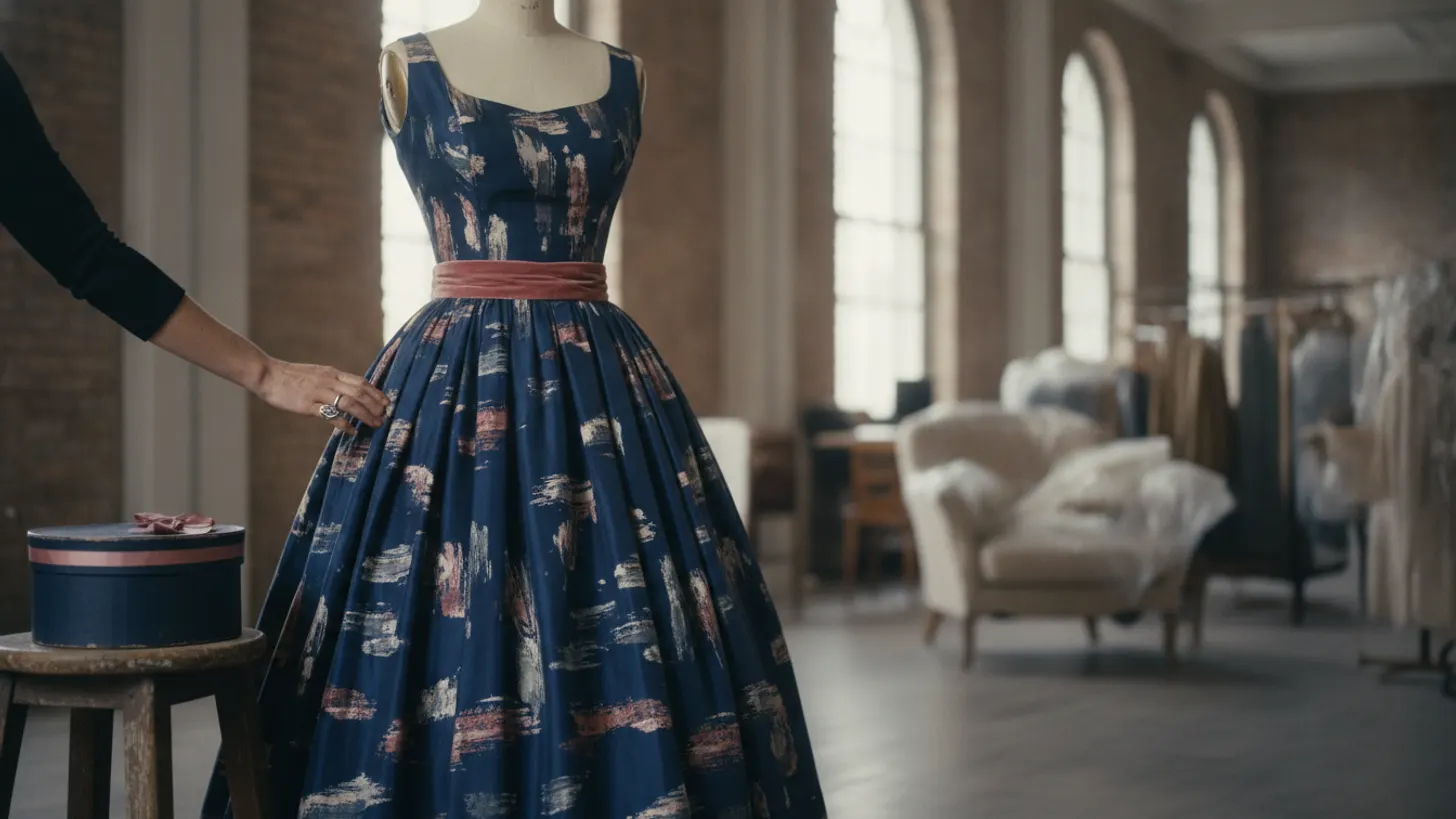
On 12 February 1947, in a gray salon at 30 avenue Montaigne in Paris, Christian Dior showed a collection that Carmel Snow of Harper's Bazaar greeted as a new look. The decade of vintage 1950s cocktail dresses grew from that afternoon: nipped waists, full skirts, rustling taffeta. Reading one now means looking at the cut, the cloth, and the zipper together, then measuring it against your own body instead of trusting the size on the label.
What makes vintage 1950s cocktail dresses different from eveningwear?
A cocktail dress sits between the afternoon frock and the floor-length gown. Most vintage 1950s cocktail dresses end between the knee and mid-calf, use evening fabrics such as taffeta, satin, and lace, and were cut for the early-evening hours, roughly six to eight, when gloves and a small hat still finished the outfit.
The collections of The Museum at FIT treat cocktail dressing as its own category of mid-century fashion, not a shortened ball gown. The distinction was social first. The cocktail party became a fixture of postwar city and suburban life, and the dress followed it: dressy enough for silk faille, short enough to perch on a sofa arm with a glass in hand, and modest enough to arrive at six o'clock without a wrap.
Daywear from the same years leaned on cotton prints, shirtwaist bodices, and buttons down the front. Formal 1950s eveningwear reached the floor and often traveled with a matching stole. The cocktail dress borrowed fabric from one and length from the other. Our guide to the vintage rockabilly dress and its 1950s tells covers the cotton day-dress side of the same silhouette.
| Category | Typical length | Typical fabrics | Usual neckline |
|---|---|---|---|
| Daywear | Below the knee | Cotton, rayon, wool jersey | Collared, shirtwaist |
| Cocktail | Knee to mid-calf | Taffeta, satin, faille, lace, chiffon | Bateau, sweetheart, portrait, strapless |
| Formal evening | Floor length | Satin, tulle, velvet, brocade | Strapless, off-the-shoulder |
The waistlines, necklines, and skirts that define vintage 1950s cocktail dresses
Two shapes rule vintage 1950s cocktail dresses: the full skirt over a fitted bodice, and the slim sheath that hugs the hips. Both keep a defined natural waist. Necklines run from the strapless sweetheart to the wide bateau and the portrait collar, and many strapless bodices hide boning and an inner grosgrain waist stay.
The Met's Heilbrunn essay on Christian Dior traces how the 1947 New Look, with its padded hips and narrow waist, became the template for occasion dressing that carried well into the 1950s. Couture lines kept shifting after that. The FIT Fashion History Timeline for 1950 to 1959 follows Dior's H-line of 1954 and A-line of 1955, Balenciaga's sack of 1957, and Yves Saint Laurent's trapeze for Dior in 1958, each one loosening the waist a little more.
On vintage 1950s cocktail dresses, these shifts show up as small details. A circle or pleated skirt over a stiff net petticoat reads early to mid decade. A narrow sheath with a kick pleat or back vent belongs to the wiggle-dress family. A bubble hem, a dropped waist, or a loose sack shape usually points to 1957 or later. Necklines help too: a deep V back or bateau front on a 1950s party dress often came with a matching bolero, so the same dress worked before and after dark.
Dating vintage 1950s cocktail dresses by fabric, zipper, and label
Read three things together: fabric, closure, and label. A metal zipper in the left side seam, hand-finished hems, pinked or overcast seam allowances, and a woven maker label beside a union tag all point toward the 1950s. A nylon coil zipper usually signals a later dress or a later repair, so check the stitching around it.
Fabric is the first clue and the easiest to misread. The V&A's fashion collection records how synthetic fibers, nylon and acetate among them, expanded the range of evening and occasion fabrics during the decade. That is why so many vintage 1950s cocktail dresses feel like silk at first touch and turn out to be acetate taffeta or nylon net. Our explainer on how to identify vintage rayon, acetate, nylon, and polyester walks through hand, drape, and sheen for each. The chart below shows how new some of these fibers still were in the middle of the decade.
Then read the labels. The ILGWU union label changed design several times across the century, and the Vintage Fashion Guild label resource shows the versions side by side. A printed fiber-content tag suggests 1960 or later, since the Textile Fiber Products Identification Act took effect that year. Couture and better American labels, such as Dior, Jacques Fath, Ceil Chapman, or Suzy Perette, show up often enough in museum holdings that comparing construction against a dated, documented example is usually possible.
Inside vintage 1950s cocktail dresses from better makers, look for a waist stay, a lining tacked by hand, and boning channels stitched to the lining. Mass-market pieces from the decade can be machine-finished throughout, so the absence of handwork alone does not rule out the era. I learned to weigh these details against each other, rather than trust any single one, over eleven years of sourcing for Sol Siren, mostly by handling union labels and waist stays under a loupe until the patterns held up without a maker's name attached. A Charleston dealer named Pat Loring walked me through my first hundred union labels back in 2015, and I still check mine against hers when a dress argues with itself.
Condition problems in vintage 1950s cocktail dresses: taffeta, satin, and lace
Taffeta splits, satin water-spots, and lace tears where it meets a heavier seam. Acetate is the largest risk across all three: it weakens with heat, melts under a hot iron, and dissolves on contact with acetone, so a drop of nail polish remover can leave a permanent hole. Check every stress point in daylight.
I learned to respect that warning the hard way in 2019, at an estate sale outside Savannah, on a cherry-red dress I was sure was silk because the sheen looked so rich under the porch light. Back at the shop I touched a cotton swab of remover to the inside of a side seam to confirm the fiber, the same test I had run on a hundred dresses before, and watched a dime-sized hole bloom through what turned out to be acetate taffeta. The dress sold at a steep discount with the damage disclosed, and I test every taffeta hem in daylight now, never under shop lighting. The fabric itself is the most prone to splitting along the fold lines and at the waist seam. Older silk taffetas can shatter into fine cracks, and acetate taffeta tends to pull apart where the bodice was fitted close. Run a hand over the skirt; a crackling, papery feel in one small patch is an early warning.
Satin shows its age differently. Water marks on acetate satin rarely come out, and perspiration under the arms can discolor or weaken the fiber. Hold the bodice up to the light to spot thinning. Snags on satin pull long floats that are hard to hide.
Lace and net age in their own way. Nylon lace and tulle yellow and stiffen, petticoat net can crumble, and lace overlays tear near zippers and hooks. Also check for rust from metal zippers, boning ends poking through the lining, and broken thread chains at the waist.
Storage matters just as much as the purchase itself. The Met's Costume Institute keeps its garments away from light and supported at the folds, a habit worth borrowing at home with acid-free tissue and a padded hanger, or a flat box for heavy skirts.
How to measure and style vintage 1950s cocktail dresses
Measure the dress, not the tag. Lay it flat, measure across the bust, waist, and hips, and double each figure. The waist is where most fits fail, because vintage 1950s cocktail dresses were cut over girdles and longline bras, so their waists run smaller than modern dresses carrying the same size number.
- Bust: armpit seam to armpit seam, doubled.
- Waist: straight across the waist seam, doubled, with a little ease above your own waist measurement.
- Hips: at the fullest point below the waist on a sheath; full skirts usually leave the hips free.
- Length and shoulders: shoulder seam to hem, and seam to seam across the back.
- Seam allowance: turn the dress inside out and look for extra fabric at the side seams, which tells you whether a tailor can let it out.
The vintage clothing size guide explains how much ease to leave by era and garment type. If the waist of a sheath is simply too small, the looser cuts in vintage 1940s rayon dresses offer a similar mood with more room.
Styling is lighter work. A net or tulle petticoat restores the swing to a full skirt, and a modern longline bra or soft waist cincher brings the torso closer to the line the dress was cut for. Keep accessories quiet and period-aware: a small frame clutch like those in the guide to vintage beaded evening bags, a single strand of pearls, a low pump. For weddings, holiday parties, and gallery openings, vintage 1950s cocktail dresses read as dressed without competing with formalwear, which is the reason the category existed in the first place.
Frequently asked questions
How long should a 1950s cocktail dress be?
Most fall between the knee and mid-calf. Hems sat a few inches below the knee through the early and middle years of the decade, then rose slightly as looser shapes such as the sack and the trapeze arrived after 1957. Floor-length dresses from the same years count as evening gowns, not cocktail dresses. The FIT Fashion History Timeline shows hemlines across the period, which helps when you compare a dress against dated examples. Before you buy, measure from the shoulder seam to the hem and hold that number against your own body, since your height changes where a hem lands.
Can I wear a vintage cocktail dress to a wedding?
Yes, and it is one of the best uses for one. Cocktail length was designed for early-evening social events, which suits most wedding receptions and dressy parties today. Avoid white, ivory, or pale champagne unless the couple invites it, and skip anything that reads as a ball gown. Mid-century magazine editors and etiquette guides paired cocktail dresses with short gloves, small hats, and low heels, a useful starting point for styling now. Add a bolero or a light wrap for a ceremony in a formal venue, then take it off for the reception.
How can I tell if a vintage dress is acetate or silk?
Start with hand and behavior. Acetate tends to feel slick, holds creases sharply, and shows a bright, even sheen; silk usually feels softer at the fold and has a deeper, shifting luster. Acetate also water-spots easily and dissolves in acetone, so never test a dress you care about with nail polish remover. The V&A's fashion collection documents how nylon and acetate entered evening and occasion fabrics during the 1950s, so acetate is the likelier answer for many party dresses of the decade. If the dress has no fiber label, ask the seller how they made the identification.
What is the difference between a New Look dress and a wiggle dress?
Both keep a tight waist, but they treat the hips differently. A New Look dress pairs a fitted bodice with a full skirt, often supported by petticoats, in the shape Christian Dior introduced in 1947. A wiggle dress, also called a sheath, follows the hips and narrows toward the knee, with a kick pleat or back vent so you can walk. The Met's essay on Dior explains how the full-skirted version spread through the following decade. Many American makers offered both shapes in the same fabrics, so the cut, rather than the cloth, tells you which family a dress belongs to.
How should I store a vintage taffeta or satin dress?
Store it clean, dark, and supported. Use a padded hanger for lighter dresses and a flat, acid-free box with tissue folded into the creases for heavy full skirts, so the fabric never rests on a sharp fold. Keep it out of plastic dry-cleaning bags, which trap moisture, and away from sunlight and radiators. The Met's Costume Institute houses its garments around the same priorities of low light, stable conditions, and physical support. Check stored dresses every few months for new splits, pests, or yellowing so you can act before small damage spreads.
Where can I look up an old dress label?
The Vintage Fashion Guild runs a free label resource with photographs of maker, department store, and union labels, and it is a widely used reference among dealers and collectors. Compare the font, the weave of the label, and how it was stitched in, not only the name, because many labels stayed in use for decades. Look for a union label too, since its design changed over time and can narrow a date. If there is no label at all, the dress may have been sewn at home from a commercial pattern, which was common in the 1950s.