November 2026
How to authenticate vintage band t-shirts: tags, prints, and wear
Learn how to authenticate vintage band t-shirts using collar tags, stitch lines, print texture, copyright lines, and honest wear before you pay a cent.
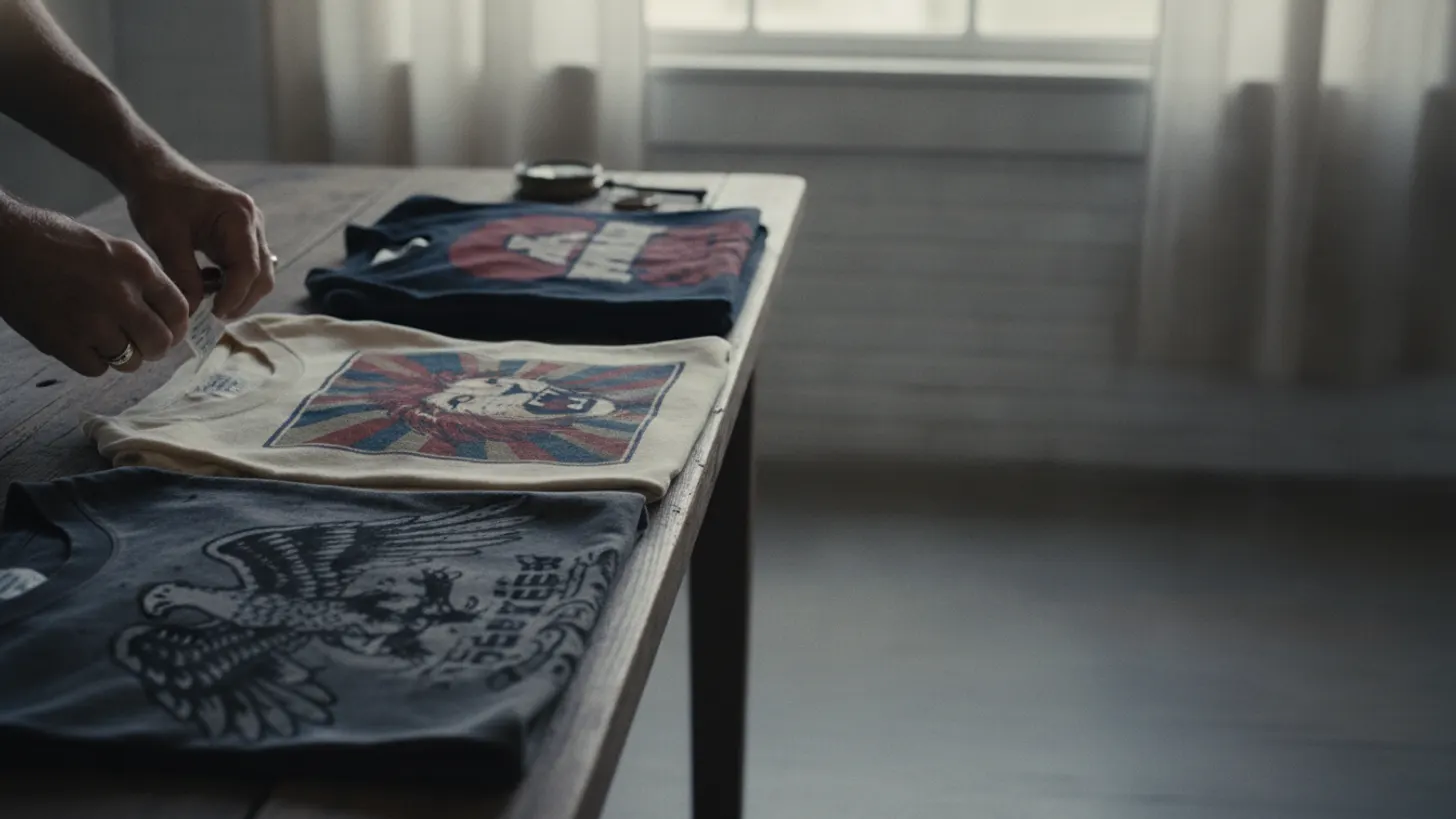
A Rolling Stones 1981 Tattoo You tour shirt turns up in an estate lot, folded under towels, its collar tag worn to a ghost, no paperwork, no seller who remembers which show it came from. That is how most vintage band t-shirts surface, and it is why the garment has to speak for itself. In ten years of grading concert tees and denim side by side at Sol Siren, I have learned that tags, stitch lines, ink texture, and the way cotton ages will narrow the decade long before anyone talks about price.
What makes vintage band t-shirts worth collecting
Scarcity, proximity to the event, and condition, in that order. A shirt pressed for one leg of a 1979 tour and sold at the merch table carries weight that a licensed reissue of the same artwork never will. Collectible vintage band t-shirts tie a date, a place, and a small press run together, and the cloth has to agree.
The garment reached collecting through work, not fashion. Smithsonian Magazine's reporting on the history of the T-shirt links the modern tee's popularity to twentieth-century military and industrial workwear: an undershirt that walked out of the barracks and off the factory floor and kept going. That lineage shows in the hand. Blanks made before the 1980s were built as labor garments, and they feel like it.
Printed graphics turned the blank into a message board. The Metropolitan Museum of Art's costume holdings include graphic clothing that shows how printed imagery on a body functions as cultural communication, the same mechanism a tour shirt uses when it names a city and a year. The Museum at FIT has treated music-adjacent dress with equal seriousness, which is part of why the resale market for these tees now behaves more like collecting than thrifting.
Value concentrates exactly where documentation is thinnest, and that is where fakes live. Reproductions are legal, plentiful, and often sold honestly. The problem is the secondhand chain, where a 2009 reissue loses its hangtag and reappears five owners later as a 1989 original. Reading the garment, the way you would read the label stack on a vintage denim jacket, is the only defense that travels with you.
How tags, hems, and fabric weight date vintage band t-shirts
Start at the collar. Tag typeface, brand, country of manufacture, fiber content, and the RN or WPL number together bracket a decade in minutes, often to within five years, faster than the graphic alone ever will. Most printed tour tees from 1970 through 1995 carry at least one of these four collar markers.
Blank makers leave a paper trail. Screen Stars, Hanes Fifty-Fifty, Sportswear, Tultex, Anvil, and merchandise houses such as Brockum, Winterland, and Giant each cycled through tag designs, and those designs are datable. The Vintage Fashion Guild Label Resource is the reference I keep open while listing; it documents label histories across the garment trade, and the method it teaches carries straight over to vintage band t-shirts.
Fabric weight and body construction narrow things further. Tubular bodies, knit as a cylinder with no side seams, were standard on many blanks into the mid-1990s. Side-seamed, heavier, boxier blanks read later. Paper-thin jersey with a soft, almost translucent drape is the record of decades of washing rather than a mill finish, and no shortcut fakes it convincingly. For background on how cotton sourcing and blank manufacturing shifted offshore across that same window, Sourcing Journal's textile manufacturing coverage is worth reading.
Print methods and copyright lines on vintage band t-shirts
Look at the ink the way you would look at paint. Period screen prints sit on the fabric with a slightly raised edge, show visible halftone dots under a loupe, and crack along fold lines. Flat, grainless images with photographic gradients and no hand feel point to modern direct-to-garment printing instead.
Plastisol dominated tour printing from the late 1970s onward, and it ages in a specific way: it cracks, flakes, and thins where the shirt flexes, not evenly across the chest. Puff ink, metallic flake, and heavy white underbases all have era profiles of their own. Registration talks too. Hand-pulled multicolor jobs show small misalignments between screens, while modern files land exactly on register every time.
Then read the small print under the graphic. Licensor credits with a year, a Winterland or Brockum line for example, are strong supporting evidence here, because that text was set for one specific run. A caution worth holding onto: the U.S. Copyright Office explains that copyright protection does not require a work to display a copyright notice for newer works, so a missing line proves nothing and a present one proves nothing. Treat the copyright block as one reading among several on vintage band t-shirts, never as a verdict.
How fading, cracking, and repairs support or weaken a claim
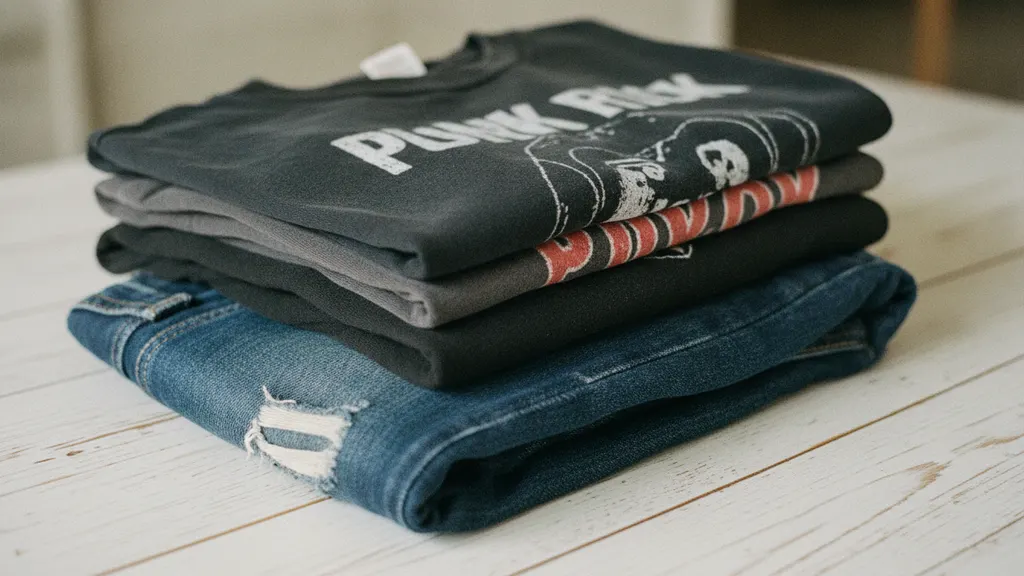
Wear is evidence when it is consistent. Sun fade should sit heaviest on the shoulders and the back of the collar. Pin holes at the shoulder seams, a collar that has lost its memory, and softened side folds all belong to the same story. Distress that appears only inside the printed area is a factory effect.
Honest repair does not disqualify a shirt; it dates it. Hand-darned pin holes, a replaced collar, a hem taken up with a different thread color: each reads as a life lived, and I describe them plainly in a listing rather than shooting around them. The same thinking behind repairing vintage knitwear applies here, where a visible mend is information rather than damage to hide.
What should stop you: crackle that looks printed on, artificial yellowing pooled in areas a body never touches, an overdye that tints the graphic along with the cloth, and whiskering identical on both sleeves. Fading on genuine vintage band t-shirts is asymmetric because people are asymmetric, and because closets, car windows, and favorite sides of the body are too.
Smell and hand are part of the read, and both survive a careful wash. A shirt stored in a damp basement carries that history in the fiber. My notes on cleaning vintage clothing cover what a cold, gentle wash will and will not lift.
What to measure and document before buying vintage band t-shirts
Measure flat, in inches, and write it down: chest pit to pit, length from the high point of the shoulder, sleeve from the shoulder seam, and shoulder seam to shoulder seam. Tagged sizes from the 1980s run small and short against modern expectation, so numbers beat letters every single time.
| Record before you buy | Why it matters | What to ask the seller for |
|---|---|---|
| Pit to pit, flat | 1980s tagged sizes run narrow | Tape photo across the chest |
| Length from high point of shoulder | Boxy vintage bodies sit shorter than modern cuts | Tape photo down the front |
| Collar tag, in focus | Brand and country bracket the decade | Flat shot, no flash |
| Hem stitch rows | Single versus double stitch is a construction tell | Close-up of sleeve and bottom hem |
| Print in raking light | Shows halftones, ink edge, and crack direction | Daylight close-up, no filter |
| Provenance notes | Estate, deadstock, or bale changes the odds | A plain answer on where it came from |
Ask how the shirt came to the seller. Estate clearance, deadstock from a defunct shop, a personal closet, and bulk bale sorting all carry different likelihoods, and a seller who answers in specifics is worth more than one who answers in adjectives. Auction houses model the habit well: Sotheby's music memorabilia sales and Christie's popular culture catalogs publish provenance chains for precisely this reason.
Buy from people who show their work. A clear return window matters more than reputation when you are buying one, because even a scrupulous seller can mis-date a shirt. My guide to shopping vintage fashion online goes deeper on measurements and returns, and the label-reading habits in dating vintage Levi's 501s transfer almost directly to a collar tag.
Frequently asked questions
How can I tell if vintage band t-shirts are really from the 1980s?
Work from the inside out. A single row of stitching at the sleeve and bottom hem, a tubular body with no side seams, a collar tag naming a US blank maker, and fiber content printed rather than woven all point pre-1990s. Then confirm the graphic: halftone dots under a loupe, a slightly raised ink edge, and cracking that follows fold lines. No single feature settles it, which is why the label histories kept by the Vintage Fashion Guild matter more than any one tell. Treat dating vintage band t-shirts as a stack of agreeing signals rather than one proof.
Does a single stitch hem always mean a shirt is vintage?
No. Single stitch tells you the hem was finished on older equipment that stayed common on American tees into the mid-1990s, and some small runs and reproduction blanks still use it today. It raises the probability; it does not close the question. Pair it with the collar tag, the body construction, the ink, and the wear pattern. Reproduction houses copy whatever buyers check first, so construction plus print plus aging together beat any single feature. The V&A dress and textiles collection is a reminder that attribution rests on several converging details, never one.
What does a missing copyright line tell me?
Less than most buyers assume. The U.S. Copyright Office guidance on notice explains that copyright protection does not require a work to display a copyright notice for newer works, so an absent line is not evidence of a fake, and a printed one is not evidence of age. Licensor credits do help when they match a known tour or merchandiser and sit in period type under the graphic. Read them as corroboration, then check that the printed year agrees with the collar tag era and the construction. A 1984 line on a side-seamed, double-stitched blank is the contradiction worth walking away from.
Are cracked prints a good sign or a problem?
Both, depending on where the cracking sits. Plastisol ink from the late 1970s onward thins and splits where the fabric flexes: fold lines, the center chest, the shoulder blades. That pattern reads as honest age. Cracking spread evenly across an otherwise bright, barely worn print is usually a finishing effect applied at manufacture. Lost ink also costs condition, so grade it plainly, because heavy flaking lowers wearability even on a genuine shirt. The Cut's secondhand fashion reporting tracks how thrift habits turned into collecting, and condition expectations rose along with that shift.
How much should fading affect what I pay?
Treat fade as condition, not as proof, and let it move value in the direction scarcity already points. Collectors tolerate soft, even sun fade on a scarce tour shirt and penalize the same fade on a common reissue, so rarity sets the frame before condition adjusts it. I avoid quoting fixed percentages here because no public dataset covers this category reliably. What is documented is the broader resale shift, which Business of Fashion's resale coverage has tracked across the secondhand sector. Set your ceiling from comparable sold listings you can actually see, not from a seller's adjectives.
Can I wear and wash a vintage band tee without ruining it?
Yes, with restraint. Cold water, inside out, a gentle liquid detergent, no dryer, and no iron over the print. Heat is what kills plastisol, and a hot dryer accelerates the cracking you were trying to preserve. Hang to dry out of direct sun, and store folded rather than on a wire hanger so the shoulders keep their line. Good On You's garment care guidance follows the same principle: washing cooler and washing less often extends a garment's life. Worn with that much care, these shirts keep going for decades more.