October 2026
Vintage hats by decade: cloches, berets, and classic buying clues
A curator's guide to vintage hats by decade: how to read cloches, berets, and pillboxes, date labels and linings, and check condition before you buy one.
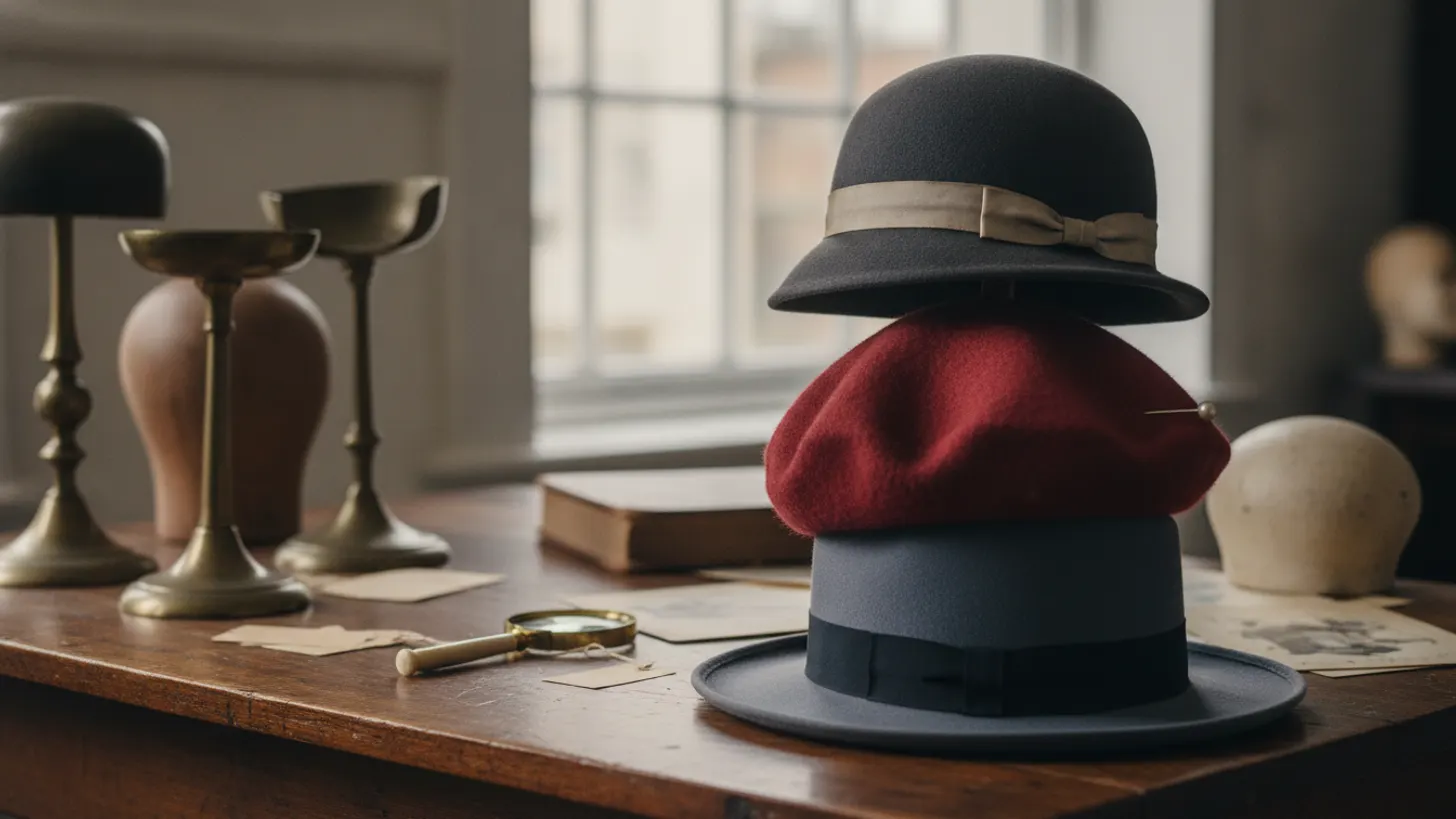
In January 1961, Jackie Kennedy walked to an inauguration in a fawn pillbox designed by Halston, and a shape that had been drifting for years became the decade's signature. That is the whole logic of reading vintage hats by decade. Silhouette dates a piece before any label does, and the cloche, the beret, and the pillbox each carry a year in their crown. Learn the shapes first, then the stitching.
Vintage hats by decade: the shapes that date a piece
Silhouette is the fastest date. Reading vintage hats by decade starts with crown depth and brim behavior: a 1920s cloche swallows the forehead, a 1940s crown climbs, a 1960s pillbox sits flat and brimless. The V&A's twentieth-century dress holdings show the same progression in garment proportion.
The 1910s ended in width. Picture hats balanced on piled hair, wired brims carried plumes, and the whole arrangement needed pins the length of a pencil. Then the hair came off. The V&A's collection of 1920s women's dress identifies the cloche as the signature hat silhouette of the decade: a felt bell pulled to the eyebrow that only reads correctly on a bobbed or shingled head. If a cloche fits you comfortably with long hair down, it is probably a later revival.
The 1930s tilted everything. Brims lifted off one side, halo shapes ringed the face, and the beret moved from Basque workwear into Paris windows. Crowns stayed shallow. The 1940s answered rationing by going up rather than out: tall crowns, draped turbans, snoods, and small platters worn forward over a roll of hair. Felt was scarce, so rayon jersey, straw braid, and fabric-covered buckram stood in for it.
Post-war millinery split in two. The 1950s produced both the half hat, a crescent of flowers or feathers clipped at the back of the head, and the wide saucer that framed a New Look collar. By the early 1960s the pillbox had taken over; the floppy brim and the crochet cap carried the 1970s; the 1980s brought structure back with deep crowns and stiff wide brims. Dating vintage hats by decade is mostly a matter of asking what the hair underneath was doing.
| Decade | Dominant silhouette | Typical materials | Quick tell |
|---|---|---|---|
| 1920s | Cloche, bell crown | Wool felt, silk velvet | Sits at the eyebrow |
| 1930s | Halo, tilt, beret | Felt, straw braid | Shallow crown, asymmetric brim |
| 1940s | Turban, tall crown | Rayon jersey, buckram | Height rather than width |
| 1950s | Half hat, wide saucer | Velvet, horsehair, flowers | Comb or clip, no full crown |
| 1960s | Pillbox, bubble | Felt, fur, synthetic faille | Flat top, no brim |
| 1970s | Floppy brim, newsboy | Suede, crochet, denim | Soft unwired brim |
| 1980s | Structured wide brim | Stiffened felt, sinamay | Deep crown, heavy grosgrain |
The chart below lays out vintage hats by decade as a single timeline, from the 1920s cloche to the 1980s wide brim, plus how collector demand for each shape runs today.
How to date vintage hats by decade: labels, lining, and trim
After shape, go to the inside. A union label, the sweatband construction, the fiber of the lining, and the trim material together narrow a hat to within a decade or so. The Vintage Fashion Guild label resource is the reference I keep open while listing.
I got this wrong once. I listed a wool felt cloche as 1920s because the bell crown and low brim looked exactly right in photos, and a buyer who collects union ephemera asked for a close-up of the sweatband before paying. It was machine-stitched grosgrain with a nylon content tag, which only exists after 1960, so the hat was a well-made revival, not an original. I refunded forty dollars off the price rather than argue the point, and now I check the sweatband before I ever write a date in a listing.
Union labels are the cleanest evidence. American millinery carried marks from the United Hatters, Cap and Millinery Workers International Union, and both wording and logo changed across the century, which gives you a floor for the date. Store labels help too: a millinery salon tag from a department store places a hat in the period when stores still blocked hats in house.
Lining and sweatband tell the rest. A grosgrain sweatband hand-stitched into the crown reads earlier and better made than a machine-taped synthetic band. Rayon linings dominate mid-century, acetate and nylon appear later, and a fiber content label at all suggests 1960 or after, since content labeling became standard only then. The Vintage Fashion Guild label resource narrows American makers further.
Trim is the most era-specific part of a hat. The Met's Costume Institute millinery holdings show how materials and ornament changed across twentieth-century fashion, from paradise plumes and celluloid buckles to molded plastics and synthetic faille. Celluloid feels warm to the touch and smells faintly of camphor; later plastics do not. Working through vintage hats by decade this way, outside shape first and inside stitching second, is slower than searching a label database and far more dependable. The same method applies to printed silk, which is why how to date vintage silk scarves sits alongside this guide.
Related reading: How to date vintage silk scarves: prints, labels, and era clues.
Vintage hats by decade: what makes cloches, berets, and pillboxes collectible
Three shapes hold value because each one is tied to a documented moment. Collecting vintage hats by decade usually means these: the 1920s cloche, the beret in its Basque and 1970s revival forms, and the 1960s pillbox. Maker marks, condition, and a traceable silhouette drive what collectors will pay.
The cloche is collectible because it cannot be faked casually. The proportions only make sense over 1920s hair, and the blocking shows it: a deep bell, a crown without seams, often a hand-worked brim turned up at one side. Beaded or appliqued examples from named salons sit at the top of the market.
Berets are the quiet one. A Basque beret is a felted wool disc with a leather-bound edge, a woven lining, and a small center nub, and the construction barely changed between its 1930s Paris adoption and its 1970s folk revival. Date those by lining, maker stamp, and dye rather than shape.
The pillbox is the most historically legible hat of the century. Vogue's archive coverage of the 1960s pillbox documents its association with Jackie Kennedy, and that association is still what moves the shape at resale. Christie's fashion and accessories sales describe millinery condition before provenance, which tells you how the trade weighs the two. If you are building around the era rather than one piece, the 1960s mod fashion guide covers what goes underneath.
Vintage hats by decade: checking moth damage, crushing, and structural loss
Condition decides whether a hat is wearable or framed. Hold felt up to raking light and look for grazed channels and pinholes, press the crown to test the buckram underneath, and run a finger along the sweatband seam. Most problems are visible in sixty seconds if you know the order.
Moth larvae graze wool felt rather than cutting clean holes, so the damage reads as thinned, velvety patches that go translucent against a window. Check under the brim, behind the trim, and inside the crown where dust and hair oil collect, because that is where larvae feed first. Grazing cannot be undone. It can be stabilized, and a milliner can sometimes cover it by relocating trim, but the felt is gone.
Crushing is often fixable. Buckram and wire crowns spring back with steam and a block; soft unstructured felts rarely hold a new shape without reblocking. Straw is the fragile one, since cracked braid splinters further with every wear. Veiling runs like a stocking, and rusted brim wire stains felt from the inside out, showing as a brown line following the brim edge.
The Museum at FIT's accessories exhibitions are a good way to train your eye on how intact period millinery actually sits, which makes damaged examples easier to read. When a hat needs surface cleaning rather than structural work, method matters, and the safe end of that is in how to clean vintage clothing. Sorting vintage hats by decade also sorts the risks: pre-1940 straw and 1980s stiffened sinamay fail in completely different ways.
The comparison below maps the damage I see most often against the repair route that actually works, and how much risk each one carries if you leave it alone.
How to fit, style, and store vintage hats by decade
Measure your head at the widest point above the ears, then convert. Fitting vintage hats by decade means accepting that mid-century heads were sized smaller, and that a 22-inch circumference reads as a label 7. A hat should sit level with room for one finger at the sweatband.
If a hat runs small, a milliner can add a petersham shim inside the sweatband. Never force a blocked crown wider. If it runs large, a thin foam or felt strip behind the sweatband brings it in without touching the structure.
Styling is a question of restraint. One strong period piece per outfit, and let the rest sit modern. A 1960s pillbox with a plain wool coat reads deliberate; the same pillbox inside a full costume reads like a rental. Harper's Bazaar's archive fashion coverage is useful for seeing how these hats were originally worn, which is almost always simpler than the revival version.
Storage is where most hats are lost. Keep them crown-down or stuffed loosely with acid-free tissue, in a rigid box, never on a hook and never stacked. Dark, dry, and ventilated beats airtight, because sealed plastic traps moisture against felt. Cedar and lavender discourage adult moths but will not kill larvae already feeding, so inspect twice a year. The long version of the same rules I use on coats is in how to store vintage outerwear, and the vintage costume jewelry guide handles the accessories that go with a period hat.
Smithsonian Magazine's reporting on American hat culture makes the broader point: hats stopped being daily wear, which is why surviving examples skew toward occasion pieces in better condition than everyday felts.
Frequently asked questions
How do I tell what decade a vintage hat is from?
Start with proportion, not the label. Crown depth, brim width, and where the hat sits on the head move in a predictable order across the century, so reading vintage hats by decade gets you within ten or twenty years before you look inside. Then check the sweatband, the lining fiber, the union or store label, and the trim material. The Vintage Fashion Guild maintains label references that narrow American makers further. A hat with a fiber content label is almost certainly 1960s or later; a hand-stitched grosgrain sweatband and no content tag points earlier.
What is a cloche hat and why is it tied to the 1920s?
A cloche is a bell-shaped hat, usually wool felt, blocked to sit low on the forehead with little or no brim. The V&A's twentieth-century fashion collection identifies it as a signature hat silhouette of 1920s women's dress, and the reason is hair. Bobbed and shingled cuts left no volume to balance a wide brim, so milliners built downward instead. That is also the quickest check: a true 1920s cloche is uncomfortable over long hair, because it was never meant to clear any. Revival versions from the 1960s and 1980s sit higher and carry deeper brims.
Are vintage berets actually worth collecting?
Yes, but for construction rather than rarity. A Basque beret is a felted wool disc with a leather-bound edge, a woven lining, and a small center nub, and makers have used the same method for well over a century. Dating one is therefore a matter of lining type, maker stamp, and dye saturation instead of shape. The beret moved from workwear into Paris fashion in the 1930s and returned with the 1970s folk revival, a pattern The Cut's fashion history writing traces across other borrowed workwear. Military berets form a separate market with their own date codes and flashes.
Can a crushed vintage hat be reshaped?
Often, depending on what sits underneath. A buckram and wire crown from the 1940s or 1950s responds well to steam over a proper hat block, and a milliner can usually bring it back. Soft unstructured felt and knitted shapes rarely hold a new form, and straw is the one to walk away from, because cracked braid keeps splintering. Home steaming is risky: too much softens the sizing and the hat dries misshapen. The Museum at FIT's collections and conservation notes are a useful reference, and the principle holds, do the least that works.
How do I know if a vintage hat will fit me?
Measure your head circumference with a soft tape about half an inch above the ears, then compare it with the hat's inside sweatband measurement rather than any stamped size. Standard millinery sizing puts a 22-inch circumference at a label 7, moving in quarter-inch steps either side, but vintage stamps are inconsistent and old sweatbands shrink. Ask a seller for the inside sweatband measurement, not the outside of the crown. The hat should rest level without pressure at the temples. Who What Wear's accessory fit explainers cover the same measure-first habit for other vintage pieces.
Where should I store a vintage hat so moths leave it alone?
Keep it somewhere dark, dry, and ventilated, crown-down or loosely stuffed with acid-free tissue, in a rigid box rather than sealed plastic. Airtight containers trap moisture against wool felt and invite mold. Cedar and lavender deter adult moths but will not kill larvae already in the fibers, so inspect the underbrim and crown lining twice a year. New York Times reporting on clothes moth infestations makes the same point about steady inspection beating any single repellent. Thinking about vintage hats by decade helps here as well: pre-1950 wool felts attract moths, while later synthetics suffer more from light and heat.